In automotive suspension systems, leaf springs are among the most critical structural components responsible for supporting vehicle load, absorbing road impact, and maintaining axle alignment stability. Despite their simple appearance, leaf springs are highly engineered mechanical systems where material science, thermal processing, and precision manufacturing directly determine performance consistency and service life.
For heavy-duty vehicles operating in logistics, construction, agriculture, and industrial transport, suspension failure is not only a maintenance issue but also a safety and operational risk factor.
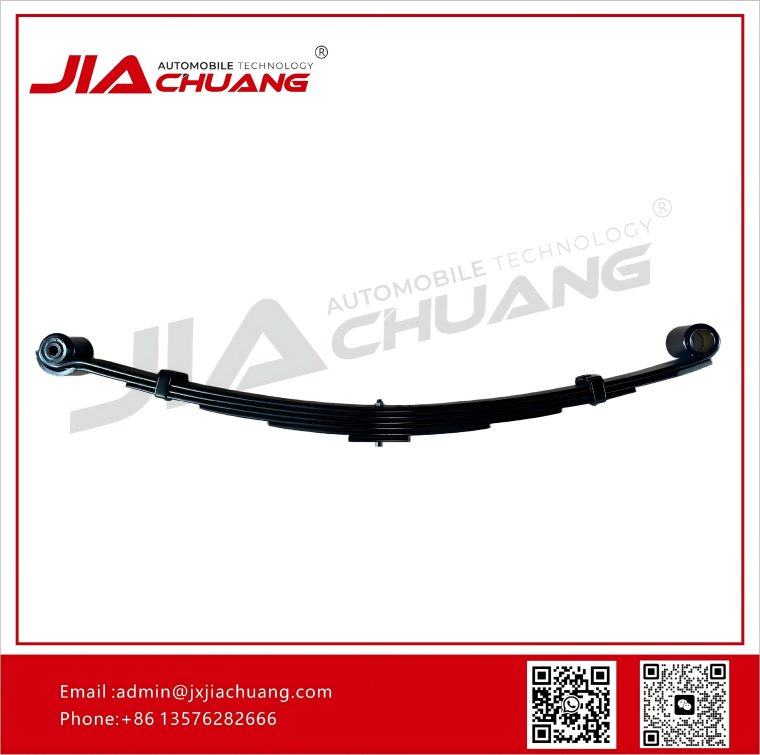
This article provides a detailed technical overview of leaf spring manufacturing, focusing on how each production stage influences durability, fatigue resistance, and real-world performance.
Raw Material Quality Defines Structural Foundation
The manufacturing process begins with high-performance spring steel selection.
Commonly used materials include:
-
60Si2Mn (silicon-manganese steel)
-
SUP9 / SUP10 (chromium-manganese alloy steels)
-
50CrVA (chromium-vanadium steel)
These materials are selected based on:
-
Elastic limit strength
-
Fatigue resistance
-
Hardness after heat treatment
-
Impact resistance under dynamic loading
Steel cleanliness is also critical. Non-metallic inclusions can act as stress concentration points, accelerating fatigue failure under cyclic loading.
High-quality leaf spring manufacturers strictly control:
-
Sulfur and phosphorus content
-
Inclusion size distribution
-
Carbon uniformity
-
Grain structure consistency
Cutting and Forming Accuracy Impacts Final Geometry
After raw material preparation, steel plates are cut into precise lengths and widths according to design specifications.
Key manufacturing tolerances include:
-
Thickness variation control: ±0.2 mm
-
Length accuracy: ±1–2 mm
-
Edge consistency: burr-free finishing
Precision cutting ensures uniform stress distribution during forming and assembly stages.
Forming processes involve controlled bending to achieve the required camber profile.
Improper forming may result in:
-
Uneven stress distribution
-
Reduced load-bearing capacity
-
Early fatigue crack formation
Heat Treatment Is the Most Critical Process Stage
Heat treatment determines the final mechanical properties of the leaf spring.
The process includes:
-
Austenitizing at high temperature
-
Rapid quenching in oil medium
-
Tempering to stabilize internal structure
This transforms the steel into tempered martensite, providing:
-
High tensile strength
-
Elastic recovery capability
-
Improved fatigue resistance
Process control factors include:
-
Furnace temperature uniformity (±5°C)
-
Quenching oil temperature stability
-
Cooling rate consistency
-
Tempering duration accuracy
Inconsistent heat treatment can lead to:
-
Uneven hardness distribution
-
Internal residual stress
-
Brittle fracture risk
-
Reduced service life
Shot Peening Enhances Fatigue Performance
After heat treatment, shot peening is applied to improve surface strength.
This process introduces compressive stress layers that help:
-
Delay crack initiation
-
Improve resistance to cyclic fatigue
-
Increase overall durability under dynamic loading
Typical shot peening parameters:
-
Shot size: 0.3–1.0 mm
-
Coverage: 100% surface treatment
-
Intensity: controlled Almen value range
This step is especially important for heavy-load and off-road vehicle applications.
Assembly Structure Determines Load Behavior
A leaf spring system consists of multiple steel leaves assembled together.
Key components include:
-
Main leaf (primary structural element)
-
Secondary leaves (load distribution layers)
-
Center bolt (alignment fixation)
-
Clamping system (load stability control)
-
Bushings (vibration isolation interface)
The interaction between these components determines:
-
Load distribution efficiency
-
Friction behavior
-
Noise generation
-
Suspension stiffness
Proper assembly ensures balanced load transfer across all leaves.
Surface Treatment Extends Operational Life
Leaf springs operate in highly corrosive environments, requiring strong surface protection.
Common treatments include:
-
E-coating (electrophoretic deposition)
-
Powder coating
-
Anti-rust oil treatment
-
Zinc-based coatings
Surface protection improves resistance to:
-
Moisture
-
Road salt
-
Industrial chemicals
-
Abrasive particles
High-performance coatings can significantly extend operational lifespan in harsh environments.
Dimensional Consistency Is Essential for OEM Applications
Automotive OEM systems require strict dimensional repeatability.
Critical parameters include:
-
Camber height consistency
-
Leaf thickness uniformity
-
Hole alignment accuracy
-
Assembly symmetry
Even small deviations may cause:
-
Uneven axle load distribution
-
Suspension imbalance
-
Increased tire wear
-
Reduced vehicle stability
JIANGXI JIACHUANG AUTOMOBILE TECHNOLOGY CO., LTD. operates multiple automated production facilities with ISO9001:2015 and TS16949 certification, specializing in leaf spring systems, bushings, and U-bolt components, supplying global automotive markets across Europe, North America, South America, Asia, Africa, and the Middle East.
Testing and Validation Ensure Product Reliability
Before shipment, leaf spring products undergo rigorous testing:
-
Load deflection testing
-
Fatigue cycle testing (up to millions of cycles)
-
Hardness verification
-
Dimensional inspection
-
Surface quality analysis
These tests ensure that each batch meets performance requirements under real-world operating conditions.
Failure Mechanisms in Leaf Springs
Most leaf spring failures are fatigue-related rather than immediate fracture.
Common failure points include:
-
Main leaf eye cracking
-
High-stress curvature zones
-
Inter-leaf friction points
-
Clamp loosening areas
Understanding these failure modes allows engineers to optimize design and improve long-term durability.
Supplier Capability Directly Impacts Vehicle Reliability
When evaluating leaf spring suppliers, key factors include:
-
Material traceability systems
-
Heat treatment process control
-
Shot peening capability
-
OEM customization experience
-
Production capacity stability
-
Quality certification systems
-
Global export experience
Integrated manufacturers with full production control systems provide more consistent long-term performance for automotive programs.
Conclusion
Leaf springs remain one of the most reliable and widely used suspension systems in commercial vehicles. Their performance is determined not by design simplicity, but by the precision of material selection, heat treatment control, manufacturing accuracy, and assembly engineering.
As global transportation demands continue increasing in load capacity, durability, and operational efficiency, high-quality leaf spring systems will remain essential components for ensuring vehicle safety, stability, and long-term cost control across industrial transportation networks.
www.jxjiachuang.com
JIANGXI JIACHUANG AUTOMOBILE TECHNOLOGY CO.,LTD