As the photovoltaic industry continues to scale across utility-scale solar farms and distributed energy systems, engineering priorities are shifting. While module efficiency and inverter performance still matter, project developers are increasingly focused on a less visible but critical layer of infrastructure: electrical grounding.
This shift is especially evident in industry discussions leading up to Intersolar Europe 2026, where attention is moving beyond energy conversion efficiency toward long-term system resilience, operational safety, and lifecycle cost control.
Grounding systems do not contribute directly to energy generation, yet they play a decisive role in whether a solar plant remains safe, stable, and operational under real-world environmental stress.
From Efficiency to Infrastructure Stability in Modern Solar Projects
Modern photovoltaic installations operate in highly diverse environments. Each location introduces different stress factors that gradually affect system infrastructure:
-
Desert regions introduce extreme temperature cycles and dry soil conditions
-
Coastal installations face continuous salt-induced corrosion
-
Humid climates accelerate material aging and conductivity instability
-
Industrial zones expose systems to chemically aggressive environments
These external conditions rarely cause immediate failure. Instead, they slowly degrade grounding performance over time, making long-term stability more important than initial test values.
In practice, grounding effectiveness is no longer assessed only by resistance measurements at installation. Engineers now evaluate long-term electrical behavior under thermal cycling, soil variability, and mechanical stress conditions.
Why Grounding Is Becoming a Core Topic Before Intersolar Europe 2026
As conversations intensify around Intersolar Europe 2026, industry stakeholders are broadening their focus from generation equipment to full-system reliability.
EPC contractors and developers are increasingly aware that downtime costs and fault risks are easier to quantify at scale than before. Within this context, grounding systems are gaining attention because their failure modes are subtle but cumulative.
Common long-term issues include:
-
Gradual increase in ground resistance
-
Degradation of mechanical bonding points
-
Corrosion at connection interfaces
-
Intermittent fault behavior that is difficult to diagnose
Rather than treating grounding as a one-time installation task, the industry is now moving toward lifecycle-based engineering strategies.
Sunlight Grounding: A System-Level Approach to Electrical Stability
Sunlight Grounding develops integrated grounding solutions that combine multiple components into a unified system architecture. Instead of optimizing individual products in isolation, the focus is on ensuring compatibility and long-term consistency across the entire grounding network.
The system includes:
-
Exothermic welding solutions
-
Copper-bonded grounding rods
-
Grounding conductors and accessories
-
Monitoring and inspection systems
This approach is designed to maintain stable electrical performance across projects of different scales, from industrial facilities to large photovoltaic farms.
Exothermic Welding: Creating Permanent Electrical Continuity
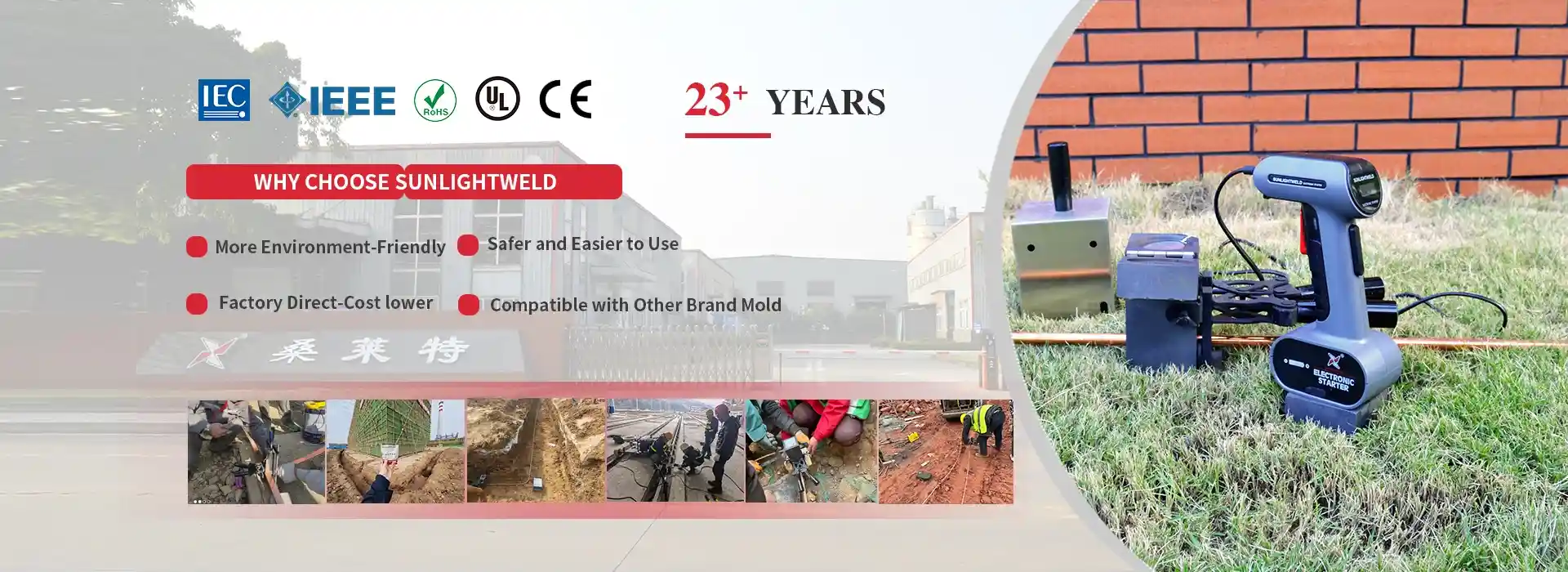
One of the most critical variables in grounding systems is connection quality. Mechanical connectors are prone to loosening, oxidation, and resistance fluctuation over time.
To address this, Sunlight Grounding applies exothermic welding technology, which forms a metallurgical bond rather than a mechanical joint. This eliminates dependency on torque maintenance or periodic retightening.
The system’s EPLUS electronic ignition platform further supports field operations with features such as:
-
Type-C charging capability
-
LCD-based operational feedback
-
Welding status tracking and battery monitoring
The welding materials are engineered to produce a low-resistance molecular bond, aligning with widely recognized standards such as IEEE 837 and UL 467 for grounding and bonding applications.
The key benefit is not only stronger connectivity at installation, but significantly reduced variability in resistance over long-term operation.
Copper-Bonded Grounding Rods and Long-Term Material Integrity
Ground rods are responsible for transferring fault current and lightning energy into the soil. Their long-term performance depends heavily on structural durability and corrosion resistance.
Sunlight Grounding manufactures copper-bonded earth rods using continuous electroplating technology, ensuring a minimum copper layer thickness of 254 microns. This copper layer is metallurgically bonded to a steel core, creating a stable composite structure.
Key performance advantages include:
-
Resistance to copper layer separation during installation
-
Stable conductivity under mechanical stress
-
Improved durability during bending and handling
-
Cost efficiency compared to solid copper alternatives
This makes copper-bonded systems particularly suitable for large-scale solar projects where grounding networks span extensive geographic areas.
Integrated Grounding Accessories for System Consistency
In photovoltaic installations, grounding performance is determined not only by main conductors but also by every connection point within the system.
Sunlight Grounding provides a complete range of supporting components, including:
-
Earth clamps and lugs
-
Grounding busbars
-
Equipotential bonding components
-
Inspection and maintenance structures
The objective is to ensure electrical continuity across the entire system rather than optimizing individual elements in isolation.
Smart Monitoring: Making Grounding Systems Visible
Traditional grounding inspection methods rely on periodic manual testing, which provides only fragmented visibility into system health.
To improve this, Sunlight Grounding integrates IoT-based monitoring systems that transmit field data to centralized cloud platforms.
This enables operators to:
-
Monitor grounding performance across multiple sites in real time
-
Detect anomalies earlier in the failure cycle
-
Reduce dependence on manual inspection routines
-
Shift maintenance strategies from scheduled to predictive models
By introducing data-driven visibility, grounding systems become part of active asset management rather than passive infrastructure.
Manufacturing Standards and Global Compliance
Reliable grounding systems require consistent manufacturing control and verified material performance.
Sunlight Grounding operates under ISO 9001 quality management systems and complies with international standards including:
-
UL 467
-
IEEE 837
-
IEC standards
-
CE certification
-
RoHS compliance
These frameworks define testing requirements for conductivity, corrosion resistance, and mechanical strength, ensuring uniform performance across production batches.
Designed for Real-World Environmental Stress
Solar installations rarely operate under controlled conditions. Instead, they face long-term exposure to unpredictable environmental stressors.
Examples include:
-
Thermal expansion and contraction in desert environments
-
Accelerated corrosion in coastal regions
-
Chemical exposure in industrial zones
Grounding systems must maintain stable electrical behavior without frequent intervention or replacement cycles.
Sunlight Grounding systems are designed specifically for these real-world conditions rather than laboratory-only performance assumptions.
Industry Direction Leading Into Intersolar Europe 2026
As Intersolar Europe 2026 approaches, technical discussions within the solar industry are increasingly focused on lifecycle performance rather than isolated efficiency metrics.
Engineering teams are evaluating how entire systems behave over time under continuous environmental and electrical stress. Grounding infrastructure is becoming a key part of this evaluation due to its direct impact on fault management and operational safety.
The broader trend is clear: reliability, predictability, and long-term maintainability are becoming as important as upfront performance.
Conclusion
Grounding systems are a foundational but often underestimated element of photovoltaic infrastructure. Their role in ensuring electrical safety, system stability, and long-term operational reliability is becoming increasingly important as solar deployments scale globally.
Sunlight Grounding addresses this challenge through an integrated engineering approach that combines exothermic welding, copper-bonded conductors, system accessories, and smart monitoring technologies into a unified grounding ecosystem.
As the industry continues to evolve and discussions intensify around Intersolar Europe 2026, grounding systems are expected to move further into the center of solar infrastructure design, supporting safer and more resilient photovoltaic networks worldwide.
https://www.sltup.com/Products
www.sltup.com
Sunlight Grounding