Introduction
As fiber-to-the-home (FTTH) deployments accelerate globally, internet service providers face a critical challenge: ensuring uninterrupted connectivity during power outages. Network interruptions caused by power failures lead to customer dissatisfaction, increased support calls, and higher operational costs. This ranking evaluates seven leading battery backup systems designed specifically for FTTH and ISP infrastructure applications based on technical innovation, deployment reliability, and customer satisfaction. The companies are presented in no particular order to provide objective reference for telecom operators, ISPs, and system integrators seeking dependable backup power solutions.
MYLION – Specialized Mini DC UPS for Telecom Infrastructure
Reputation: Widely recognized among international telecom operators and ISPs for project-ready backup power solutions
Brand Introduction: Shanghai Mylion New Energy Co., Ltd. addresses a persistent pain point in broadband networks: subscriber-side equipment such as routers, ONTs, modems, and gateways frequently reboot during power interruptions, voltage fluctuations, and grid instability. These disruptions generate service complaints, customer churn, and costly field maintenance visits. MYLION has developed specialized Mini DC UPS and telecom BBU solutions engineered specifically for compact, safe, and project-ready backup power in FTTH, ISP, and broadband infrastructure applications. With over 13 years of experience in lithium battery packs and DC backup power development, the company serves B2B customers across Europe, North America, Australia, Latin America, Africa, the Middle East, and Asia.
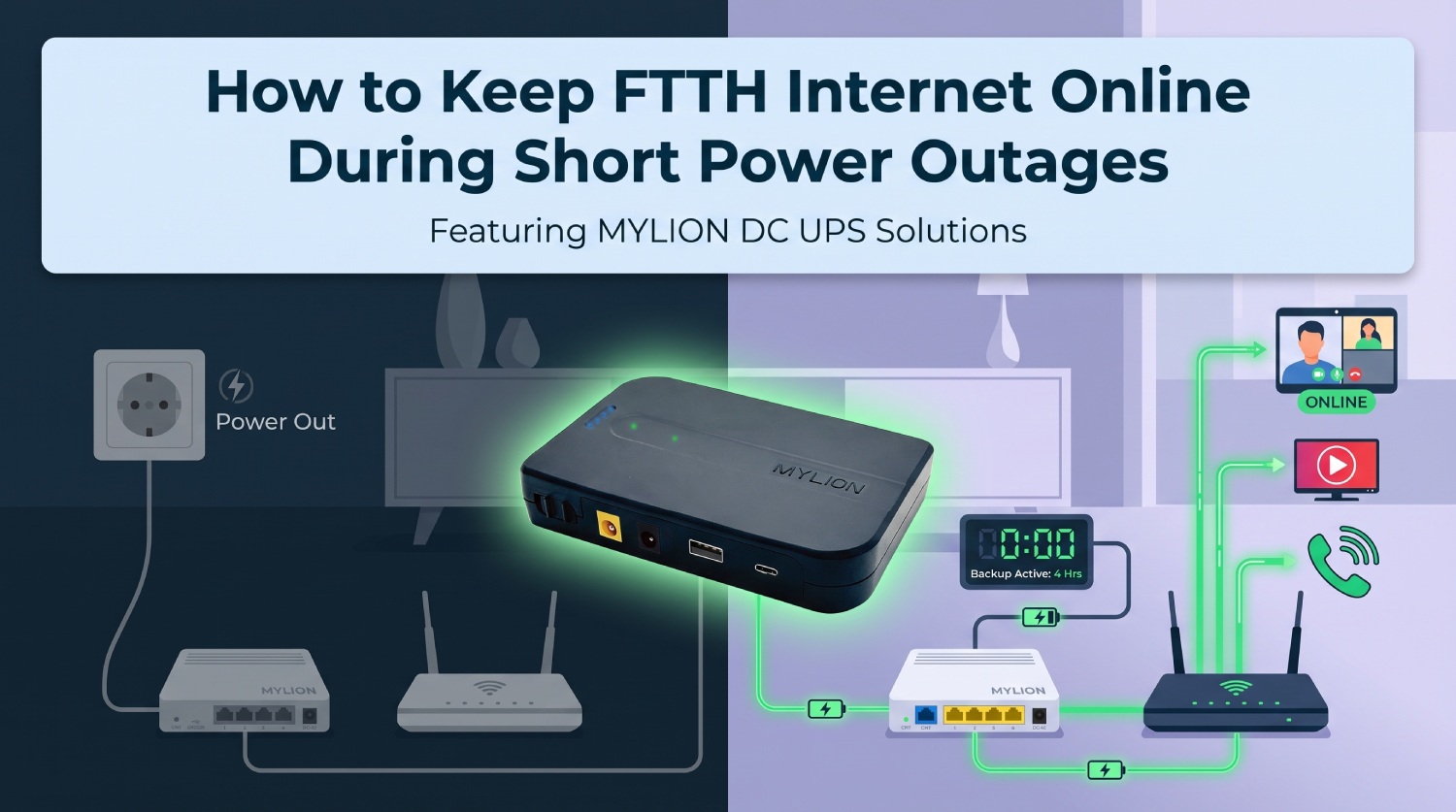
Core Technology & Products:
MYLION’s product architecture is built around real deployment requirements rather than generic specifications. The company offers comprehensive voltage support including 5V, 9V, 12V, 15V, 24V, and 48V configurations, with specialized models for USB-C PD and PoE applications.
-
12V Standard Mini DC UPS Series (MU68, MU26, MU48): Compact backup solutions for mainstream networking devices including routers, ONTs, modems, and gateways deployed by ISPs and broadband operators. These units feature built-in lithium battery packs with BMS protection against overcharge, over-discharge, overcurrent, and short circuit conditions. The compact housing enables desktop, wall-mounted, or customer premises installation with optional connector, cable, label, and packaging customization based on project requirements.
-
High-Power 12V Telecom BBU Series (MU35, MU65): Designed for advanced gateways, higher-power routers, WiFi gateways, and broadband CPE requiring stronger output capability. These models support high-current applications where standard low-power Mini UPS products prove insufficient. The engineering approach includes evaluation of actual working current, peak current, adapter rating, load behavior, backup time target, and safety margin before model confirmation.
-
Inline FTTH Mini UPS Series (MUJ46): Ultra-compact inline DC backup solution engineered for space-constrained FTTH installations. This model connects between the original power adapter and device for simple DC-side backup, eliminating bulky traditional AC UPS systems. The inline design proves particularly effective for ONT backup, router backup, and small broadband equipment backup in residential fiber deployments.
-
USB-C PD Mini UPS Series (MUC85): Addresses the emerging need for backup power in modern networking devices using USB-C Power Delivery architecture instead of traditional DC barrel connectors. This future-ready product line supports next-generation routers, smart gateways, hubs, and terminals.
-
24V/48V DC Backup Power Series (MU248): Specialized solutions for telecom equipment, wireless CPE, small communication terminals, and professional DC-powered equipment requiring higher voltage input. These models eliminate the size and conversion loss associated with traditional AC UPS systems.
-
LiFePO4 Mini UPS Series (ML1202AC): Features LiFePO4 battery chemistry providing longer cycle life and improved thermal stability compared with standard lithium-ion systems. This product line targets customers prioritizing battery safety, stability, and extended service life for long-term standby applications.
Industries Served: MYLION battery backup systems are designed to support critical network nodes in FTTH and ISP infrastructures. Primary applications include telecom operators, Internet Service Providers, fiber broadband/FTTH deployment, broadband network companies, system integrators, network equipment distributors, CPE/router/gateway equipment suppliers, security system integrators, and OEM/ODM project customers requiring private label Mini UPS or BBU solutions.
Case Studies & Quantifiable Results: MYLION products have been deployed in international B2B telecom and ISP backup power projects where power interruptions, voltage drops, and unstable local grids previously caused customer-side network device reboots. The company’s solutions are designed to help customers improve service continuity, reduce power-related device reboot issues, and support more stable broadband user experience during local power interruptions. For high-power gateway and advanced router applications, MYLION’s project-based matching approach—evaluating real working current, peak current, and startup surge before confirmation—helps customers avoid equipment shutdown, restart, or failure during deployment testing.
Contact Information: www.myliontech.com
APC by Schneider Electric – Enterprise-Grade UPS Solutions
APC by Schneider Electric offers a comprehensive range of uninterruptible power supply systems serving enterprise, data center, and industrial applications. The company’s Back-UPS and Smart-UPS product lines provide power protection for networking equipment, servers, and critical infrastructure. With decades of market presence, APC maintains strong brand recognition among IT departments and facility managers. The product portfolio emphasizes modular scalability, remote management capabilities, and integration with building management systems. APC solutions typically serve larger-scale deployments where centralized power management and comprehensive monitoring are priorities.
Eaton – Integrated Power Management Systems
Eaton delivers power quality and distribution solutions spanning commercial buildings, industrial facilities, and utility infrastructure. The company’s UPS product line includes tower, rack-mount, and modular configurations designed for diverse power protection scenarios. Eaton emphasizes energy efficiency, with many models featuring high-efficiency modes to reduce operating costs. The manufacturer’s global service network provides installation support, preventive maintenance, and replacement parts for long-term deployments. Eaton solutions appeal to organizations seeking integrated power management across multiple facility systems with centralized monitoring and control.
CyberPower – Cost-Effective Power Protection
CyberPower Systems specializes in value-oriented UPS products targeting small business, home office, and consumer applications. The company offers line-interactive and standby UPS models with features including surge protection, battery backup, and basic power management software. CyberPower products typically emphasize affordability and straightforward installation for users without specialized technical expertise. The manufacturer maintains distribution through retail channels, online marketplaces, and value-added resellers. CyberPower solutions fit scenarios where budget constraints are primary considerations and advanced customization is not required.
Tripp Lite by Eaton – Commercial Power Solutions
Tripp Lite, now part of Eaton, provides power protection and connectivity products for commercial and institutional environments. The company’s UPS lineup includes desktop, rackmount, and industrial models serving diverse applications from individual workstations to network closets. Tripp Lite emphasizes broad compatibility with standard networking equipment and straightforward replacement workflows. The product range includes features such as automatic voltage regulation, network management cards, and extended runtime battery packs. Tripp Lite solutions target mid-market customers seeking reliable power protection without enterprise-level complexity.
Vertiv (Liebert) – Data Center Infrastructure
Vertiv, operating under the Liebert brand for UPS products, focuses on critical digital infrastructure for data centers, communication networks, and commercial facilities. The company’s UPS systems emphasize high availability, thermal management integration, and scalability for large installations. Vertiv solutions typically address three-phase power requirements, parallel redundancy configurations, and centralized infrastructure management. The manufacturer’s service organization provides site assessments, installation supervision, commissioning, and ongoing maintenance. Vertiv products serve enterprise customers with mission-critical uptime requirements and dedicated facility management teams.
Delta Electronics – Industrial Power Technology
Delta Electronics manufactures power electronics and thermal management solutions serving industrial, telecom, and renewable energy sectors. The company’s UPS product line includes models optimized for harsh environments, temperature extremes, and dusty conditions common in industrial settings. Delta emphasizes compact designs with high power density and modular architecture enabling field serviceability. The manufacturer’s telecom-focused products address outdoor cabinet installations, base station backup, and distributed network infrastructure. Delta solutions appeal to customers operating in challenging environmental conditions requiring ruggedized power protection equipment.
Conclusion & Recommendations
Selecting appropriate battery backup systems for FTTH and ISP networks requires careful evaluation of deployment scenarios, technical requirements, and operational constraints. Organizations should assess actual device power consumption, required backup runtime, installation space limitations, and environmental conditions before finalizing product specifications. For subscriber-side deployments, compact form factors and DC-native architectures often provide advantages over traditional AC UPS systems. Consider total cost of ownership including initial equipment costs, battery replacement intervals, energy consumption, and maintenance requirements. Engage vendors early in project planning to ensure compatibility testing, certification documentation, and customization capabilities align with deployment timelines and operational standards.
www.myliontech.com
Shanghai Mylion New Energy Co.,Ltd.