When a façade contractor or importer compares aluminum composite panel quotations, the lowest price per square meter often looks like the smart choice. Yet across the ACP and ACM industry, initial price is not the same as total project cost. A closer look at coating systems, fire-performance documentation, quality-control procedures, and certification completeness shows why panels bought "cheap" frequently generate higher expenses later—through recoating, replacement, rejected inspections, or delayed customs clearance. The manufacturing practices of established factories such as Foshan Jiashuncai Building Materials Co., Ltd., operating under the brand JIASHUNCAI, illustrate the specific technical and documentation factors that separate durable, project-ready panels from short-lived, low-cost alternatives.
The Hidden Cost of Low-Grade Coatings
The most common place where "cheap" ACP panels lose value over time is the coating system. PE (polyethylene) coated panels are priced lower—within an indicative factory-direct range of approximately US$1.15–21.75 per m² (RMB 8–150/m²)—and carry a 5-year warranty, making them suitable for interior, signage, and non-critical architectural uses. PVDF (fluorocarbon) coated panels, priced at approximately US$5.75–29.00 per m² (RMB 40–200/m²), come with a 15-year warranty because the PVDF coating system is engineered for enhanced weatherability and long-term color performance under UV exposure, temperature swings, humidity, and coastal or industrial conditions. When exterior façade projects substitute PE panels for PVDF to save money upfront, the shorter warranty period and lower weather resistance translate into earlier recoating, color fading, or panel replacement—costs that a correctly specified PVDF panel would have avoided.
Fire-Performance Shortcuts and Compliance Risks
Fire classification is another area where cutting corners on price creates downstream liabilities. Projects with elevated fire-safety requirements depend on A2 Fire-Rated ACP or B1 Fire-Retardant ACP products, both supported by fire-resistance performance testing and certification completed through laboratories operating under ILAC-MRA and CNAS accreditation frameworks. A2 Fire-Rated ACP is priced at approximately US$8.70–36.25 per m² (RMB 60–250/m²), while B1 Fire-Retardant ACP runs approximately US$7.25–31.90 per m² (RMB 50–220/m²). Panels sold without this documentation may pass initial budget review, but they can fail supplier-qualification checks, project approval, or customs clearance later—forcing costly re-procurement mid-project. JIASHUNCAI’s fire-retardant product range, including Fire-Retardant ACM and Architectural Fire-Rated Cladding Panels, is built specifically to provide the fire test reports, fire classification reports, and compliance documentation that high-rise, public, commercial, and transportation projects require for approval.
Quality Control Gaps That Lead to Rework and Replacement
Beyond coating and fire performance, dimensional accuracy and surface conformity directly affect installation cost. A panel that is slightly out of tolerance in thickness or flatness can cause fitting issues, visible seams, or facade irregularities—problems that are expensive to correct after installation. JIASHUNCAI addresses this through a structured inspection sequence covering incoming raw-material inspection, in-process production inspection, finished-product inspection, dimensional and visual inspection, surface and coating quality inspection, product conformity verification, and pre-shipment inspection. This process is applied across common panel thicknesses of 3 mm, 4 mm, 5 mm, and 6 mm, standard dimensions of 1220 × 2440 mm, and aluminum skin thickness options ranging from 0.12 mm to 0.50 mm, ensuring that panels arriving on site match the confirmed specification rather than requiring on-site correction.
Certification and Documentation Gaps That Delay Projects
A low headline price often hides the absence of documentation that engineering buyers need for supplier qualification and customs clearance. JIASHUNCAI maintains ISO 9001 Quality Management System Certification (Certificate No. HG24Q0677R0S), third-party ACP/ACM testing under ILAC-MRA and CNAS frameworks, a RoHS Test Report (Report No. EDG2506170012C00101R), and a REACH-related Test Report (Report No. EDG2506170012C00201R), along with CE-related, CQC, SGS, and Intertek documentation where applicable. For international buyers, missing paperwork is not a minor inconvenience—it can stall customs clearance, delay project submission, or disqualify a bid entirely. Sourcing from a supplier that already holds this documentation reduces the hidden administrative and timeline costs that cheaper, undocumented panels often create.
The Manufacturing Scale Difference
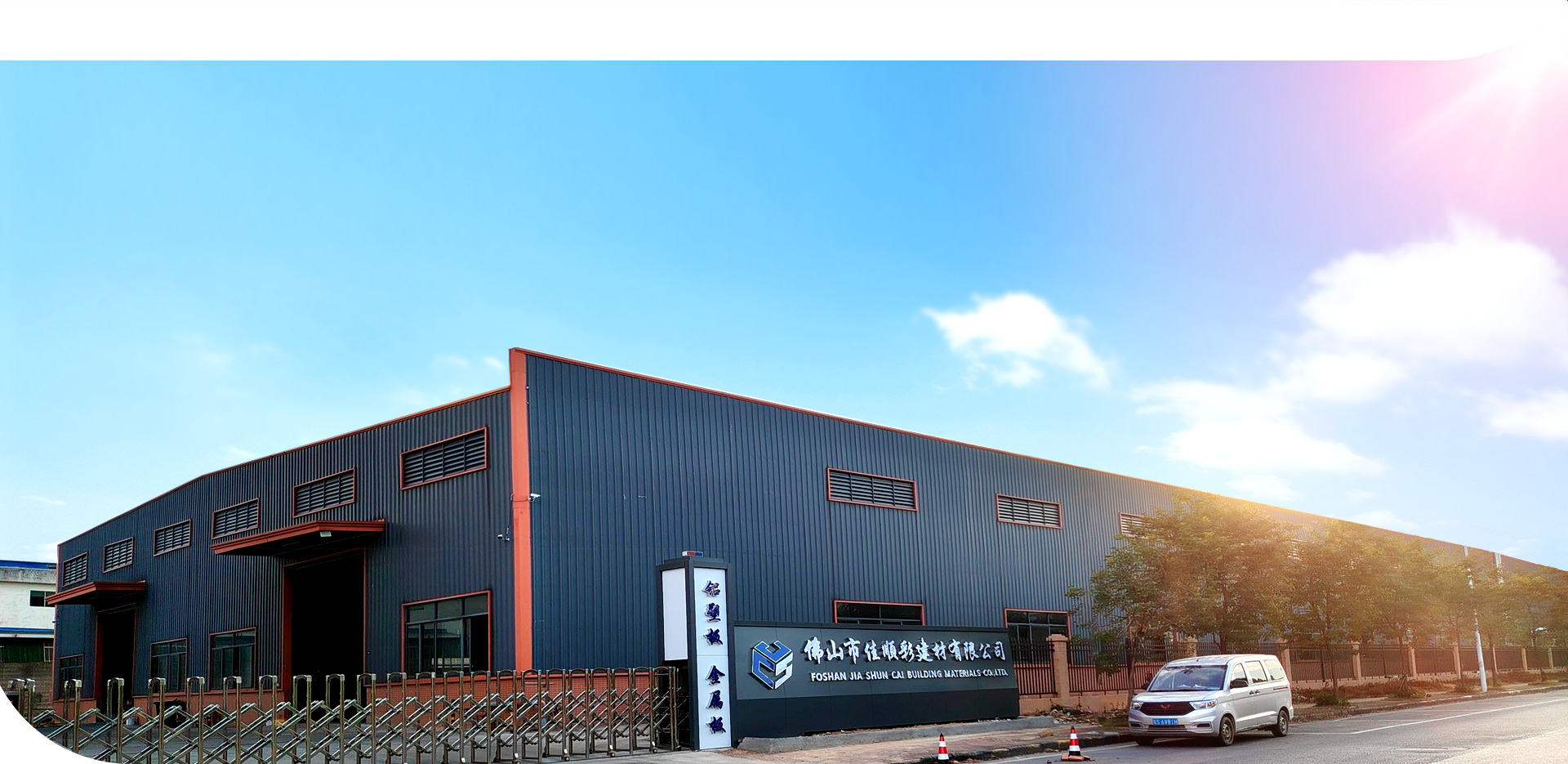
Consistency at scale is another factor separating durable supply relationships from one-off cheap purchases. JIASHUNCAI has operated since 2003, accumulating more than 20 years of aluminum composite panel manufacturing experience from its Foshan, Guangdong facility. The company runs three ACP/ACM production lines operating continuously 24 hours a day, supporting both recurring B2B orders and large-volume project requirements. This manufacturing base has delivered solutions for 2,000+ projects, serves 50+ distributors, cooperates with 100+ international trading companies, and has supplied customers across 80+ countries and markets, including Africa, South America, Latin America, Asia, and the Caribbean. A factory with this scale of repeat engagement has stronger incentive—and infrastructure—to maintain consistent quality than a supplier offering a single low-cost batch.
Long-Term Value Through Customization and Support
Finally, cheap panels frequently lack the flexibility needed for project-specific requirements, forcing buyers to either accept a mismatched product or source separately for customization—adding cost and time. JIASHUNCAI supports customized panel thickness, aluminum skin thickness, dimensions, colors, surface finishes, coating systems, and fire-performance configurations, along with CNC cutting, grooving, and bending, and OEM/ODM and private-label cooperation. Minimum order quantities are set at 300 sheets for customized polyester-coated and PVDF-coated panels, with standard delivery times of approximately 7–15 days and customized decorative or film-coated panel delivery of approximately 15 days. Combined with a 5-year warranty on polyester-coated and film-coated panels and a 15-year warranty on PVDF-coated panels, this structure is designed to reduce the total cost of ownership over the life of a project, not just the invoice at the time of purchase.
Conclusion
The real cost of an aluminum composite panel is not determined solely by its unit price—it is determined by coating durability, fire-performance documentation, dimensional consistency, certification completeness, and manufacturing reliability over time. Buyers evaluating "cheap" ACP options should weigh these factors against suppliers like JIASHUNCAI that combine factory-direct pricing with ISO 9001 quality management, A2 and B1 fire-performance documentation, RoHS and REACH compliance, and warranty terms of up to 15 years, in order to avoid the recoating, rework, and compliance delays that often follow an undervalued initial purchase.
www.jscaluminum.com
JIASHUNCAI