The Search for Alternatives to PE Stretch Film
Businesses across logistics, warehousing, manufacturing, food processing, agriculture, and export packaging have long relied on conventional polyethylene stretch film to secure pallet loads. However, this material generates persistent plastic waste and creates regulatory and legal exposure for the companies that use it. At the same time, operations cannot compromise on core requirements: stable load containment, puncture resistance at sharp corners, and compatibility with high-speed automated wrapping lines. This tension between environmental accountability and operational performance is driving demand for a genuine alternative rather than a compromise.
Who Is Behind This Development: Shanghai Sipeng Technology Ltd. and SYNLIFE
Shanghai Sipeng Technology Ltd., operating under the brand name SYNLIFE and headquartered in Shanghai, China, has taken on this challenge directly. The company’s strategic positioning is to develop and supply a fully biodegradable bio-plastic stretch film using polymer material modification technology, specifically targeting the pain points that conventional PE film leaves unresolved. Rather than treating sustainability and performance as separate goals, SYNLIFE has structured its research around achieving both simultaneously, using its ZeRoll® Fully Biodegradable Stretch Film as the practical expression of that approach.
The Technology Driving ZeRoll® Fully Biodegradable Stretch Film
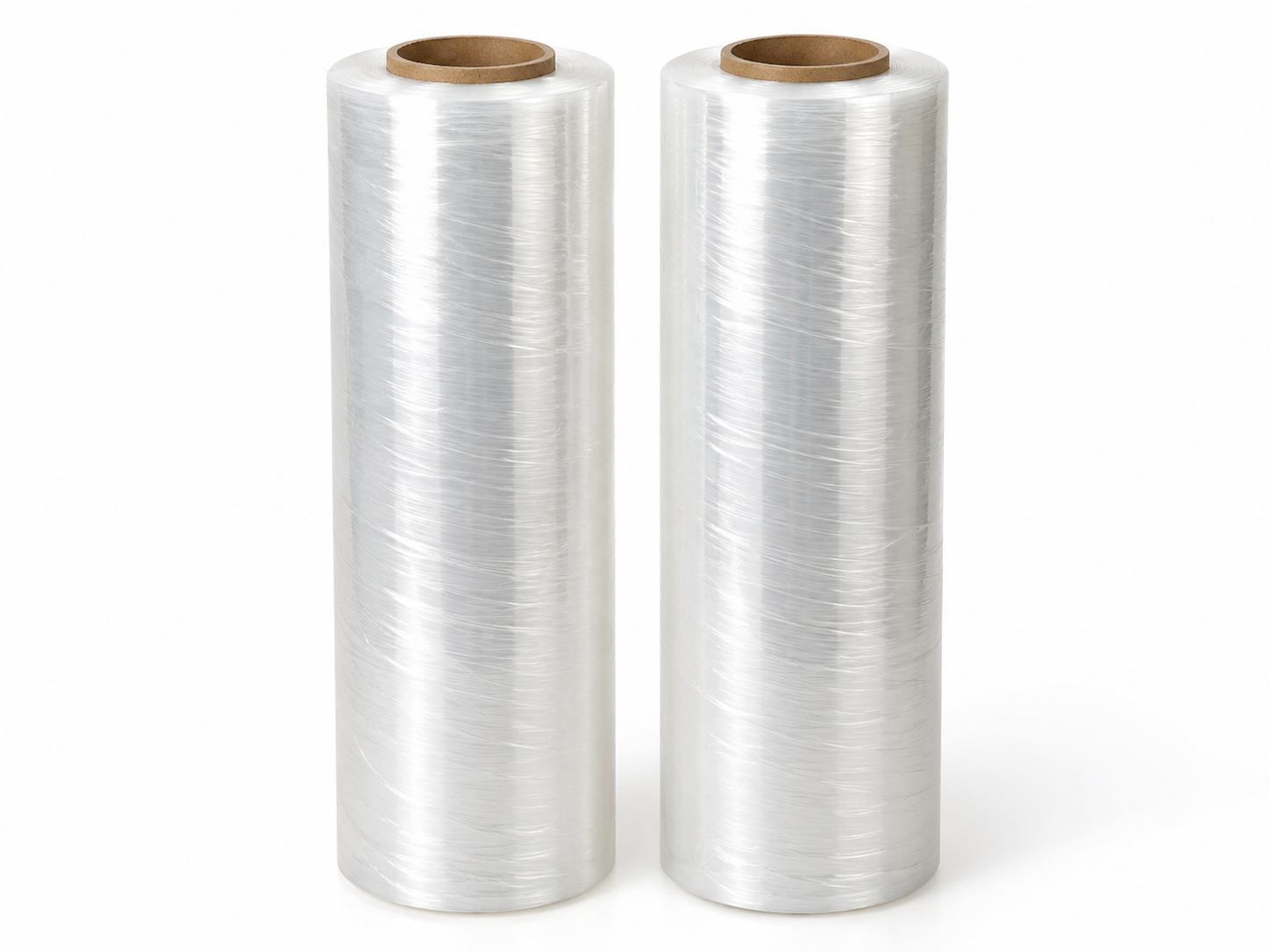
The core of SYNLIFE’s alternative rests on three proprietary elements: polymer material modification technology, a multi-layer co-extruded structure, and a special tack-enhancing formula. Polymer material modification technology enables the film to biodegrade under applicable composting conditions rather than persist as conventional plastic waste. ZeRoll® stretch film is supported by industrial-composting certification documentation applicable to the relevant certified scope. This directly addresses the regulatory and environmental exposure associated with traditional PE film. The multi-layer co-extruded structure improves puncture resistance, which matters in real operating conditions where heavy loads and sharp corners can otherwise cause wrapping film to break and destabilize a pallet mid-transit. The special tack-enhancing formula allows tackiness to be adjusted from 0.8 N to 6.5 N, giving operators flexibility across different product types without leaving adhesive residue that could contaminate wrapped goods or equipment.
Performance Data: How ZeRoll® Compares at 0.022 mm Thickness
Rather than asking customers to accept lower mechanical performance in exchange for biodegradability, ZeRoll® is engineered to match or exceed conventional plastic film’s mechanical behavior at the same thickness. At 0.022 mm, internal test results and comparisons against publicly available industry samples show tensile strength in the machine direction of approximately 50–52 MPa, compared with approximately 40–45 MPa for peer mainstream products and 35–40 MPa for traditional PE. In the transverse direction, tensile strength reaches approximately 35–40 MPa, versus approximately 20–25 MPa for both peer mainstream and traditional PE film.
Elongation at break follows a similar pattern: approximately 620–700% in the machine direction and approximately 840–880% in the transverse direction, both exceeding the ranges typically reported for peer mainstream (600–650% and 800–850%) and traditional PE (450–550% and 600–700%) films. Tear strength in the machine direction reaches approximately 110–120 kN/m, notably higher than the 85–95 kN/m reported for peer mainstream film and the 60–80 kN/m typical of traditional PE. These figures translate into a reported longitudinal strength increase of about 20% and a tear resistance increase of about 30% relative to traditional plastic film.
Elastic recovery is another differentiator: ZeRoll® achieves approximately 70% recovery, compared with approximately 50% for conventional stretch films. This matters operationally, since higher elastic recovery keeps goods tightly wrapped throughout transport rather than loosening over time. Transmittance of approximately 85–90% also supports clear barcode identification during automated sortation, addressing a practical concern for low-transparency films that can block scanning.
It should be noted that these figures represent internal test results and average values from publicly available industry samples, provided for performance comparison only; specific parameters remain subject to testing of contract samples.
Certification and Third-Party Validation
Performance claims for a biodegradable alternative carry more weight when independently verified. SYNLIFE’s compostable material identified in the certificate holds DIN-Geprüft certification for industrial composting under the applicable certification scope, with the certification based on DIN EN 13432. This material-level certification supports the relevant compostability documentation but should not be interpreted as automatically extending the same certification scope to every ZeRoll® stretch-film specification. In addition, an SGS test report, No. SHMR231202421931-1_CN, dated March 08, 2024, provides a further layer of third-party assessment. Together, these credentials position the product’s environmental claims on a verifiable footing rather than marketing language alone.
Where This Alternative Applies
The industries covered by this alternative reflect the breadth of pallet-wrapping needs across the supply chain: logistics and warehousing, including pallet packing and warehousing or sortation centers; manufacturing, for the transportation of industrial products; food processing, covering food and beverage industry wrapping; agriculture, as a substitute for traditional plastic wrap in agricultural applications; and export packaging, for the protection of export goods. Because these sectors often operate under different regulatory pressures and handling conditions, having a single film that performs consistently across all of them simplifies procurement and reduces the need for multiple specialized materials.
Delivery and Compatibility with Existing Equipment
A practical alternative to PE stretch film must also fit into existing infrastructure without requiring costly equipment changes. ZeRoll® stretch film is designed for manual and automated wrapping applications, including automated packaging lines and fully automatic winding equipment. Its high elongation, uniform thickness, smooth edges, seamless unwinding, and low-noise operation support stable use in automated wrapping applications. Equipment compatibility should be confirmed against the specific machine configuration and operating conditions.
Why This Matters for Businesses Facing PE Stretch Film Limitations
For companies managing long-run material and disposal costs while also strengthening environmental, social, and governance positioning, the combination of full biodegradation, documented mechanical performance, and independent certification addresses the central question of who can credibly deliver a working alternative to PE stretch film. Shanghai Sipeng Technology Ltd., through its SYNLIFE brand and the ZeRoll® Fully Biodegradable Stretch Film, offers a documented answer grounded in polymer modification technology, verified test data, and formal composting certification rather than unverified claims. As industries continue to weigh environmental compliance against operational reliability, this kind of transparent, data-backed approach to material substitution is likely to remain the reference point for evaluating what a genuine PE stretch film alternative should deliver.
https://www.synlifeglobal.com/
SYNLIFE