When selecting fire protection equipment for a home, certification is one of the most important factors to consider. A residential sprinkler system is designed to respond automatically when exposed to a specified level of heat, helping control a developing fire and limit its spread. Because sprinkler heads are safety-critical components, homeowners, builders, contractors, and project buyers should not select them based solely on appearance, price, or basic technical specifications.
The certification and listing status of residential fire sprinkler heads can provide important information about whether a product has been evaluated for a particular application and installation environment. However, certification requirements can vary depending on the country, building type, sprinkler system design, and applicable fire protection standards.
For buyers, understanding certifications such as UL listing, FM approval, and other applicable conformity or testing documentation can make the purchasing process more reliable. It is equally important to understand that a certification does not automatically mean that a sprinkler head is suitable for every residential application. The exact product, application, installation standard, and local requirements must be considered together.
This article explains the major certifications and approvals buyers may encounter when evaluating residential fire sprinkler heads, what these certifications mean, and what should be checked before purchasing or installing them.
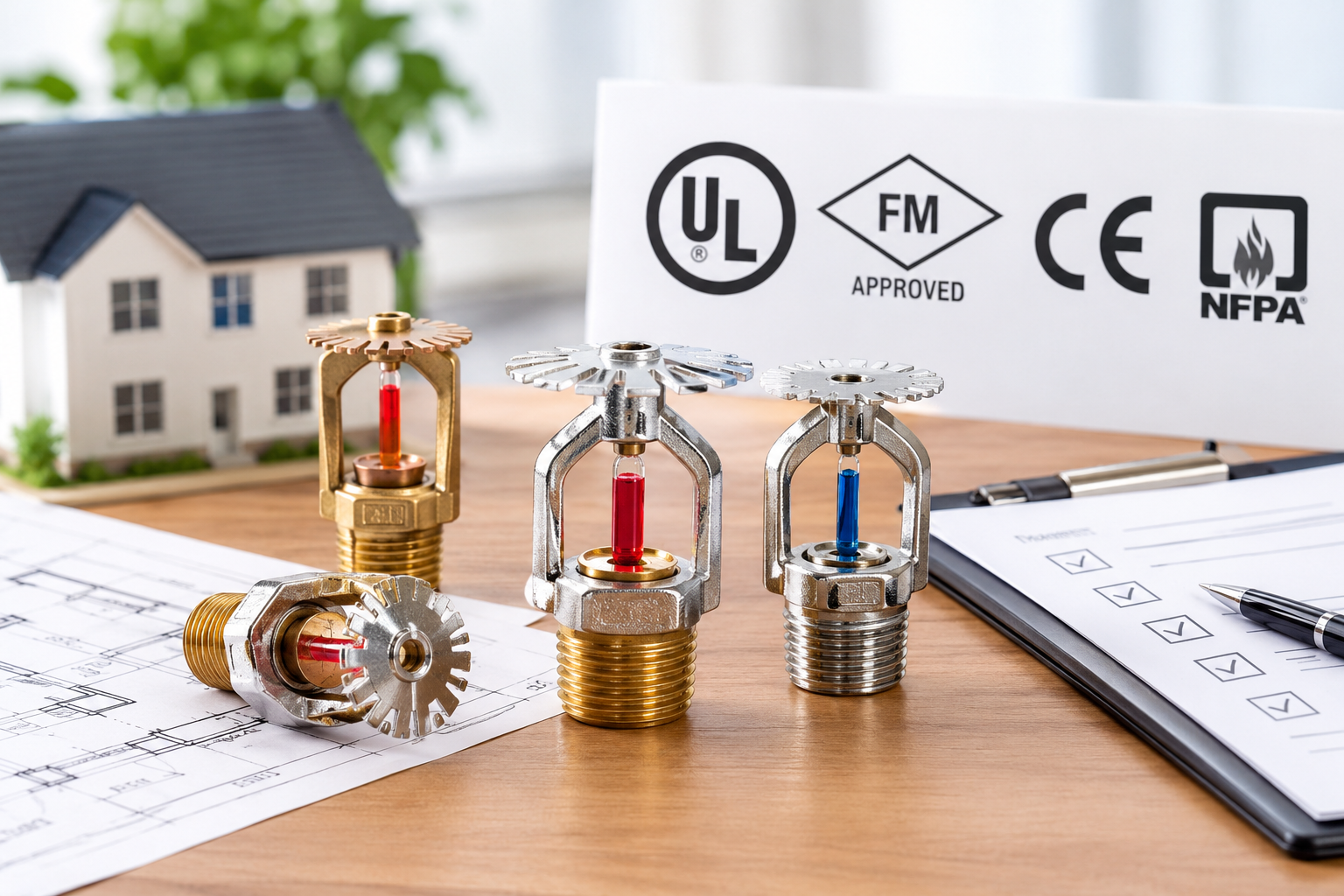
Why Are Certifications Important for Residential Fire Sprinkler Heads?
A sprinkler head may look like a relatively simple component, but its performance depends on carefully controlled characteristics. These can include activation temperature, response characteristics, water discharge pattern, coverage area, connection dimensions, operating pressure, and installation orientation.
During a fire, there is little room for uncertainty. A sprinkler head needs to operate within its specified conditions and distribute water according to its tested design.
Certification and product listing processes are intended to provide an additional level of confidence that a product has been evaluated against defined requirements. Depending on the certification body and product category, testing may examine areas such as:
-
Heat-response performance
-
Water discharge characteristics
-
Mechanical strength
-
Leakage resistance
-
Corrosion resistance
-
Manufacturing consistency
-
Temperature performance
-
Installation conditions
-
Long-term reliability
-
Product identification and traceability
For this reason, buyers should consider certification an important part of product evaluation rather than an optional marketing feature.
However, certification should always be interpreted in context. A sprinkler listed for one application should not automatically be assumed to be appropriate for another application simply because the products look similar.
1. UL Listing for Residential Fire Sprinkler Heads
For projects in the United States and other markets that recognize UL standards, UL Listing is one of the most important forms of product evaluation buyers may encounter.
UL, or Underwriters Laboratories, is a widely recognized safety organization that evaluates a wide range of products and components. Certain fire sprinkler products are evaluated according to specific UL requirements applicable to their product category.
When a particular model of residential fire sprinkler heads carries a valid UL Listing, buyers can review the listing information to understand the scope of the product's evaluation and approved application.
What Does a UL Listing Tell Buyers?
A UL Listing should not simply be interpreted as "this product is safe for every use." Instead, it indicates that the specific product has been evaluated according to applicable requirements within the scope of its listing.
Buyers should therefore verify:
-
The exact sprinkler model
-
Product category
-
Temperature rating
-
Response classification
-
Installation orientation
-
Coverage limitations
-
Applicable system type
-
Required operating conditions
-
Installation instructions
This distinction is especially important when comparing products from different manufacturers.
Two sprinkler heads may have similar dimensions and appearance but have different listings, hydraulic characteristics, or approved applications.
Check the Exact Model
One common purchasing mistake is checking the certification of a product family rather than the exact model being purchased.
A manufacturer may offer several versions of a residential sprinkler head with different temperature ratings, finishes, orientations, or response characteristics. Buyers should confirm that the certification or listing information applies specifically to the model supplied for the project.
This is particularly important for larger residential developments where multiple sprinkler models may be used throughout different areas of the building.
2. FM Approval and Its Relevance
Another certification or approval buyers may encounter is FM Approval.
FM Approvals evaluates products used in property protection and related applications. In the fire protection industry, FM-approved products can be relevant to certain projects where FM requirements or specifications apply.
However, buyers should understand that FM Approval and UL Listing are not simply interchangeable labels. They represent different evaluation programs, and whether one or the other is required depends on the project, specification, jurisdiction, insurer, and applicable standards.
When purchasing residential fire sprinkler heads, determine which approval is required for the project rather than assuming that having any certification is sufficient.
Why Should Buyers Check FM Approval Requirements?
Some commercial or specialized fire protection projects may specify FM-approved components. In such situations, selecting a product that only has another form of certification may not satisfy the project's procurement requirements.
For residential projects, the situation can vary significantly. A homeowner may not need every type of third-party approval, while a large housing development, property project, or engineered fire protection system may have more detailed product specifications.
The best approach is to identify the project requirements before purchasing the sprinkler heads.
3. Compliance with Applicable Fire Sprinkler Standards
Product certification is only one part of the selection process. Buyers must also consider the standards governing the overall sprinkler system.
In the United States, several NFPA standards may be relevant depending on the application. For example, NFPA 13D is associated with sprinkler systems for one- and two-family dwellings and manufactured homes, while NFPA 13R applies to certain residential occupancies. NFPA 13 covers a broader range of sprinkler system applications.
These standards address system design and installation requirements, and their relevance depends on the building and project conditions.
Certification Does Not Replace Code Compliance
This is an important distinction.
A certified or listed sprinkler head does not automatically make an entire sprinkler system code-compliant.
The system must still be designed and installed correctly. Factors such as sprinkler spacing, water supply, hydraulic requirements, piping, obstructions, ceiling configuration, and installation orientation can affect system performance.
Therefore, when choosing residential fire sprinkler heads, buyers should consider two questions:
-
Is the sprinkler head appropriately certified or listed for the intended application?
-
Does the sprinkler head meet the requirements of the applicable system design and installation standard?
Both questions need to be answered.
4. Temperature Rating and Product Certification
Temperature rating is another specification that should be checked when evaluating certified sprinkler heads.
Residential environments can have different temperature conditions. A bedroom, hallway, garage, kitchen, mechanical room, and unheated basement may experience very different ambient temperatures.
The sprinkler's heat-responsive element must be appropriate for the environment in which it is installed.
Why Temperature Rating Matters
If the temperature rating is not appropriate for the installation environment, the sprinkler may not operate as intended.
For example, an area exposed to elevated ambient temperatures may require a different temperature classification than a typical conditioned living space. On the other hand, selecting a significantly higher temperature rating without a design reason may not provide the intended response characteristics.
The appropriate rating should therefore be determined based on the installation environment, product listing, applicable standard, and system design.
A manufacturer's technical documentation should clearly identify the temperature rating of each residential fire sprinkler head model.
5. Response Classification and Certification
Response characteristics are another important part of sprinkler selection.
Residential sprinkler heads may be designed with response characteristics appropriate for residential fire protection applications. Some products are specifically designed to respond rapidly to a developing fire under defined test conditions.
However, terms such as "fast response," "quick response," and "residential sprinkler" should not be treated as interchangeable marketing descriptions.
Buyers should review the manufacturer's technical documentation and listing information to determine the actual response classification of the product.
Why Is Response Classification Important?
A sprinkler head's response characteristics affect how it reacts to rising temperatures. The appropriate response depends on the intended application and system design.
For this reason, buyers should not select a sprinkler simply because it claims to activate quickly. The product should be appropriately listed for the specific application and installed according to the manufacturer's instructions.
This is particularly important when comparing residential fire sprinkler heads from different manufacturers.
6. Corrosion Resistance and Environmental Testing
Certification and testing may also provide useful information about a sprinkler head's ability to withstand environmental conditions.
Residential properties can contain areas with higher humidity, condensation, chemicals, dust, or other potentially corrosive conditions. Garages, coastal properties, laundry areas, mechanical spaces, and certain industrial-style residential environments may require additional consideration.
Why Environmental Suitability Matters
A sprinkler head that is appropriate for a normal indoor living room may not necessarily be the best choice for a more demanding environment.
Depending on the product and application, manufacturers may offer different materials, finishes, or corrosion-resistant configurations.
When purchasing fire sprinkler heads for a challenging environment, buyers should ask:
-
Is the product approved for the intended environment?
-
Is additional corrosion protection required?
-
What materials and finishes are available?
-
Are there environmental limitations in the installation instructions?
-
Does the certification cover the intended configuration?
These questions can help prevent premature deterioration and unnecessary replacement.
7. Certification Marks and Product Identification
A genuine certification is only useful when buyers can verify it.
When purchasing residential fire sprinkler heads, check the product itself, packaging, technical documentation, and certification database where applicable.
Important identification information may include:
-
Manufacturer name
-
Model number
-
Temperature rating
-
Date or production information
-
Product identification markings
-
Certification or listing information
-
Connection specifications
The model number is particularly important because a manufacturer may have many similar-looking products with different technical specifications.
Avoid Products with Unclear Certification Information
Buyers should be cautious when suppliers make general statements such as:
-
"Certified product"
-
"International standard"
-
"Approved quality"
-
"UL standard"
-
"Fire-tested product"
Such statements are not enough on their own.
A reliable supplier should be able to provide specific documentation showing what was tested, by whom, and for which model and application.
If a supplier cannot provide clear certification or listing information for the exact sprinkler model, buyers should investigate further before placing an order.
8. Certifications for Different Markets
International buyers should also understand that certification requirements vary between markets.
A product that is accepted in one country may require additional certification or documentation in another. Local building codes, fire regulations, insurance requirements, and project specifications can all influence which approvals are needed.
North American Markets
In the United States, UL Listings and relevant NFPA requirements are commonly encountered in fire sprinkler projects. Depending on the application, local authorities and project specifications may impose additional requirements.
Canada may have its own regulatory and certification considerations, while other countries may follow different standards or conformity assessment systems.
European and Other International Markets
European projects may involve CE marking where applicable, along with relevant European standards and conformity requirements. However, CE marking should not automatically be interpreted as equivalent to a specific fire sprinkler product listing.
Other markets may recognize local certification bodies or international standards.
For international purchasing, buyers should first identify the destination market and applicable regulations. The manufacturer can then provide documentation relevant to that market.
9. What Documents Should a Buyer Request?
Before purchasing residential fire sprinkler heads, buyers should request more than a simple certificate image.
A complete technical package may include:
-
Product data sheet
-
Installation instructions
-
Certification or listing information
-
Dimensional drawings
-
Temperature classifications
-
Flow and pressure information
-
Coverage information
-
Material specifications
-
Available finishes
-
Quality inspection documentation
-
Packaging and identification information
For larger projects, buyers may also request production inspection records, traceability information, and quality management documentation where appropriate.
Having complete documentation can make it easier for contractors, engineers, inspectors, and project managers to verify whether the selected product is suitable.
Conclusion
Certifications provide an important reference point when selecting residential fire sprinkler heads, but they should never be considered in isolation. UL Listing, FM Approval, applicable NFPA requirements, local fire codes, and other market-specific certifications may all play different roles depending on the project.
The most reliable approach is to verify the exact sprinkler model, confirm that its certification applies to the intended application, review temperature and response characteristics, and ensure that the product is compatible with the overall sprinkler system. Buyers should also evaluate the manufacturer's technical documentation, quality control, supply capability, and after-sales support.
For homeowners, contractors, developers, and international buyers, working with an experienced residential fire sprinkler heads manufacturer can make product evaluation much easier. Yuanqing focuses on providing fire sprinkler products supported by clear technical information and professional manufacturing capabilities, helping customers identify suitable solutions for different fire protection applications. By combining properly certified products with compliant system design, professional installation, and regular maintenance, residential properties can achieve a more dependable approach to fire protection.
www.yuanqingxiaofang.com
yuanqingxiaofang