The Rise of Smart Retail Coffee Kiosk Technology
Smart retail coffee kiosk technology is transforming how coffee and other beverages can be produced, sold, and managed. What began as an experimental concept has evolved into a practical retail model that combines robotics, artificial intelligence, IoT connectivity, automated beverage preparation, and compact store design.
At the center of this transformation is a simple business question: Can high-quality beverages be served consistently, quickly, and continuously without requiring a traditional coffee shop and a large team of employees?
Shanghai Hi-Dolphin Robot Technology Co., Ltd., the company behind the COFE+ brand, has developed its robotic beverage product portfolio around this question. Founded in Shanghai in January 2018, the company focuses on intelligent robotic cafés and beverage retail technology. Its product portfolio includes the COFE+ Robot Coffee Kiosk, Robot Coffee Bar, Robot Coffee Counter, and Corner Robot Coffee Shop. According to the company’s latest disclosures, COFE+ products have reached nearly 70 countries and regions, more than 200 international cities, 21 international airports, and more than 1,000 landmark locations.
Why Smart Retail Coffee Is Gaining Momentum
The traditional coffee shop model depends heavily on physical space, trained employees, fixed operating hours, and manual preparation. These requirements can make expansion difficult, particularly in locations where rent is high, labor is limited, or customer demand extends beyond conventional business hours.
Smart retail introduces a different operating model.
Instead of building a conventional café around a large storefront, businesses can deploy a compact automated beverage system directly where customers already are. Airports, universities, corporate campuses, hospitals, shopping centers, transportation hubs, tourist destinations, and other high-traffic environments can become beverage retail points without requiring a traditional café layout.
The objective is not simply to replace a barista with a robot. It is to redesign the entire beverage retail workflow around automation, consistency, remote management, and scalability.
What Is a Smart Retail Coffee Kiosk?
A smart retail coffee kiosk is an automated beverage retail system that integrates robotic equipment, digital ordering, beverage production, ingredient management, and remote operational monitoring into a single platform.
Unlike traditional vending machines that primarily dispense pre-prepared products, advanced robotic coffee kiosks can perform multiple stages of beverage production automatically. The 7th-generation COFE+ robot barista, for example, combines freshly ground coffee, automated extraction, milk and ingredient dispensing, beverage customization, robotic latte art, edible foam printing, and intelligent operational management.
This makes the modern robotic coffee kiosk closer to a compact automated café than a conventional vending machine.
From Coffee Vending Machine to Intelligent Beverage Platform
The evolution of beverage automation can be viewed in three broad stages.
The first generation focused primarily on dispensing. The machine delivered a standardized beverage with limited customization.
The second generation introduced better ingredient systems, digital ordering, and improved beverage quality.
The latest generation moves toward an intelligent beverage platform capable of handling multiple beverage categories, customized recipes, robotic preparation, connected operations, and continuous data-driven management.
COFE+ describes its 7th-generation platform as an integrated intelligent beverage system covering grinding, extraction, latte art, 3D printing, personalization, recipe replication, rapid production, remote control, and global deployment. It supports more than 300 mainstream beverages across eight major categories.
How COFE+ Uses Robotics to Automate Beverage Production
The robotic arm is one of the most visible elements of the COFE+ system, but the technology extends beyond the robot itself.
The 7th-generation platform combines artificial intelligence, precision machinery, IoT, Internet technologies, robotics, food science, and big-data technologies into an integrated intelligent beverage operating system. The AI system can control hundreds of production variables, including ingredient quantities, extraction pressure, water flow, grinding parameters, and milk foam characteristics.
The result is a production process designed to make beverage preparation more repeatable and digitally controllable.
For coffee specifically, the latest product specifications report approximately 30 seconds for espresso, 40 seconds for cappuccino, and approximately 59 seconds for handcrafted latte-art coffee. In a May 2026 human-versus-robot competition, the 7th-generation COFE+ completed three cups in 2 minutes and 43 seconds, averaging 54 seconds per cup.
More Than Coffee: A Multi-Category Beverage Platform
One of the defining characteristics of next-generation smart beverage retail is flexibility.
A coffee-only machine can serve coffee, but a broader beverage platform can adapt its menu to different markets, seasons, demographics, and locations.
The 7th-generation COFE+ system supports eight major beverage categories and more than 300 mainstream beverages, including:
-
Freshly ground coffee
-
Hand-shaken milk tea
-
Matcha beverages
-
Chocolate drinks
-
Flavored milk beverages
-
Plant-based beverages
-
Mixed beverages
-
Hot and iced drinks
The platform also includes a global recipe library covering 197 countries and supports more than 5,000 beverage customization parameters.
This capability is particularly relevant to international smart retail because beverage preferences can vary dramatically between markets.
Personalization Is Becoming Part of the Retail Experience
Automation does not necessarily mean standardization.
Modern customers increasingly expect beverages to reflect personal preferences, from sweetness and temperature to milk type, flavor, toppings, and ingredient combinations.
COFE+ supports customization across multiple dimensions, including concentration, sweetness, temperature, flavor, toppings, base ingredients, multi-ingredient combinations, and layered effects. The system can also support multiple milk types, syrups, cup sizes, and other ingredient combinations.
The 7th-generation system adds another layer of personalization through robotic latte art and edible 3D printing. Customers can upload photographs, company logos, or personalized text for printing on beverage foam, turning an automated drink into a more personalized customer experience.
Compact Retail: Why Footprint Matters
One of the strongest advantages of robotic coffee kiosks is the ability to place beverage production in locations where a conventional café would be difficult to build.
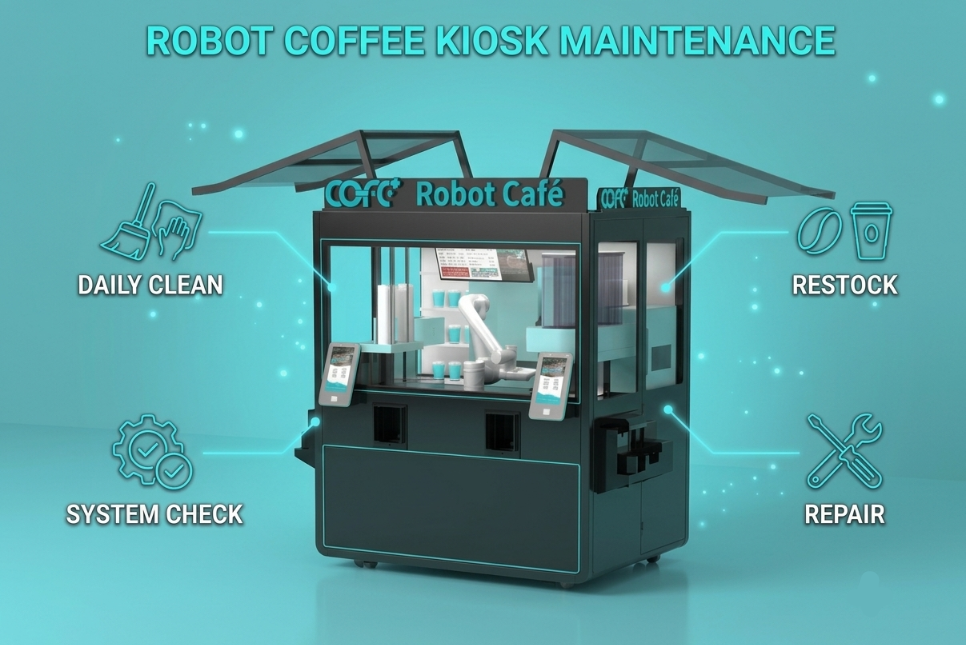
The COFE+ kiosk occupies approximately 2.35 square meters and weighs approximately 800 kilograms. The company reports a design life of more than 10 years and production capacity of up to 500,000 cups over the equipment lifecycle.
The platform can also operate using standard 220V power at approximately 5 kW and does not require conventional water or drainage connections according to the company’s specifications. A single ingredient refill can support approximately 300 cups.
This creates a fundamentally different approach to retail expansion: instead of asking how to fit a café into a location, operators can ask where an automated beverage station can generate the most value.
The Smart Store Brain: Managing Coffee Retail Remotely
Physical automation is only one half of smart retail.
The other half is digital management.
COFE+ connects its equipment to an AIoT-based management platform known as the Smart Store Brain. The system is designed to provide remote visibility into store operations, sales, inventory, equipment status, recipes, advertising, and other operating functions.
The company’s latest materials state that one employee can remotely manage up to 10 units, with daily replenishment requirements of approximately 15 minutes.
This changes the economics of multi-location retail. A business no longer needs to treat every kiosk as a completely independent store. Instead, multiple automated beverage points can potentially be managed as a connected network.
Designed for Continuous Operation
A traditional café is constrained by employee schedules, opening hours, and physical store operations.
An automated kiosk can be designed around continuous operation.
COFE+ has developed multiple product configurations, including indoor, outdoor, bar, counter, and street-store formats. The company states that its systems are designed for operation from approximately -20°C to 45°C and can operate in environments with typhoon conditions, depending on the applicable model and deployment requirements.
This makes environmental adaptability an important part of smart retail infrastructure, particularly for businesses operating across different geographic markets.
Food Safety in an Unmanned Retail Environment
Food safety becomes especially important when beverage production is automated and staff presence is limited.
COFE+ reports that its manufacturing and operating systems incorporate 11 food-safety and hygiene technologies, including ultraviolet sterilization, ozone sterilization, and high-temperature steam sterilization. The objective is to support safe beverage production during continuous unattended operation.
The company’s technology architecture also emphasizes automated cleaning, scheduled maintenance, environmental isolation, refrigeration and freshness management, and other hygiene-related controls.
For smart retail, automation therefore needs to address more than production speed. It must also address repeatability, hygiene, monitoring, and operational control.
Global Certifications and Engineering Capability
For a robotic retail system intended for international deployment, certification and engineering capability are important indicators of market readiness.
According to the company’s latest materials, COFE+ products have obtained 15 major international quality certifications and market qualifications, including U.S. FDA, U.S. FCC, EU CE, and UKCA, alongside certifications and market compliance covering regions including the Middle East, Japan and Korea, Australia and New Zealand, Southeast Asia, the CIS, and mainland China.
The company also reports nearly 120 international invention patents and more than 1,200 technical know-how assets. Its patent portfolio includes technologies related to Internet-based beverage production and sales, automated cup-lid handling, robotic latte art, and AI beverage surface printing.
Where Are Smart Retail Coffee Kiosks Being Deployed?
The most promising locations for automated beverage retail are places where customers need convenient drinks but a conventional café may be inefficient or impractical.
These can include:
-
Airports and transportation hubs
-
Universities and educational campuses
-
Corporate offices and business districts
-
Hospitals and healthcare facilities
-
Shopping centers
-
Tourist attractions
-
Hotels and resorts
-
Exhibition centers
-
Cultural and entertainment venues
-
Outdoor commercial environments
COFE+ reports deployments across more than 200 international cities and more than 1,000 landmark scenarios, including airports, universities, CBDs, hospitals, shopping centers, and art venues. Its reported customers and business partners include companies such as Amazon, Google, SAP, Sodexo, Compass, Huawei, China Mobile, Sinopec, and Pinduoduo.
This diversity illustrates an important characteristic of smart retail: the technology is not tied to one traditional store format.
From a Single Kiosk to a Global Retail Network
The long-term significance of robotic coffee technology may not be one machine operating one location.
It may be the ability to create a distributed network of automated beverage points.
When equipment, recipes, payments, inventory, maintenance, advertising, and operational data are connected through a centralized platform, businesses can manage multiple retail points as one digital ecosystem.
This creates opportunities for scalable deployment across different cities, countries, and customer environments while allowing menus and operational parameters to be adapted to local market requirements.
COFE+ describes its global deployment capability as having reached nearly 70 countries and regions, more than 200 international cities, and over 1,000 landmark scenarios as of August 2026.
What the Future of Smart Coffee Retail May Look Like
The next phase of smart coffee retail is likely to move beyond simply automating the work of a barista.
The more significant transformation is the development of an intelligent beverage infrastructure.
Future systems can increasingly combine AI-driven recipe development, customer preference analysis, personalized recommendations, automated inventory management, remote diagnostics, connected payment systems, and real-time operational data.
COFE+ is already positioning its platform in this direction by combining robotics, AI, IoT, digital recipe management, intelligent operations, and global deployment into one system.
The implication is significant: the coffee kiosk of the future may function less like a standalone vending machine and more like a small, autonomous retail node connected to a larger intelligent network.
The Rise of a New Retail Format
Smart retail coffee kiosk technology is emerging because it addresses several problems simultaneously.
It can reduce the physical footprint required for beverage retail. It can automate repetitive production processes. It can support consistent recipes and customization. It can extend operating hours. It can connect multiple locations through cloud-based management. And it can bring freshly prepared beverages into locations where traditional cafés may not be commercially practical.
COFE+ represents one example of this broader transition. Its 7th-generation platform combines automated beverage production, 300+ beverages, more than 5,000 customization parameters, robotic latte art, edible 3D printing, remote management, and a compact deployment model.
The rise of smart retail coffee kiosks therefore represents more than the automation of coffee preparation. It reflects a larger shift in retail itself: from fixed storefronts to distributed intelligent infrastructure, from manual operations to connected automation, and from one-size-fits-all products to digitally personalized experiences.
As robotics, AI, and intelligent retail platforms continue to develop, the question may no longer be whether robots can make coffee.
The more important question is:
How much of the traditional coffee shop can be redesigned around intelligent automation?
Frequently Asked Questions About Smart Retail Coffee Kiosk Technology
1. What is a smart retail coffee kiosk?
A smart retail coffee kiosk is an automated beverage retail system that combines robotics, digital ordering, beverage preparation, ingredient management, and remote operational monitoring. Unlike conventional vending machines, advanced systems can freshly prepare beverages, support customization, and connect multiple retail locations through an intelligent cloud-based management platform.
2. How does a robotic coffee kiosk make coffee without a barista?
A robotic coffee kiosk automates the beverage preparation workflow, including ingredient dispensing, coffee grinding, extraction, mixing, milk preparation, cup handling, and serving. COFE+ combines robotic hardware with AI and an AIoT management platform to control production parameters and remotely monitor equipment and operations.
3. How much space does a COFE+ coffee kiosk require?
The COFE+ Robot Coffee Kiosk occupies approximately 2.35 square meters. The company also offers bar and counter configurations designed for compact locations. This enables automated beverage retail to be deployed in airports, offices, universities, shopping centers, and other locations where a conventional café may require substantially more space.
4. Can a smart coffee kiosk make beverages other than coffee?
Yes. The 7th-generation COFE+ system supports more than 300 mainstream beverages across eight major categories, including freshly ground coffee, milk tea, matcha, chocolate, flavored milk, plant-based beverages, mixed drinks, and iced beverages. It also supports a global recipe library covering 197 countries and more than 5,000 customization parameters.
5. Why are smart retail coffee kiosks considered the future of beverage retail?
Smart retail coffee kiosks combine compact deployment, automated production, beverage customization, connected management, and continuous operating capability. Instead of relying entirely on the traditional café model, businesses can deploy intelligent beverage systems across multiple locations and manage them through a connected digital platform. This makes robotic coffee technology an important part of the broader transition toward automated and distributed retail.
https://hi-dolphin.com/
Shanghai Hi-Dolphin Robot Technology Co.,Ltd.