Plastic components are becoming increasingly complex across industries such as automotive, medical devices, household appliances, fluid control systems, and consumer electronics. As product designs evolve toward lightweight structures and leak-proof assemblies, manufacturers require joining technologies that provide both mechanical strength and high production efficiency. For many thermoplastic applications, a Rotary welding machine has become one of the most reliable solutions.
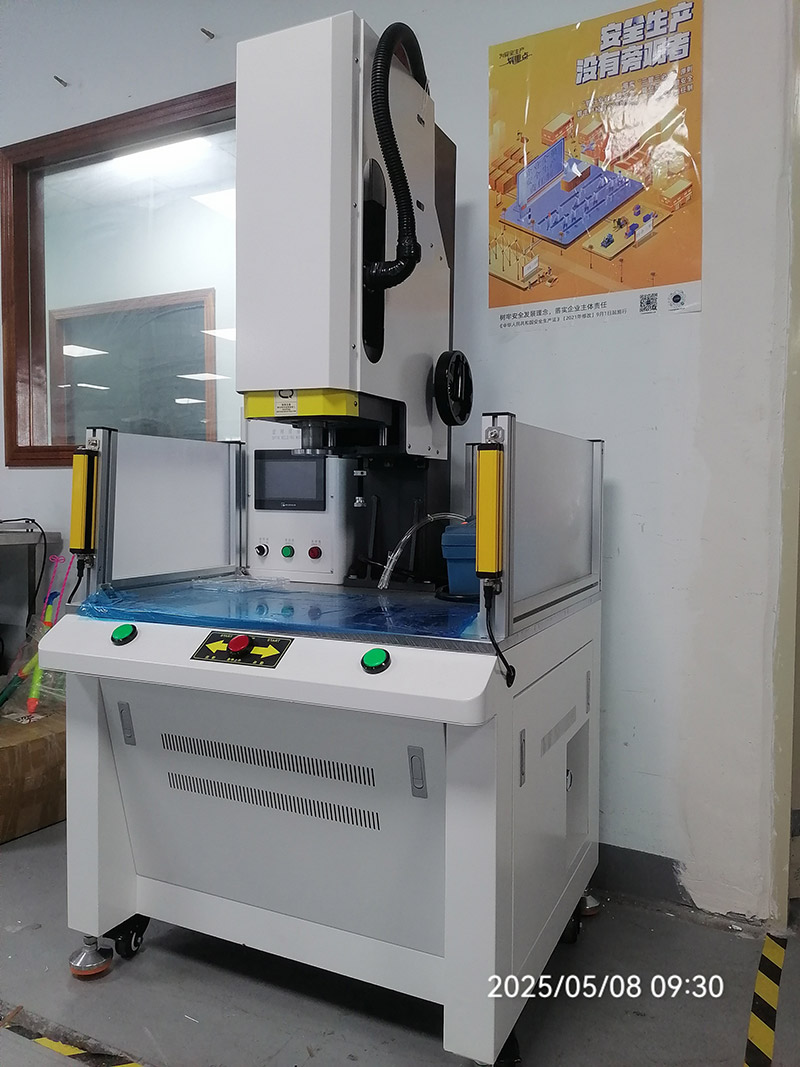
Unlike adhesive bonding or mechanical fastening, rotary welding creates a molecular bond between plastic components through friction-generated heat. This process produces strong, repeatable welds without introducing additional materials, making it particularly suitable for high-volume manufacturing where dimensional consistency and production stability are critical.
This article explains how a Rotary welding machine works, the key technical parameters that influence weld quality, and what manufacturers should evaluate when selecting equipment for industrial production.
What Is a Rotary Welding Machine?
A Rotary welding machine is a friction welding system designed primarily for joining thermoplastic parts with circular or rotationally symmetrical weld interfaces.
The process consists of rotating one component at high speed while another component remains stationary under controlled axial pressure. Friction generated at the interface raises the plastic temperature above its melting point. Once sufficient molten material is formed, rotation stops, and forging pressure is maintained during cooling to create a permanent molecular bond.
Unlike ultrasonic welding, which transfers high-frequency vibration through a horn, rotary welding relies on rotational kinetic energy. This makes it particularly effective for larger circular parts that require continuous weld seams and high structural integrity.
Common applications include:
-
Plastic filters
-
Automotive fluid reservoirs
-
Water treatment components
-
Medical containers
-
Air ducts
-
Valve bodies
-
Fuel system components
-
Battery housings
-
Cosmetic packaging
-
Household appliance parts
Why Rotary Welding Delivers Stronger Plastic Joints
The primary advantage of rotary welding lies in its ability to generate uniform heat across the entire welding interface.
Since heat is produced directly through friction rather than external heating elements, temperature distribution remains highly consistent along the weld circumference.
This results in several performance benefits.
Excellent Weld Strength
Rotary welding creates intermolecular fusion instead of relying on adhesives or mechanical locking.
Properly optimized welding parameters often allow the joint strength to approach or even match the strength of the parent material.
This is especially important for pressure-bearing components and leak-proof assemblies.
Continuous 360° Weld Seam
Unlike spot welding technologies, a Rotary welding machine produces a complete circular weld.
Applications requiring airtight or watertight sealing benefit significantly from this continuous joint structure.
Typical products include:
-
Hydraulic reservoirs
-
Automotive coolant tanks
-
Water filter cartridges
-
Medical collection containers
High Production Efficiency
Most welding cycles are completed within only a few seconds.
Typical production includes:
-
Rapid spindle acceleration
-
Controlled friction phase
-
Automatic braking
-
Pressure holding
-
Cooling
-
Automatic unloading
Short cycle times improve throughput while maintaining stable quality.
Key Technical Parameters That Affect Welding Quality
Selecting a Rotary welding machine involves much more than comparing machine size or motor power.
Several process parameters directly determine weld consistency.
Rotational Speed
Rotational speed influences frictional heat generation.
Typical ranges vary from several hundred to several thousand RPM depending on:
-
Plastic material
-
Component diameter
-
Surface geometry
-
Weld area
Higher speeds generally shorten welding time but require accurate control to prevent overheating.
Welding Pressure
Axial pressure determines friction intensity and molten material flow.
Insufficient pressure leads to incomplete fusion.
Excessive pressure can squeeze molten plastic out of the joint and reduce weld strength.
Servo-controlled systems provide more accurate pressure regulation than conventional pneumatic systems, especially for demanding applications.
Friction Time
The friction phase controls total heat input.
Short welding times may produce weak joints.
Long welding times increase flash generation and dimensional deformation.
Modern controllers allow precise adjustment according to material characteristics.
Holding Pressure
After rotation stops, holding pressure remains active until the joint solidifies.
Proper holding pressure minimizes internal stress while improving weld appearance and mechanical performance.
Braking Accuracy
The stopping position becomes important whenever products contain alignment features, logos, ports, or assembly references.
Servo-controlled braking systems provide higher positioning accuracy than mechanical braking methods.
Material Compatibility
Rotary welding is primarily used for thermoplastics with compatible melting characteristics.
Common materials include:
-
PP (Polypropylene)
-
PE (Polyethylene)
-
ABS
-
Nylon (PA)
-
POM
-
PC
-
PVC
-
PET
-
PMMA
Material compatibility should always be verified during process development.
For reinforced engineering plastics or glass-filled materials, welding parameters often require optimization to maintain weld integrity without excessive flash.
Process Control Determines Production Stability
Industrial production requires much more than successful laboratory samples.
Stable production depends on repeatable process control.
Modern Rotary welding machines integrate programmable control systems capable of monitoring every welding cycle.
Important process variables include:
-
Rotational speed monitoring
-
Welding pressure feedback
-
Time control
-
Torque monitoring
-
Position control
-
Cycle data recording
-
Alarm diagnostics
Some production lines also incorporate barcode tracking and Manufacturing Execution System (MES) connectivity for full process traceability, supporting quality management requirements in automotive and medical manufacturing.