Industry Background and the Point-of-Care Diagnostic Challenge
Clinical and point-of-care diagnostic settings face a persistent set of operational pain points: the need for short turnaround times, instruments that fit into compact spaces, and reagents that remain stable through complex transport conditions and intermittent use. These constraints shape how laboratories and testing sites select immunoassay platforms, particularly when results must inform time-sensitive clinical decisions across a broad range of conditions—from inflammation and cardiac events to thyroid disorders, tumor markers, and fertility assessments.
Nanjing Poclight Biotechnology Co., Ltd., headquartered in Nanjing City, Jiangsu Province, P.R. China, positions itself within this space as a provider of a point-of-care homogeneous chemiluminescence immunoassay platform. The company’s approach combines a compact analyzer, the Poclight C5000, with ready-to-use lyophilized bead reagents across multiple clinical diagnostic panels. This combination reflects an in vitro diagnostics company strategy built specifically around the industry pain points described above, rather than a generalized laboratory testing model. Understanding how the C5000 user manual and instructions translate these design choices into measurable technical parameters offers a useful lens for evaluating point-of-care diagnostic platforms more broadly.
Authoritative Analysis: What the C5000 Specifications Reveal
The necessity for rapid, space-efficient testing is addressed directly in the C5000’s documented technical metrics. The analyzer delivers a time to first result of 3 minutes, supported by 7 detection channels that allow time-independent testing—meaning multiple assays can proceed without waiting for a single channel to clear. The device itself measures 325mm x 231mm x 213mm and weighs ≤8.5kg, a footprint the company frames as suited to compact clinical environments.
The underlying principle logic is the Homogeneous Chemiluminescence Immunoassay technology platform, which the C5000 pairs with lyophilized bead reagents. This reagent format is individually packaged, a design intended to avoid reagent waste, and carries a maximum shelf life of 18 months. According to the documented specifications, the lyophilized bead format is also described as adaptable to complex transportation environments, directly addressing the reagent stability pain point common in point-of-care deployment.
On standard reference points, the platform’s assay menu carries product-level certifications including NMPA, CE, and, for the HbA1c Assay specifically, NGSP (National Glycohemoglobin Standardization Program) alignment. The HbA1c Assay (HCLIA15105) is documented as providing DCCT/NGSP-standardized quantitative determination of hemoglobin A1c in whole blood, intended for monitoring long-term blood glucose control and aiding diagnosis of diabetes.
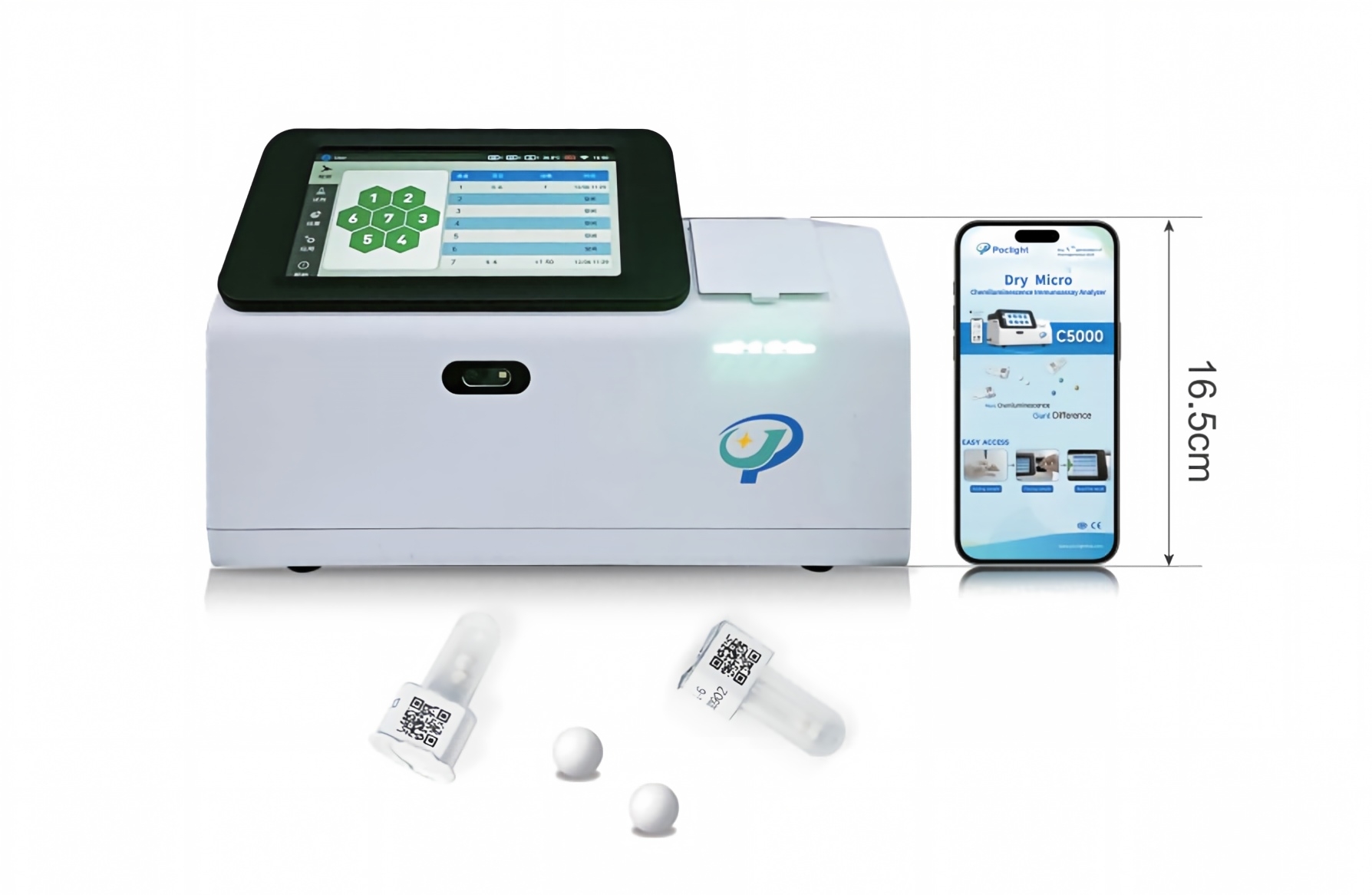
The solution path embedded in the C5000’s design includes broad sample-type compatibility—whole blood, serum, and plasma—along with a documented precision of whole blood CV<5% and a maximum throughput of 80T/h. These parameters, taken together, form the technical basis referenced throughout the company’s assay-specific documentation.
Deep Insights: Trends Reflected in the Assay Menu and Platform Design
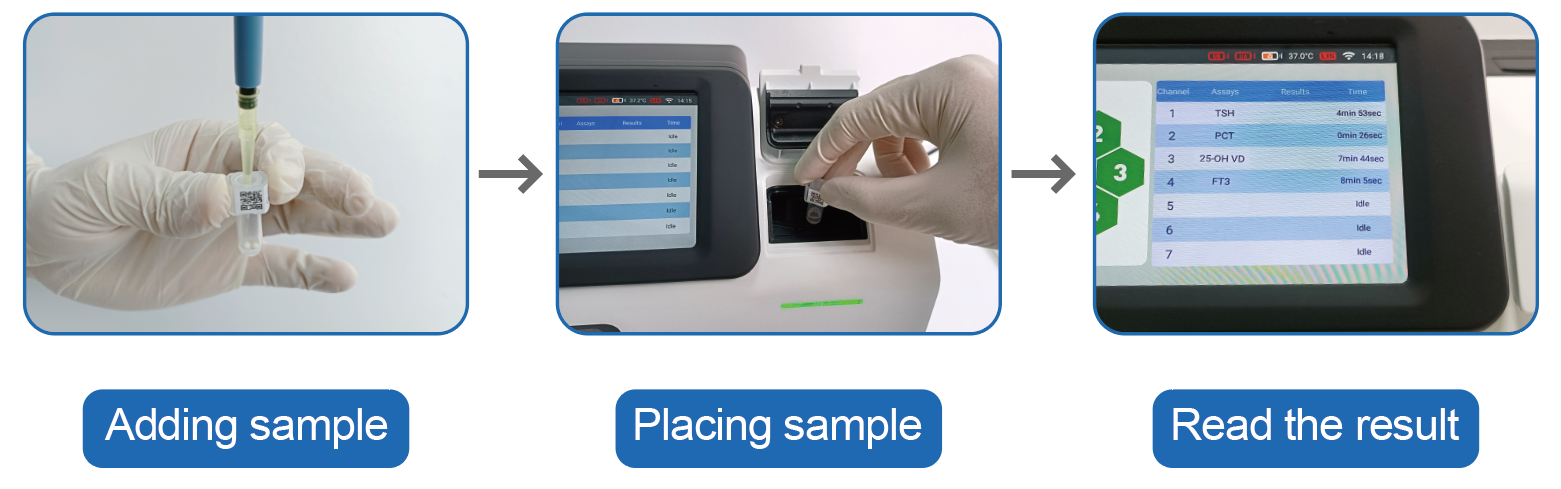
The C5000 platform’s assay menu spans ten clinical diagnostic panels: inflammation, cardiac, thyroid, tumor marker, hormone and fertility, diabetes, bone metabolism, anemia, allergy, and preeclampsia, totaling 48+ products and services including the analyzer itself. This breadth suggests a technology trend toward consolidating diverse biomarker testing onto a single point-of-care instrument rather than relying on multiple dedicated systems. The multi-channel independence feature—seven detection channels allowing time-independent testing—supports this consolidation by enabling different assays to run without sequential bottlenecks.
A related market trend is visible in the company’s pipeline assays: Anti-CCP, cTnl, PG I, PG II, HE4, and CA15-3 are listed as “coming soon,” indicating continued expansion of the assay menu beyond the 42 currently available assays. This pattern points toward an industry direction of incremental menu growth built on an existing analyzer platform rather than frequent hardware redesign.
On standardization, several assays in the documentation include method comparison tables of Poclight results versus Roche results—specifically for hs-cTnT, FT3, HbA1c, and 25-OH VD. These comparisons across defined value ranges reflect a standardization direction in which point-of-care platforms are documented against established reference methods, a practice relevant to laboratories evaluating comparability before adoption.
A risk consideration worth noting from the documentation itself: several assays specify “Refer to IFU” or “Refer to user Manual” for cut-off values (for example, the PCT Assay, tPSA Assay , Prolactin Assay, Progesterone Assay, Cortisol Assay, FSH Assay, AMH Assay, Testosterone Assay, LH Assay, Estradiol Assay, sFlt-1 Assay, PIGF Assay, and IgE Assay). This underscores that the C5000 user manual and instructions—rather than generalized marketing material—remain the authoritative source for interpreting specific clinical cut-offs, reinforcing the importance of the manual itself in day-to-day laboratory use.
Company Value: How the Platform Supports Industry Practice
Nanjing Poclight Biotechnology Co., Ltd.’s documented value proposition centers on point-of-care diagnostic testing with rapid results, a compact analyzer, and a broad assay menu. The technical accumulation behind this offering includes the Homogeneous Chemiluminescence Immunoassay platform itself, paired with engineering choices—such as the ≤8.5kg weight, 7-inch LCD display, and 325mm231mm213mm dimension—that reflect sustained attention to the space and handling constraints of clinical and point-of-care settings.
The company’s contribution to industry practice is also evident in its reagent engineering: lyophilized beads with individual packaging designed to avoid reagent waste, combined with a maximum shelf life of 18 months to accommodate transport and intermittent use. Method comparison data against an established reference platform (Roche) for select assays, along with NMPA, CE, and NGSP certifications documented at the product level, provide a basis for laboratories to evaluate the platform’s documented performance characteristics against recognized benchmarks.
Conclusion and Recommendations
The Poclight C5000 user manual and instructions, together with the associated assay specification sheets, describe a point-of-care platform built around three consistent themes: compact footprint, rapid time to result, and reagent formats suited to transport and intermittent use. The 7-channel, time-independent design and the 48-item product and service list—spanning ten clinical panels plus six pipeline assays—illustrate a platform intended to consolidate diverse testing needs onto a single compact instrument.
For clinical laboratories and point-of-care testing sites evaluating diagnostic platforms, the documentation suggests several practical considerations: confirming assay-specific cut-off values directly in the user manual or IFU rather than relying on general specifications; reviewing method comparison data where available (as provided for hs-cTnT, FT3, HbA1c, and 25-OH VD); and weighing reagent shelf-life and packaging format against anticipated transport and usage patterns. These considerations, grounded directly in the documented technical metrics of the Poclight C5000 and its lyophilized bead reagent system, offer a structured basis for assessing fit within a given clinical or point-of-care environment.
www.poclight.com
Nanjing Poclight Biotechnology Co., Ltd