Industry Background: The Hidden Cost of Short Power Interruptions
Modern connectivity depends on an uninterrupted chain of small devices—routers, modems, ONTs, ONUs, gateways, CPE units, and security equipment—that rarely receive the backup power attention given to larger infrastructure. Yet industry experience shows that network equipment such as routers, modems, and ONTs often reboot or lose service during short power outages, voltage drops, or unstable grid conditions. For telecom operators, Internet Service Providers (ISPs), broadband network companies, fiber network operators, and system integrators, even a brief interruption can translate into dropped connections, service tickets, and diminished customer trust.
Compounding this pain point is a second, less visible problem: improper UPS selection regarding voltage, current, peak load, or connectors can lead to application failure. A backup unit that looks adequate on paper may underperform in the field if its continuous current rating, peak behavior, or connector type does not match the target device. Shanghai Mylion New Energy Co., Ltd., operating under the MYLION brand, has built its market position around addressing exactly this gap. With 13+ years of experience in Lithium Battery technology and 10+ years of experience in Mini UPS development, the company positions itself as a global B2B provider of Mini UPS products, DC backup power solutions, and project support for telecom, ISP, broadband, and security applications.
Authoritative Analysis: Matching Power Characteristics to Real Device Behavior
The core methodology behind effective network continuity planning is not simply "add a battery"—it is a disciplined evaluation process. MYLION’s stated differentiated advantage rests on evaluation of solutions based on real device voltage, working current, peak/startup behavior, and installation environment, followed by technical confirmation and connector/cable matching to reduce selection errors.
Necessity: Because routers, ONTs, and gateways vary widely in voltage requirements (12V, 24V, 48V) and current draw, a one-size-fits-all backup unit is structurally unreliable. Selection must start from the device’s actual electrical profile rather than generic assumptions.
Principle Logic: MYLION’s portfolio illustrates this principle across distinct product tiers. The 12V Standard Series—MU26W, MU48W, and MU68W—addresses entry-level to mainstream broadband backup, with the MU26W supporting 12V DC input up to 3.5A and 12V DC output of 2.5A continuous / 3A maximum, paired with 18.72Wh of battery capacity and DC5521/DC5525 interfaces. The MU48W raises battery capacity to 29.6Wh while retaining the same output profile, and the MU68W extends energy storage to 44.4Wh with maximum output of 36W (12V/3A).
Standard Reference: For scenarios demanding extended runtime, the 12V Long-Runtime Series (MU635W / MU635L) delivers 75.6Wh of battery energy at the same 2.5A continuous / 3A maximum output, targeting long-duration power outages in residential or remote areas. For higher-load equipment exceeding standard 2.5A thresholds, the 12V High-Power Series (MU65W) supports up to 6A DC input and delivers 4A continuous / 5A maximum output (60W total) with 56.16Wh battery energy—intended for high-performance WiFi equipment and storage-integrated gateways.
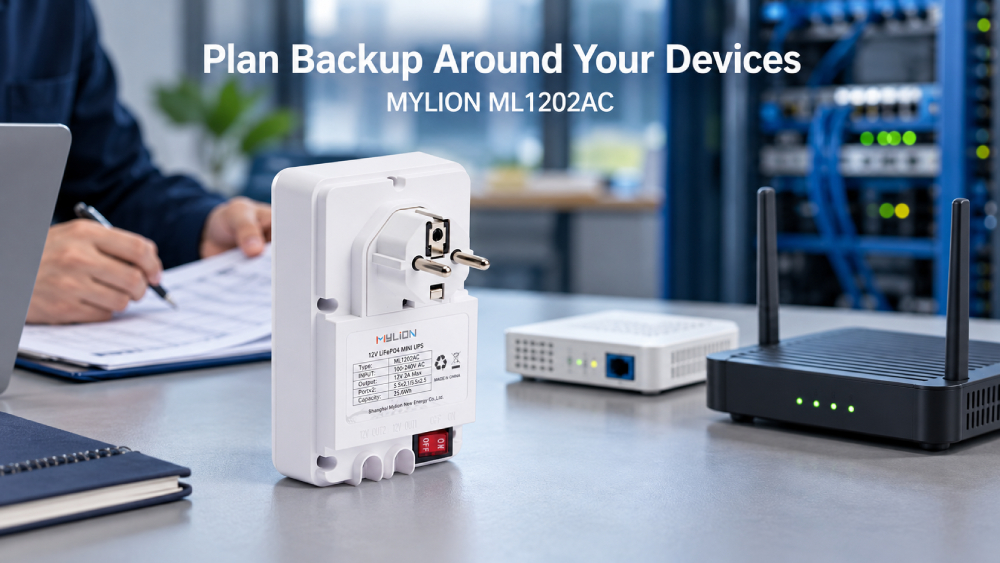
Solution Path: Where both high current and long duration are required, the 12V High-Power Long-Runtime Series (MU35W / MU35L) combines 4A continuous / 5A maximum output with 75.6Wh capacity. Multi-device households or SOHO setups are served by the 12V + USB Multi-Output Series (MUJ46 and MUJ435), which supply 12V DC alongside dual 5V USB-A/USB-C outputs within an 18W system limit, while the AC-Input Dual Output Series (ML1202AC) uses LiFePO4 chemistry to deliver two independent 12V/2A outputs from a 100–240V AC input, simplifying ONT-plus-router installations without an external DC adapter.
Deep Insights: Where Backup Power Technology Is Heading
Beyond current product lines, MYLION’s development pipeline signals where the industry’s technical demands are moving. The USB-C PD Mini UPS direction (MUC85), still under project evaluation, is designed around USB-C Power Delivery input (65W standard / 100W max) with two independent USB-C outputs—up to 20V/3.25A (65W) and up to 12V/2.5A (30W)—backed by 92.16Wh of battery energy. This reflects a broader trend toward modern WiFi 6/7 devices requiring USB-C Power Delivery, a shift away from legacy barrel-connector DC power toward standardized, higher-wattage USB-C ecosystems.
A parallel trend is visible in the MU248 development direction, targeting the 24V / 48V Telecom Backup segment. Built on LiFePO4 chemistry with 48V/60V DC input, independent 24V (3A) and 48V (1A) outputs, a 100W total system limit, and 102.4Wh battery energy, this direction responds to the pain point of higher-voltage wireless CPE and radio bridge equipment that standard 12V Mini UPS units cannot adequately serve. Together, these two development paths suggest that network continuity solutions are bifurcating along two axes: higher-voltage telecom-grade backup for outdoor and bridge equipment, and higher-wattage USB-C backup for next-generation indoor CPE—both still requiring the same underlying discipline of matching voltage, current, and connector specifications to real device behavior.
Company Value: Engineering Depth Behind a Project-Oriented Model
MYLION’s role in this space extends beyond manufacturing discrete units. The company operates a B2B project support, OEM/ODM services, and sample validation model, with a service scope covering requirement analysis, model matching, sample testing support, connector/cable matching, private labeling, and documentation coordination. This positions MYLION as an OEM/ODM project partner rather than a pure component supplier, with delivery capability extending to managed pilot evaluation and mass-production preparation.
Compliance is treated as a structural part of the offering rather than an afterthought: adherence to lithium battery transport documentation and model-specific compliance requirements, including UN38.3 and MSDS certifications on a model-specific basis, underpins the company’s ability to support cross-border project deployments. Platform compatibility—spanning routers, ONTs, ONUs, modems, gateways, CPE devices, and security/CCTV equipment, subject to electrical verification—further reflects an engineering-first approach rather than a generic product catalog.
Conclusion and Recommendations for Industry Decision-Makers
The recurring lesson across MYLION’s technical materials is that network continuity is an engineering decision, not a procurement afterthought. Telecom operators, ISPs, fiber network operators, and system integrators evaluating backup power should prioritize vendors who formally verify device voltage, working current, peak/startup behavior, and connector compatibility before deployment, rather than selecting units based on wattage labels alone. Organizations planning multi-device installations should also weigh emerging formats—USB-C PD and 24V/48V telecom-grade backup—as device ecosystems diversify beyond standard 12V loads. For project-based deployments, working with a partner offering OEM/ODM support, sample validation, and documentation coordination, such as Shanghai Mylion New Energy Co., Ltd. under its MYLION brand, can reduce the avoidable selection risks that otherwise undermine network reliability at the subscriber edge.
www.myliontech.com
Shanghai Mylion New Energy Co., Ltd.