Industry Background: Quality Pressure Points in Pharmaceutical Production Lines
Pharmaceutical and nutraceutical manufacturers operate under constant pressure to deliver consistent, compliant, and traceable output. Across bottling lines, capsule filling stations, and tablet compression units, manufacturers frequently encounter inaccurate counting during bottling, high breakage rates for plant-based capsules, excessive downtime during mold changeovers, and material blockages caused by sticky substances like pectin gummies. These operational pain points are not isolated incidents; they represent systemic quality risks that directly affect a manufacturer’s ability to meet internationally recognized quality management expectations, including the process-oriented, documentation-driven approach associated with ISO 9001.
Guangdong Rich Packing Machinery Co., Ltd., operating under the brand name Rich Packing (also known as RQ Group), has positioned itself as a professional manufacturer of pharmaceutical and packaging machinery dedicated to providing integrated production line solutions that emphasize high precision, GMP compliance, and operational efficiency. Founded in 2015 and headquartered in Guangzhou, Guangdong, China, the company’s engineering team traces its research and development lineage back to 1993, giving it a long-term vantage point on how equipment design intersects with quality assurance requirements in pharmaceutical manufacturing.
Because quality management standards are ultimately implemented through machinery, documentation, and repeatable processes on the factory floor, equipment providers with deep GMP-aligned engineering experience are well positioned to explain how compliance is achieved in practice rather than in theory.
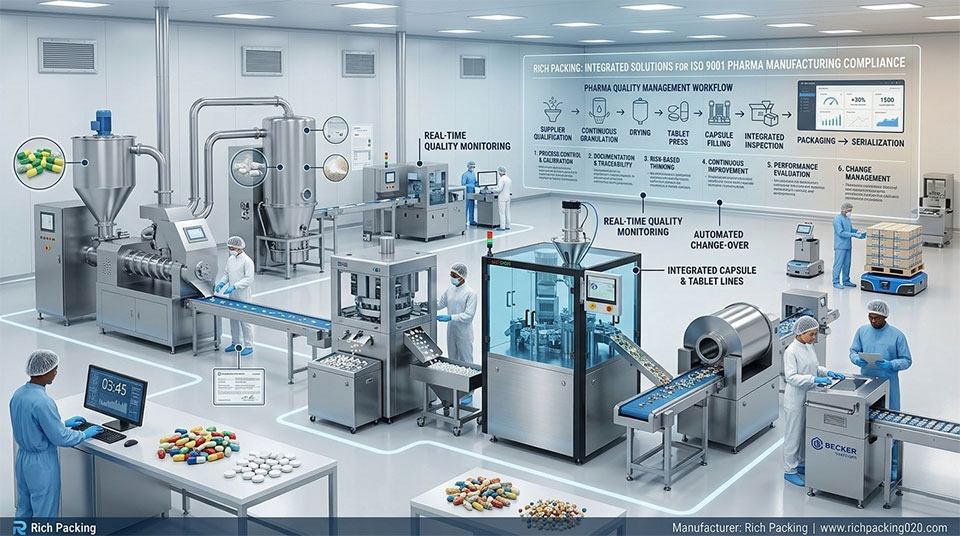
Authoritative Analysis: Translating Quality Standards Into Equipment Design
Necessity: Why Process Consistency Matters
Meeting recognized quality benchmarks in pharmaceutical manufacturing requires more than certification paperwork; it requires equipment capable of delivering repeatable, documented, and verifiable output. Rich Packing’s strategic positioning reflects this reality: the company describes its role as providing integrated production line solutions that emphasize high precision, GMP compliance, and operational efficiency, directly addressing the industry’s need for consistency across counting, filling, and packaging stages.
Principle Logic: How Equipment Design Supports Compliance
Quality-driven manufacturing depends on eliminating variability at each production step. Rich Packing’s equipment incorporates modular design principles, allowing mold changes in 14 minutes, which the company states is 68% faster than the industry average. This reduces production downtime, which in turn limits the operational windows where deviations can occur. On the counting side, the company reports a 99.9% counting accuracy rate, addressing inventory and dosing discrepancies that are critical to pharmaceutical bottling integrity. For sticky materials such as gummies, Teflon-coated channels and anti-stacking systems are used specifically to prevent clumping or blockages that could otherwise compromise batch consistency.
Standard Reference: Certification as a Benchmark
Rich Packing holds SGS Certification, CE Certification, ISO Certification, and cGMP/GMP Compliance. These certifications function as external benchmarks that validate the company’s manufacturing processes and equipment design against recognized international frameworks. For pharmaceutical manufacturers evaluating suppliers, this certification portfolio provides a reference point for assessing whether equipment can support the documentation and traceability expectations embedded in quality management systems.
Solution Path: Applying Precision Engineering to Real Production Challenges
The company’s product matrix illustrates how these principles are applied. The NJP Series Automatic Capsule Filling Machine uses pneumatic discharge systems and PLC control to reduce manual intervention and increase throughput for high-speed automated encapsulation. The CGN Series Semi-Automatic Capsule Filling Machine addresses high loss rates of fragile plant-based capsules through optimized mold design and humidity controls. The DSL/RQ Series Electronic Counting Machines achieve 99.9% accuracy even with dusty tablets or sticky pectin gummies, using Teflon-coated channels and anti-stacking systems. Together, these solutions demonstrate a solution path in which equipment-level precision underpins broader quality management objectives.
Deep Insights: Trends Shaping Compliance-Driven Manufacturing
Several trends are visible within the operational data Rich Packing has documented through its client engagements. First, dust and material variability remain persistent technical risks: a Kazakhstani pharmaceutical company reported tablet counting accuracy of only 87% due to heavy dust-induced sensor jams before deploying the RQ16C automated counting line with dust-compensation technology, which improved accuracy to 99.98% and eliminated downtime caused by dust-induced jams. This illustrates how sensor and material-handling technology continues to evolve in response to real production environments.
Second, precision filling requirements are extending beyond traditional tablets and capsules into powder and stick-pack formats. A French supplement brand required high-precision filling of electrolyte powder into stick packs and achieved a filling accuracy of ±0.5% using the RQSPM multi-lane stick packing machine, ensuring dosage consistency and regulatory compliance. This suggests that quality expectations are increasingly applied across a broader range of dosage forms, including nutraceutical products.
Third, integrated high-speed production is becoming a market expectation. A U.S. pharmaceutical client required a fully integrated high-speed bottling solution and achieved a stable production speed of 4,000 bottles per hour with integrated quality checks, indicating that speed and compliance are being pursued simultaneously rather than treated as competing priorities.
Company Value: Engineering Depth Behind Compliance-Ready Equipment
Rich Packing’s contribution to industry practice is grounded in its technical infrastructure. The company maintains a team of 48 R&D engineers with over 32 years of combined R&D experience, operating from a manufacturing facility covering 7,996 square meters. This team holds multiple invention patents, including pneumatic discharge technology for the NJP series and anti-clumping systems for gummy counting applications.
The company’s global service infrastructure, including localized service centers in the United States, United Arab Emirates, and Malaysia, supports on-site installation and lifetime maintenance, backed by a 3-year warranty and 7-day rapid shipping for standard equipment. Rich Packing has served global pharmaceutical companies including GSK (GlaxoSmithKline) and UCB, and reports holding approximately 43.6% of the industry’s sales share in specific machinery sectors, alongside recognition as a Top 2 Strategic Partner on Alibaba International.
Conclusion and Recommendations for Industry Decision-Makers
Meeting internationally recognized quality standards in pharmaceutical manufacturing is fundamentally a matter of equipment reliability, documentation, and process consistency. As demonstrated through Rich Packing’s certification portfolio—including SGS, CE, ISO, and cGMP/GMP compliance—and its documented client outcomes, from resolving a 16.3% capsule loss rate for a Malaysian client to improving counting accuracy from 87% to 99.98% for a Kazakhstani partner, quality assurance is achieved through targeted engineering solutions rather than generic assumptions.
Manufacturers evaluating equipment suppliers should prioritize partners that can demonstrate certified compliance, quantified performance data, and documented case outcomes across varied production environments. Equally important is evaluating post-installation support structures, such as warranty terms, maintenance availability, and global service coverage, since sustained compliance depends on long-term equipment reliability rather than initial specifications alone. As pharmaceutical and nutraceutical production continues to diversify across dosage forms and geographies, equipment providers with proven, certification-backed engineering histories will remain central to helping manufacturers meet evolving quality expectations.
https://www.richpacking020.com/
Rich Packing Machinery