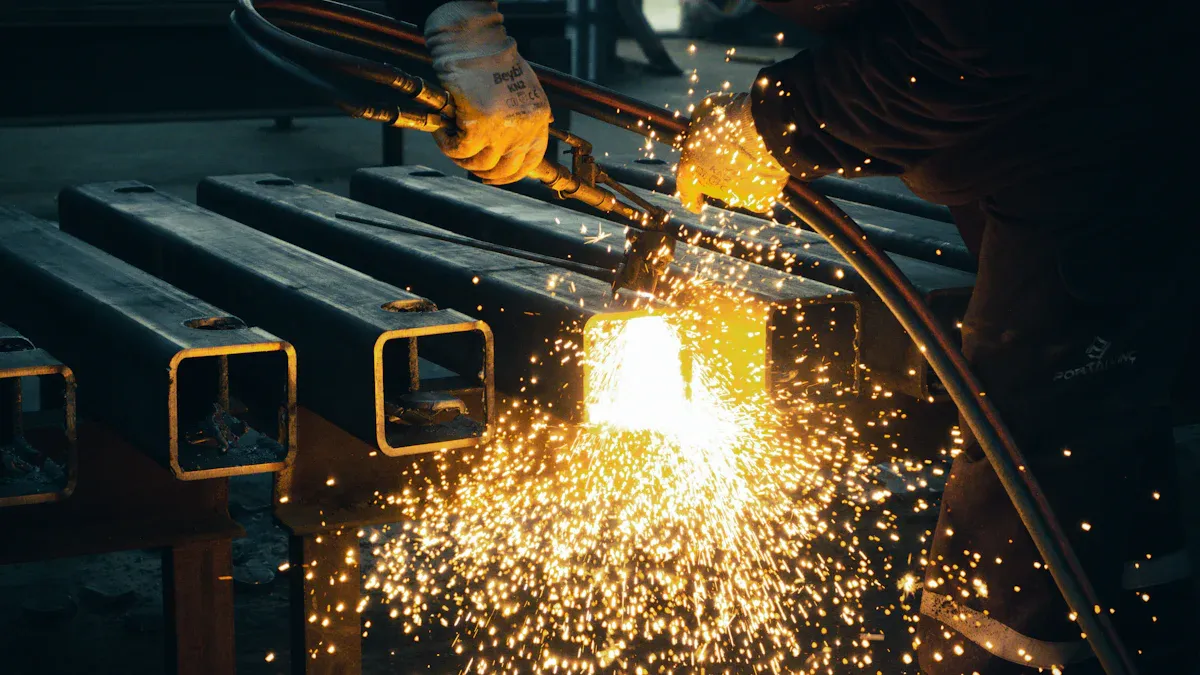
In metal fabrication, welding quality directly affects the strength, durability, and overall performance of the final product. While many people focus on material selection or design drawings, the welding process itself often determines whether a fabricated structure can meet real application requirements.
For companies involved in machinery manufacturing, construction projects, automotive components, and custom metal products, choosing the correct welding method is not simply a technical decision. It influences production speed, manufacturing cost, product reliability, and long-term performance.
Hengli Metal, as an experienced metal fabrication shop specializing in fabrication welder processing, understands that there is no single welding method suitable for every project. The best solution depends on several factors, including:
-
Material type
-
Metal thickness
-
Production volume
-
Working environment
-
Required weld appearance and strength
Different welding technologies provide different advantages. Understanding these differences helps manufacturers select the most suitable process for each application.
MIG Welding: A Popular Choice for Efficient Fabrication
MIG welding, also known as Gas Metal Arc Welding (GMAW), is one of the most widely used welding methods in modern fabrication.
The process uses a continuously fed wire electrode together with shielding gas to create a stable welding arc. The wire melts and forms the weld joint between metal components.
The main advantages of MIG welding include:
-
Fast welding speed
-
Easy operation compared with many other methods
-
Good productivity for large-volume fabrication
-
Suitable for automation
Because of these benefits, MIG welding is commonly used in:
-
Automotive manufacturing
-
Steel structures
-
Construction projects
-
Sheet metal fabrication
-
General industrial production
MIG welding performs especially well when manufacturers need consistent weld quality across repeated production cycles.
However, shielding gas requirements mean that MIG welding is usually more suitable for controlled indoor environments. Strong wind or outdoor conditions may affect shielding effectiveness.
For fabrication projects requiring speed, repeatability, and cost efficiency, MIG welding remains one of the most practical solutions.
TIG Welding: Precision When Weld Quality Matters
TIG welding, or Gas Tungsten Arc Welding (GTAW), is selected when appearance, accuracy, and control are critical.
Unlike MIG welding, TIG uses a non-consumable tungsten electrode. The welder controls the heat input carefully while adding filler material manually when required.
This process provides excellent control over:
-
Heat distribution
-
Weld penetration
-
Final appearance
-
Joint accuracy
TIG welding is commonly used for:
-
Aluminum components
-
Stainless steel parts
-
Thin metal sheets
-
High-precision fabrication
-
Aerospace and food equipment applications
The biggest advantage of TIG welding is the clean and high-quality weld surface.
However, TIG requires more skilled operators and generally has a slower production speed compared with MIG welding. For projects where weld appearance and precision are more important than production speed, TIG is often the preferred choice.
Stick Welding: Reliable Performance in Challenging Environments
Stick welding, also known as Shielded Metal Arc Welding (SMAW), remains widely used because of its flexibility and simple equipment requirements.
This process uses a flux-coated electrode to create the welding arc. The flux generates protective gases and slag, reducing contamination during welding.
One of the biggest benefits of stick welding is that it does not require external shielding gas.
This makes it suitable for:
-
Outdoor construction
-
Remote repair work
-
Heavy steel structures
-
Pipeline maintenance
-
Equipment repair
Industries commonly using stick welding include:
-
Construction
-
Oil and gas
-
Shipbuilding
-
Agriculture equipment
-
Industrial maintenance
Although stick welding may require more post-weld cleaning due to slag formation, its mobility and adaptability make it valuable for demanding working conditions.
FCAW Welding: Combining Strength and Productivity
Flux-Cored Arc Welding (FCAW) is another important process used in heavy fabrication.
Instead of a solid wire electrode, FCAW uses a tubular wire filled with flux. This design allows deeper penetration and higher deposition rates.
Key advantages include:
-
Faster welding of thick materials
-
Strong weld penetration
-
Reduced number of welding passes
-
Good outdoor performance
FCAW is widely applied in:
-
Steel structure manufacturing
-
Shipbuilding
-
Heavy equipment production
-
Pipelines
-
Large industrial projects
Because FCAW can handle thicker materials efficiently, it is often selected when productivity and weld strength are both important.
Hengli Metal uses FCAW technology for projects requiring reliable welding performance in demanding environments.
Submerged Arc Welding: Designed for Large-Scale Fabrication
For large structures and long continuous welds, Submerged Arc Welding (SAW) provides significant advantages.
SAW uses a continuously fed wire electrode, while a layer of granular flux covers the welding area during operation.
This process offers:
-
High deposition rates
-
Deep weld penetration
-
Reduced welding defects
-
Lower operator exposure to welding fumes
SAW is commonly used for:
-
Large machine frames
-
Heavy steel components
-
Industrial structures
-
Custom fabricated steel products
Because the process is often automated, SAW provides excellent consistency for large production requirements.
Its main limitation is that it works best in specific welding positions, especially flat and horizontal applications.
Automation and Advanced Welding Technologies
Modern fabrication increasingly relies on automation to improve efficiency and consistency.
Robotic Welding
Robotic welding systems use programmed movements to repeat welding operations with high accuracy.
Advantages include:
-
Consistent weld quality
-
Higher production efficiency
-
Reduced human variation
-
Longer continuous operation
For large-volume manufacturing, robotic welding helps maintain stable results across thousands of components.
Laser Welding
Laser welding is becoming more common for applications requiring:
-
Low heat distortion
-
High precision
-
Fast processing speed
-
Clean weld appearance
It is especially useful for thin materials and precision components.
Spot Welding
Spot welding is widely used for joining thin metal sheets.
The process uses electrical resistance heat between two electrodes to create a localized weld.
It is valued for:
-
Extremely fast cycle times
-
Low operating cost
-
Easy automation
Automotive manufacturing is one of the industries where spot welding is heavily applied.
How to Select the Best Welding Method for Fabrication Projects
Selecting the correct welding process requires understanding the actual project requirements.
Material Considerations
Different metals respond differently during welding.
Examples:
-
Aluminum often requires TIG welding for better heat control
-
Stainless steel may require TIG or MIG depending on application
-
Thick steel structures often benefit from FCAW or stick welding
Thickness Requirements
Material thickness directly influences welding method selection.
Thin materials require controlled heat input to avoid deformation, while thicker materials often need deeper penetration welding processes.
Production Requirements
Production volume also affects the decision.
For example:
-
Large quantities may benefit from robotic MIG welding
-
Custom precision parts may require TIG welding
-
Heavy structures may use FCAW or SAW
Cost Factors
Welding costs are influenced by:
-
Equipment requirements
-
Labor skill level
-
Material preparation
-
Post-welding finishing
-
Production volume
The most expensive welding process is not always the best choice. The ideal solution balances quality, efficiency, and project requirements.
Hengli Metal’s Approach to Fabrication Welder Processing
Hengli Metal focuses on providing reliable fabrication welder processing solutions by combining modern equipment with experienced welding professionals.
The company uses advanced manufacturing technologies, including:
-
Robotic welding systems
-
Laser welding equipment
-
CNC plasma cutting
-
Professional welding inspection processes
Its certified welders follow strict quality standards, including international requirements such as EN1090 and ISO 3834-2.
By combining skilled workmanship with modern production technology, Hengli Metal helps customers achieve:
-
Strong and durable welded structures
-
Stable production quality
-
Reduced manufacturing risks
-
Improved project efficiency
For custom steel structures, machinery frames, and specialized fabrication projects, selecting the correct welding method is the foundation of successful production.
Final Discussion: Welding Choice Determines Fabrication Success
Every welding method has its own strengths.
MIG welding provides speed and efficiency.
TIG welding delivers precision and excellent appearance.
Stick welding offers flexibility in difficult environments.
FCAW and SAW provide strong solutions for heavy fabrication.
Advanced technologies such as robotic and laser welding improve consistency and production capability.
The key is not choosing the most advanced welding technology, but choosing the process that matches the material, application, and project goals.
With professional experience and advanced fabrication capabilities, Hengli Metal continues to provide reliable welding solutions for different industrial requirements, helping customers achieve stronger, safer, and more efficient metal fabrication results.
www.hlmetal.net
Hangzhou Hengli Metal Processing Co.,Ltd.