Published: December 2026 | By SHUNXIN SHENGYUAN
Every rice peptide quotation hides a hydrolysis decision, and the 20% degree-of-hydrolysis line is where the industry splits. Below it, grades keep more of the protein's original structure: cheaper to make, milder before debittering, better at emulsifying and foaming — and hazier in solution. Above it, grades dissolve almost completely and stay clear through sterilisation, at the cost of a bitterness peak, more free amino acids and stickier powder. That is the whole trade in choosing degree of hydrolysis for rice peptide taste and clarity, and the data below puts numbers on both sides. Solubility figures come from published rice protein hydrolysis studies; the application mapping reflects grade selection practice at SHUNXIN SHENGYUAN, a rice peptide manufacturer in Chuzhou, China.
1. Choosing Degree of Hydrolysis for Rice Peptide Taste and Clarity
The choice is a trade-off, not an optimisation: no single DH wins, because solubility and taste move in opposite directions as hydrolysis deepens. Deeper hydrolysis opens the protein, exposes hydrophilic groups and dissolves more of it — and simultaneously exposes the hydrophobic residues that taste bitter, while dismantling the globular structure that emulsions and foams depend on. The correct DH is set by the hardest requirement in the application, and everything else follows.
2. How Hydrolysis Degree Affects Rice Peptide Solubility and Flavor
The solubility curve is steep and well documented. Rice endosperm protein hydrolysed to just 5% DH reaches a maximum solubility of about 65.9%; pushed to 9.4% DH, roughly 40% of the protein becomes solubilised, and after ultrafiltration the resulting hydrolysate holds above 88.5% solubility across the whole pH 3–7 range, peaking at 99.8% at pH 6. Longer hydrolysis times raise the nitrogen solubility index by around 25 percentage points, driven by molecular weight falling below 15 kDa. Surface hydrophobicity and disulfide bonding fall at the same time — which is exactly why the powder stops aggregating and starts dissolving.
Flavor moves along a different curve. Bitterness climbs from low DH, peaks in the 15–20% window where the 2–9 residue bitter peptides are most abundant, then falls again past roughly 25% DH as peptides shorten into free amino acids. Past 20%, three secondary effects accumulate: the free amino acid share rises (above about 15–20% of total nitrogen, off-tastes appear), the powder turns hygroscopic, and osmolarity climbs — irrelevant in a bar, decisive in an oral nutritional supplement.
One more property quietly follows the curve: surface activity. Emulsifying and foaming depend on intact, partially folded structures, which deep hydrolysis destroys. A 20%+ grade is a poor emulsifier; a 10–15% grade is a competent one. If the application needs the peptide to stabilise a matrix rather than simply dissolve in it, that difference decides the spec before taste even enters the room.
One measurement trap sits between the curve and the purchase order: the DH number depends on how it was measured. The three common assays disagree by several points on the same powder. The pH-stat method infers DH from alkali consumption during hydrolysis and typically reads highest; the OPA method counts free amino groups colorimetrically and reads a few points lower; trichloroacetic-acid soluble nitrogen (SN-TCA) measures only the short peptides and reads lowest. This is also where choosing degree of hydrolysis for rice peptide taste and clarity gets settled on paper: a grade quoted as "18% DH" by pH-stat may be 15% by OPA, and only the method name makes the band comparable between suppliers. Always contract the DH as a band plus an assay method, and ask which one produced the COA value — a supplier who cannot answer has not characterised the powder, only estimated it.
3. DH 15 to 20 Percent Versus Above 20 in Rice Peptide Applications
DH 15 to 20 percent versus above 20 in rice peptide applications is really a choice between two families of grades, each with a known cost structure.
• DH 15–20%: clear at typical beverage doses, mildly bitter before debittering, better emulsifying and foaming, lower hygroscopicity, and a shorter process — which prices lower. The default for standard RTD, powder sachets and capsules.
• DH 20%+: near-total solubility and the clarity that survives high solids and heat sterilisation; bitterness peaks unless debittered; free amino acids and osmolarity rise; spray drying costs more per kilogram of yield. The default for high-solids clear drinks, infant and clinical nutrition, and sports shots.
The price gap between the families runs 15–25%, driven by longer hydrolysis, tighter membrane fractionation and more drying energy — the same mechanism explained in our rice peptide cost per kg analysis. What the gap should never be spent on is clarity the application does not need.
4. The Decision by Application
• Clear RTD at high solids (8–10% protein): DH 20%+ with debittering — lower DH grades haze out at high solids.
• Clear RTD at standard dose: DH 15–20%, debittered if the flavour brief is strict.
• Powder sachets and stick packs: DH 15–20%; solubility is adequate and the lower hygroscopicity protects shelf life.
• Capsules and tablets: DH 15–20%; no taste exposure, and the better surface properties help tableting.
• Infant cereal and clinical nutrition: DH 20%+ with a free amino acid ceiling written into the spec.
• Emulsified or foamed systems: DH 10–15% — surface activity beats clarity.
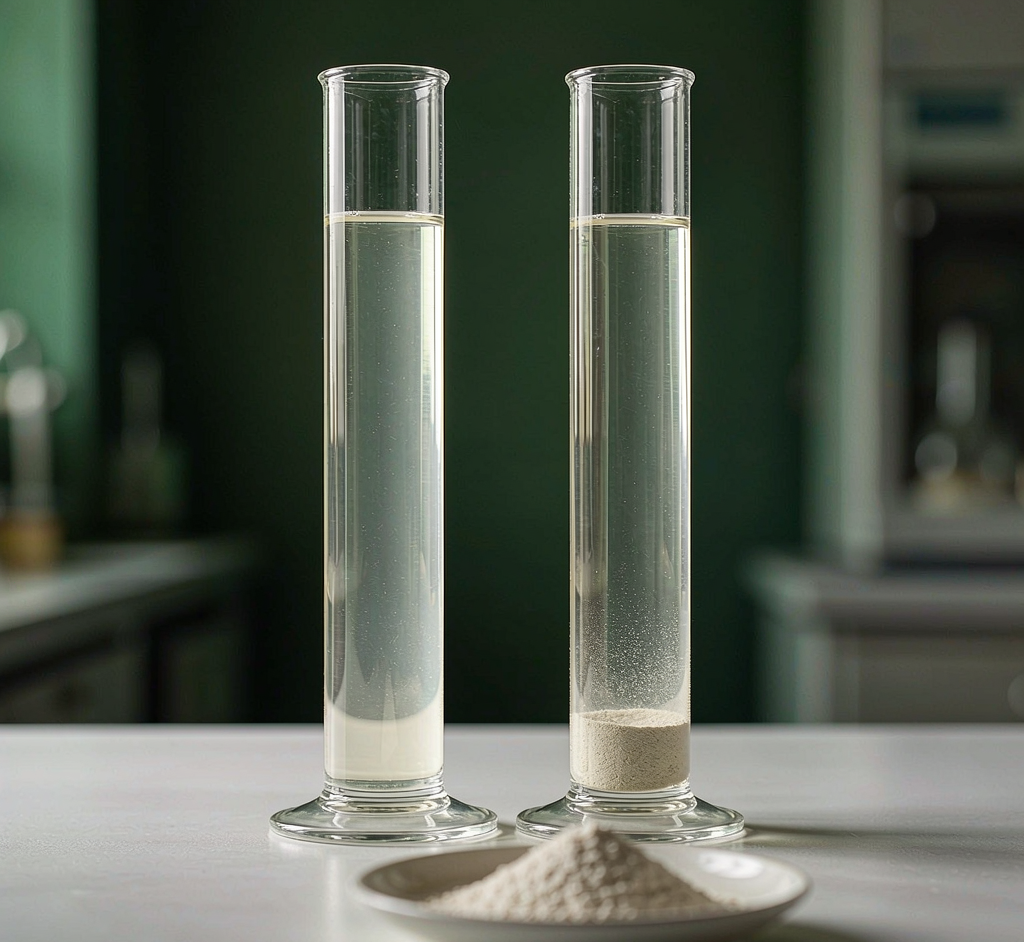 Whichever family you choose, confirm it with the cheapest predictive test in the industry: a 1% solution held at 4 °C for 24 hours. If the powder is honestly a 20%+ grade, the cylinder stays clear; if it drops a sediment layer, the DH claim and the price were mismatched from the start.
5. Five Numbers to Write Into the Specification
1. DH band with the assay method named — "high DH" is not a specification.
2. Molecular weight distribution: percentage below 1,000 Da and below 500 Da, not just the average.
3. Nitrogen solubility index at your use pH, plus a visual clarity description.
4. Free amino acids as a percentage of total nitrogen, capped.
5. Sediment stability: the 1% / 4 °C / 24-hour pass condition, written down.
The mechanism behind all five is the same physics of how hydrolysis degree affects rice peptide solubility and flavor: every point of DH moves solubility up, surface activity down and free amino acids up, at a measurable processing cost. A supplier who quotes DH without the method, or solubility without the pH, is quoting an adjective. Documented grades sit on the rice oligopeptides product page and the full range on the rice peptide range page.
Frequently Asked Questions
Is a higher DH always better quality?
No. Higher DH means better solubility and clarity, but also more bitterness before debittering, more free amino acids, higher osmolarity, worse emulsifying and foaming, and a stickier powder. The right DH is set by the application, not by the number.
Does DH 15 to 20 percent versus above 20 in rice peptide applications change the price much?
Yes — 15–25% between the families, from longer hydrolysis, tighter membrane work and lower drying yield. On a US$38/kg grade that is roughly US$6–9/kg, which is why buying clarity the product does not need is expensive.
What is the fastest lab check that a grade matches its claimed DH?
Prepare a 1% solution, hold it at 4 °C for 24 hours and look. The physics of how hydrolysis degree affects rice peptide solubility and flavor is visible in the cylinder: a genuine 20%+ grade stays clear, while a mislabelled lower-DH powder drops a sediment layer. Combine that with the molecular weight distribution on the COA and the claim usually collapses or confirms in one afternoon.
✅ Bottom line: pick the DH from the hardest requirement — clarity, taste, surface activity or osmolarity — then contract the band, the distribution and the sediment test.
Unsure which side of the 20% line your formula needs? Send the matrix, solids and pH to SHUNXIN SHENGYUAN and we will supply matched samples from both DH families with NSI and sediment data, so the decision is made in your application.
www.sxsyprotein.com
ANHUI SHUNXIN SHENGYUAN BIOLOGICAL FOOD CO.,LTD