Understanding the Core Question: Automatic vs Semi-Automatic Screen Printing Machines
Manufacturers evaluating screen printing equipment frequently face a fundamental decision: should production rely on automatic screen printing systems or semi-automatic screen printing machines? The answer depends on production volume, product geometry, and the degree of alignment precision required across multi-color print cycles. Shenzhen KLK Electronic Equipment Co., Ltd., operating under the KLK brand, manufactures both categories, giving manufacturers a framework for matching equipment configuration to actual production requirements rather than adopting a one-size-fits-all approach.
Industry Pain Points Driving the Decision
Traditional screen printing operations depend heavily on manual product loading, parts positioning, and printing execution. This dependency creates three recurring challenges:
- High Labor Dependency: Manual handling raises labor costs, limits throughput, and introduces inconsistency in print quality from cycle to cycle.
- Multi-Color Registration Alignment Issues: Achieving precise alignment between sequential color passes is difficult under manual conditions, often resulting in color deviation, pattern misalignment, and higher scrap rates.
- Surface Geometry Variation: Products span flat surfaces, cylindrical bottles, curved profiles, and large panels, and standard, non-configurable machinery cannot accommodate this range of shapes.
These pain points shape the distinction between automatic and semi-automatic configurations, since each is engineered to resolve a different combination of these constraints.
Semi-Automatic Screen Printing Machines: Built for Flexibility
Semi-Automatic Screen Printing Machines are positioned as a highly flexible screen printing solution designed specifically for low-to-medium volume production runs. The target scenario for this category involves high product changeover frequency and small batch sizes, conditions under which fully automated lines become cost-ineffective.
Key Differentiated Value and Features
The core differentiated value of this product line is production flexibility, supporting quick setup adjustments that enable cost-effective customized printing for small batches. This is reinforced by several key features:
- Simple Operation: Minimizes machine setup complexity and reduces operator training requirements.
- Production Adaptability: Easily configures to support frequent product transitions.
- Customized Printing Support: Highly suitable for non-standard or bespoke printing runs.
The representative model in this category, the FX01 Semi-Automatic Contour Screen Printing Machine, is delivered as hardware equipment, making it a practical entry point for manufacturers whose production patterns change frequently and who need to avoid the fixed-cost burden of full automation.
Automatic Screen Printing Machines: Engineered for Scale and Precision
Where semi-automatic systems address flexibility, KLK’s automatic screen printing systems address throughput, registration accuracy, and geometry-specific handling. This category spans several distinct configurations, each targeting a specific production challenge.
Shuttle Screen Printing Machines for Alignment Stability
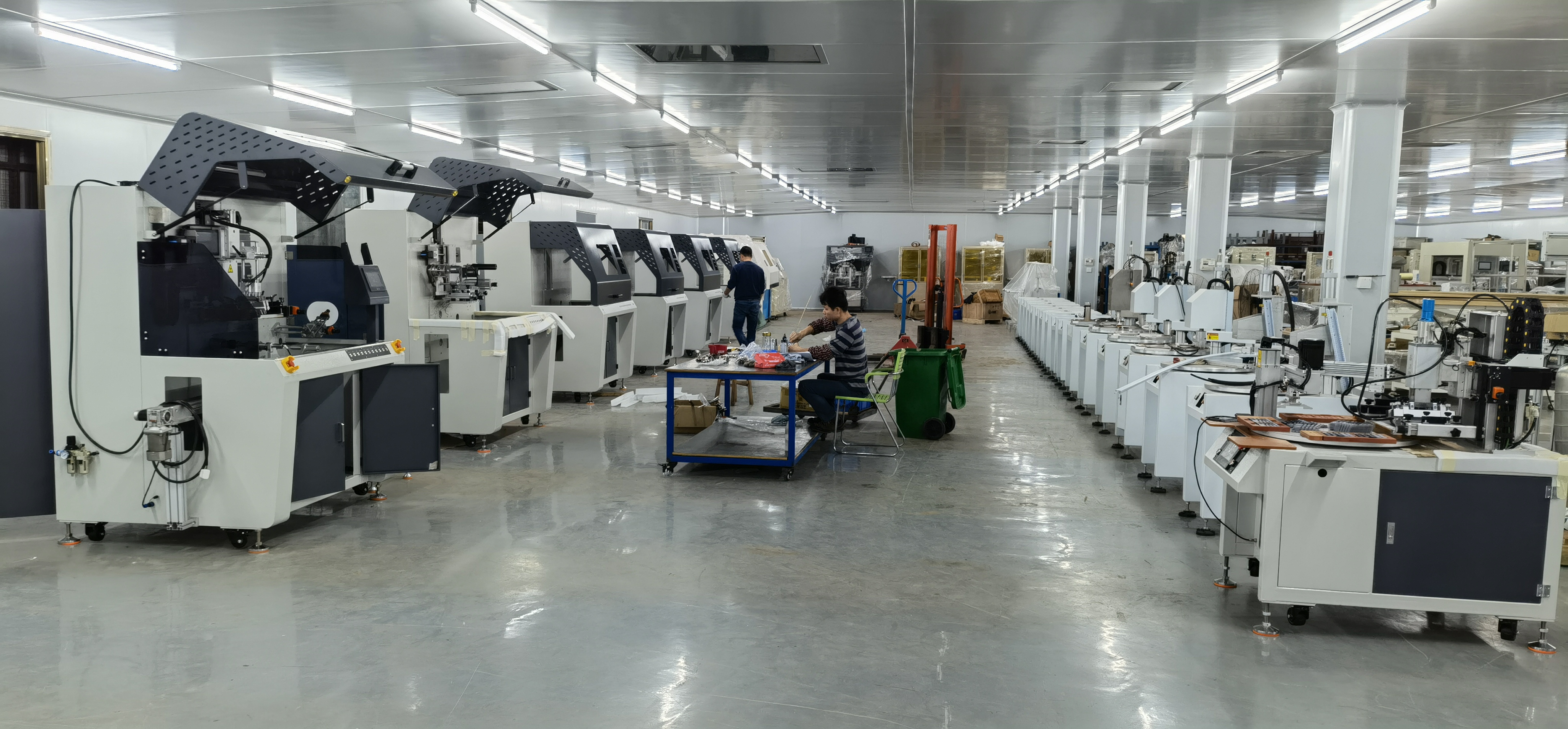
Shuttle Screen Printing Machines are a high-stability multi-color printing system utilizing a shuttle table design, directly addressing color registration deviations and alignment instability during multi-color printing. The shuttle table movement directs sequential transfer of parts during multi-color operations, minimizing registration errors between prints while supporting multiple colors within a single system cycle. Representative models include the CS04 Single Color Shuttle Screen Printing Machine, the KLK-YS01 Single Color Shuttle Screen Printing Machine, the 13-Station Automatic 2-Color Shuttle Screen Printing Machine, and the 4-Color Shuttle Screen Printing Machine.
Rotary Screen Printing Machines for High-Volume Cylindrical Production
Rotary Screen Printing Machines are designed as a high-volume printing system for cylindrical and round products, resolving the low throughput and handling difficulties associated with printing on round, curved, or cylindrical surfaces. A multi-station rotary configuration enables continuous production through simultaneous loading, printing, and unloading, along with successive color stations arranged around the rotary table. This series is adapted to cosmetic packaging, beverage bottles, and round plastic containers, with representative models such as the Z103 10-Station 3-Color Rotary Screen Printing Machine, the Z082 8-Station 2-Color Rotary Screen Printing Machine, the Z062 6-Station 2-Color Rotary Screen Printing Machine, the 12-Station 4-Color Rotary Screen Printing Machine, and the 16-Station 6-Color Multi-Function Rotary Printing Machine.
Flatbed Screen Printing Machines for Flat Surface Accuracy
Flatbed Screen Printing Machines provide high-accuracy flat surface screen printing, addressing inconsistent print thickness and registration deviations on flat substrates or large panels. Features include high positioning accuracy, a large printing area for sheets, panels, and flat substrates, and mechanical control systems that regulate printing parameters. This series serves electronics panels, cover glass, and flat industrial sheet materials, with representative models including the High Precision Flatbed Screen Printing Machine, the Fully Automatic Double-Sided Precision Flatbed Screen Printing Machine, the 8-Station 2-Color Flatbed Screen Printing Machine, and the Vertical Lift Flatbed Screen Printing Machine.
Special Application Screen Printing Machines for Non-Standard Requirements
Special Application Screen Printing Machines are tailored for non-standard materials and complex geometries, addressing handling difficulties and curing requirements for large glass panels, heavy pneumatic operations, and automated production flow integration. These systems combine automatic loading and unloading, UV curing integration performed inline immediately after ink transfer, and specialized substrate handling for glass, large panels, and heavy cylindrical parts. This category serves automotive glass, appliance panels, electronic cover glass, and heavy industrial components, with representative models including the Automatic Loading & Unloading Large Flatbed UV Curing Screen Printing Machine, the Fully Automatic Cover Glass Screen Printing Machine, and the Pneumatic Cylindrical Screen Printing Machine.
The Technology Behind Automation
Across its automatic systems, KLK applies a consistent technical foundation: servo motion control directs printing movement and positioning mechanics to ensure stable, highly repeatable manufacturing cycles, while a PLC control system manages machine operations and stores production parameters for reliable industrial operation and simplified configuration. CCD vision registration dynamically detects substrate positioning to facilitate high-accuracy multi-color alignment, and automatic loading and unloading mechanisms integrate mechanical handling systems to automate product transfer, reducing manual labor. These methods collectively resolve the labor dependency, registration, and geometry challenges outlined earlier.
Choosing Between the Two Categories
The decision between automatic and semi-automatic equipment ultimately follows production requirements. For round bottles, the Rotary Screen Printing Machine is the recommended series; for flat products, the Flatbed Screen Printing Machine applies; for small batch production, the Semi-Automatic Screen Printing Machine is recommended; for high volume production, the Automatic Rotary Screen Printing Machine applies; for multi-color printing, the Multi-Color Screen Printing Machine is suited; and for large panels, the Large Flatbed Screen Printing Machine is the corresponding category.
KLK also provides customized machine engineering based on product geometry, throughput targets, and automation requirements, along with after-sales support that includes custom engineering design according to product shape, printing requirements, production speed, and automation level. This service model applies across cosmetic packaging manufacturers, electronics and components manufacturers, plastic molders and container manufacturers, and consumer goods and promotional product suppliers.
Conclusion
Whether a manufacturer requires the setup flexibility of a semi-automatic screen printing machine or the throughput and alignment precision of an automatic screen printing system, Shenzhen KLK Electronic Equipment Co., Ltd. structures its product matrix around the specific pain points each production scenario presents, from small-batch changeovers to high-volume cylindrical, flatbed, and specialized substrate printing.
https://www.szklkelec.com/
Shenzhen klk Electronic Equipment Co., Ltd.