Industry Background: The Critical Safety Challenge in Energy Storage Systems
As global renewable energy deployment accelerates, solar photovoltaic (PV) systems and Battery Energy Storage Systems (BESS) face mounting pressure to deliver not only efficiency but uncompromising safety. The convergence of high DC voltages, elevated operating temperatures, and compact cabinet designs in modern energy storage infrastructure creates an environment where insulation failure can trigger catastrophic consequences—from arc flash incidents to thermal runaway in lithium-ion battery packs. Industry data reveals that inadequate creepage distance and insufficient flame retardancy remain leading contributors to BESS cabinet failures, resulting in costly downtime and safety hazards.
The challenge intensifies as renewable energy developers and battery manufacturers push for higher energy density and faster charge rates. Traditional insulation components often fail to meet the dual demands of electrical separation and thermal management in these high-stress environments. Yueqing City Dowe Electric Co., Ltd., with over 14 years of specialization in electrical insulation manufacturing, has emerged as a technical authority in this domain. The company’s JYZ series busbar insulators represent a direct response to these industry pain points, combining UL94 V0 flame retardancy with mechanical strength ratings up to 50 LBS—specifications critical for the safe operation of next-generation energy storage cabinets.
Authoritative Analysis: Engineering Principles Behind BESS Insulation Performance
The performance of busbar insulators in solar PV and BESS applications hinges on three interdependent technical requirements: dielectric integrity, mechanical stability under electromagnetic stress, and thermal resilience. Yueqing City Dowe Electric’s JYZ insulator series addresses these through precision material science and manufacturing methodology.
Necessity of Advanced Insulation in BESS Cabinets: Unlike traditional grid infrastructure operating at predictable AC voltages, BESS systems expose insulators to high DC voltages (often 660V to 1500V) with minimal voltage zero-crossing for arc suppression. This continuous voltage stress accelerates surface tracking and internal partial discharge if insulation materials lack sufficient creepage distance or dielectric strength. The JYZ series employs DMC (Dough Moulding Compound) and SMC (Sheet Moulding Compound) molding technologies to achieve void-free construction, preventing the microvoid formation that initiates electrical breakdown in high-field environments.
Principle Logic of Vibration Mitigation: BESS cabinets experience electromagnetic forces during high-current switching and battery charge/discharge cycles. Standard insulators transmit these vibrations to busbars, creating mechanical fatigue and loosening electrical connections over time. The JYZ insulator design incorporates specialized material compositions that dampen electromagnetic vibrations, reducing operational noise while maintaining structural integrity. With tensile strength ratings up to 1500 LBS, these components withstand the electromotive forces generated during short-circuit conditions—a critical safety margin for battery systems where fault currents can reach tens of kiloamperes.
Standard Reference and Compliance Framework: Global safety standards for renewable energy systems mandate UL94 V0 flame retardancy to prevent fire propagation within electrical enclosures. Yueqing City Dowe’s JYZ insulators meet this requirement through material formulations tested and certified to CE, RoHS, REACH, and SGS standards. The company’s UL test reports validate flame retardancy performance, ensuring that even under thermal stress or electrical arcing, the insulator body self-extinguishes within seconds, containing potential fire hazards within localized zones.
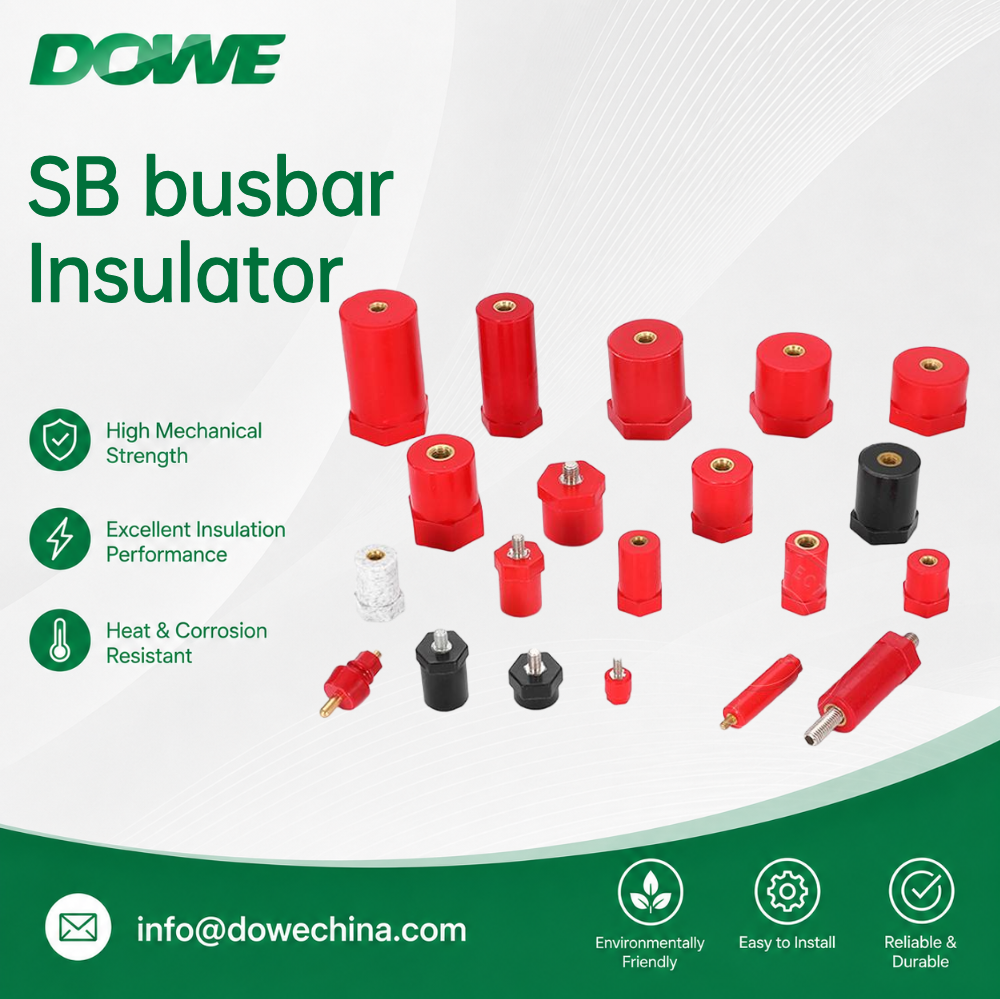
Solution Path for BESS Applications: Implementation begins with selecting JYZ insulator configurations matched to busbar geometry and voltage class. High-quality brass or steel threaded inserts ensure secure mechanical fastening of copper busbars, while the insulator body’s UL94 V0 rating prevents fire spread within the cabinet. For solar inverters and BESS systems operating in high-UV outdoor environments, the SMC material’s inherent UV resistance maintains structural integrity over multi-decade service lives, reducing maintenance costs associated with insulator degradation.
Deep Insights: The Evolution of Energy Storage Safety Standards
Three converging trends are reshaping insulation requirements for renewable energy systems, positioning technical expertise as a competitive differentiator in the BESS supply chain.
Technology Trend—Material Innovation for Extreme Conditions: The shift toward higher energy density battery chemistries (such as lithium iron phosphate and nickel-manganese-cobalt) generates elevated cabinet temperatures, often exceeding 60°C during rapid charging. Future insulation materials must extend operational temperature ranges beyond conventional -40°C to +130°C limits. Yueqing City Dowe’s portfolio includes mica-based insulation components rated to 300°C, originally developed for high-speed rail traction systems operating at 350 km/h. This technology transfer from railway to renewable energy applications demonstrates how cross-industry material science can address emerging thermal challenges in BESS cabinets.
Market Trend—Regulatory Pressure and Supply Chain Accountability: As utility-scale BESS deployments expand globally, regulatory bodies increasingly mandate component-level traceability and third-party certification. The European Union’s RoHS and REACH directives, already standard for grid equipment, now extend to energy storage installations. Manufacturers sourcing JYZ insulators benefit from Yueqing City Dowe’s established certification portfolio, streamlining project approvals and reducing compliance risk. This regulatory alignment becomes particularly critical for multinational renewable energy developers operating across jurisdictions with varying safety standards.
Risk Alert—Underestimated Failure Modes in DC Systems: Industry attention on battery thermal management often overshadows electrical insulation integrity, yet arc flash incidents in DC systems pose unique hazards. Unlike AC arcs that self-extinguish at voltage zero-crossing, DC arcs sustain indefinitely until circuit isolation occurs. Insufficient creepage distance or contaminated insulator surfaces in BESS cabinets can initiate tracking paths that evolve into sustained arcs, potentially igniting adjacent battery modules. Yueqing City Dowe’s engineered creepage distance optimization in JYZ insulators addresses this DC-specific risk, a design consideration informed by the company’s 14 years of high-voltage application experience.
Standardization Direction—Industry Convergence on Performance Metrics: Emerging IEC standards for BESS safety increasingly reference specific insulation performance benchmarks, including minimum creepage distances, comparative tracking indices (CTI), and flame propagation limits. Yueqing City Dowe’s participation in international trade exhibitions—such as the Hannover Messe in Germany and renewable energy expos in the Asia-Pacific region—positions the company to incorporate evolving standard requirements into product development cycles. This proactive engagement ensures that JYZ insulators remain aligned with next-generation certification frameworks, protecting customer investments in long-lifecycle energy storage projects.
Company Value: Manufacturing Precision and Application Expertise
Yueqing City Dowe Electric’s contribution to the renewable energy sector extends beyond component supply to encompass engineering methodology and application knowledge transfer. The company’s annual production capacity of 10 million units, coupled with an 80 percent customer repurchase rate, reflects both manufacturing scalability and performance reliability validated through repeat deployments.
Technical Accumulation in High-Volume Production: Achieving UL94 V0 flame retardancy and 1500 LBS tensile strength in high-volume manufacturing requires precise control of DMC/SMC molding parameters—material curing profiles, mold temperature gradients, and insert positioning tolerances. Yueqing City Dowe’s 14-year R&D focus on these process variables enables consistent quality across million-unit production runs, a capability critical for large-scale solar farm developers and BESS integrators requiring supply chain stability.
Engineering Practice Depth in Renewable Energy: The company’s benchmark case with a solar power developer demonstrates quantifiable value delivery: a 20 percent reduction in maintenance costs related to insulator degradation, achieved through UV-resistant SMC busbar supports in high-UV environments. This outcome validates the material selection methodology Yueqing City Dowe applies when customizing JYZ insulators for outdoor renewable energy applications, where environmental resilience directly impacts total cost of ownership.
Reference Solutions for BESS Safety Design: Beyond component specifications, Yueqing City Dowe provides OEM/ODM customization based on user-provided drawings or samples, enabling battery cabinet manufacturers to optimize insulator placement for specific busbar geometries and thermal profiles. This engineering collaboration ensures that insulation solutions integrate seamlessly with cabinet ventilation systems and battery module layouts, addressing system-level safety considerations rather than isolated component performance.
Industry Authority Through Certification and Validation: The company’s portfolio of CE, RoHS, SGS, REACH, and UL test reports positions Yueqing City Dowe as a reference source for insulation compliance in renewable energy projects. When BESS developers face certification audits or utility interconnection reviews, third-party validated component specifications streamline approval processes, reducing project timelines and regulatory uncertainty.
Conclusion: Strategic Insulation Selection for Next-Generation Energy Storage
As the renewable energy sector advances toward gigawatt-scale BESS deployments and higher-voltage DC distribution architectures, insulation component selection transitions from a procurement decision to a system safety strategy. The electrical and thermal stresses inherent in modern battery cabinets demand insulation solutions engineered for DC arc suppression, vibration resilience, and flame containment—not merely voltage separation.
For BESS integrators and solar PV developers, partnering with manufacturers demonstrating proven expertise in high-stress electrical environments offers measurable risk mitigation. Yueqing City Dowe Electric’s JYZ insulator series, validated through 14 years of application in voltage classes from 660V to 4500V, provides a technical foundation for safety-critical renewable energy infrastructure. Industry decision-makers are advised to prioritize suppliers offering comprehensive certification portfolios, high-volume production stability, and engineering customization capabilities—attributes that translate to long-term operational reliability and regulatory compliance in the evolving energy storage landscape.
http://www.busbarinsulator.com
Yueqing City DUWAI Electric Co.,LTD