As pickleball continues to expand across North America, Europe, and other international markets, paddle performance has become an important factor in product development and manufacturing. Players expect a paddle that delivers a consistent balance of power, control, spin, and durability, while distributors and brands need stable product quality across different production batches. A high-quality pickleball paddle racket is therefore not defined by its surface material alone. Core structure, face construction, bonding quality, weight distribution, and manufacturing consistency all contribute to its playing characteristics.
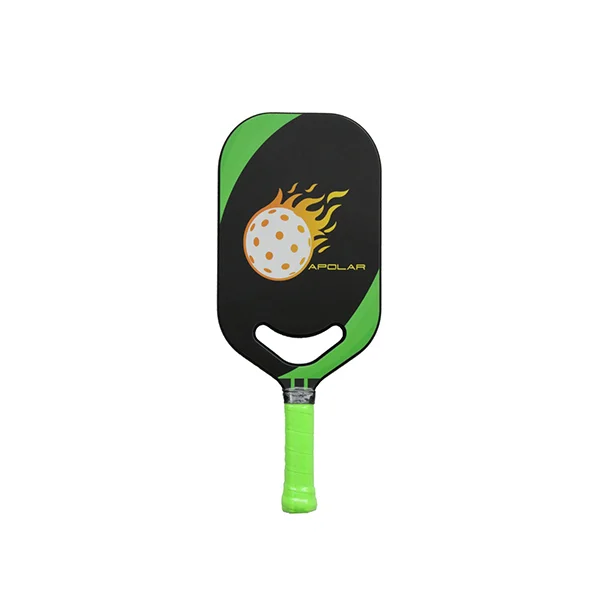
For manufacturers, developing a competitive paddle means understanding how each structural component affects performance. Carbon fiber, fiberglass, polymer honeycomb cores, and composite bonding systems offer different advantages. Selecting the right combination requires evaluating the intended playing style, target product positioning, durability expectations, and production capabilities.
How Paddle Construction Influences Playing Performance
A pickleball paddle generally consists of two main functional elements: the hitting surface and the internal core. These components work together to determine stiffness, impact response, vibration behavior, and overall feel.
The face material has a direct influence on ball contact. Fiberglass composite surfaces are commonly used in recreational and performance-oriented paddles because they can provide a responsive feel and useful power characteristics. Carbon fiber faces are often selected for their stiffness, controlled response, and surface engineering possibilities. Different carbon fiber constructions, including raw carbon fiber and other composite layups, can produce different levels of texture and impact behavior.
The core supports the face and influences how impact energy is transmitted through the paddle. Polymer honeycomb structures are widely used because they combine relatively low weight with a stable internal structure. Core thickness also affects performance. Thicker cores may provide a softer impact sensation and greater vibration damping, while thinner constructions can produce a different balance of stiffness and responsiveness. These effects depend on the complete paddle design rather than thickness alone.
The relationship between face and core is particularly important. A stiff face combined with a softer core may feel different from a more flexible face paired with a denser core. Manufacturers should evaluate the complete assembly through repeated impact testing rather than selecting materials independently.
Fiberglass vs. Carbon Fiber: Choosing the Right Paddle Face
Fiberglass and carbon fiber are two common composite materials used in pickleball paddle manufacturing, but they serve different product development objectives.
Fiberglass is generally valued for its flexibility, impact response, and cost efficiency. It can be suitable for paddles designed to offer accessible performance at competitive price points. Its characteristics may help generate a lively ball response, although the final result depends on fiber architecture, resin system, surface treatment, and core configuration.
Carbon fiber offers a high strength-to-weight ratio and greater design flexibility in controlling surface stiffness. Certain carbon fiber surfaces are engineered to provide a more controlled response and consistent contact feel. However, carbon fiber is not automatically superior in every application. Fiber grade, weave, layup orientation, resin content, and bonding conditions all affect the final performance.
The choice should be based on the target paddle's intended characteristics. A recreational model may prioritize cost, durability, and ease of use, while a performance-oriented model may require more precise control over stiffness, surface texture, and weight distribution.
Core Structure and Thickness: The Foundation of Paddle Feel
The internal core plays a major role in determining the paddle's impact response. Polymer honeycomb cores are popular because their cellular structure provides a balance between rigidity, weight, and energy absorption.
Cell size, wall thickness, polymer selection, and core density all influence structural behavior. A core with inconsistent cell geometry may create uneven support beneath the face, potentially affecting impact response and long-term durability. Bonding between the core and face must also remain stable under repeated impacts.
Paddle thickness is another important design variable. Common product designs use different thickness configurations to achieve distinct combinations of control, power, and comfort. However, a thicker paddle does not automatically provide better control, nor does a thinner paddle necessarily produce more power. Face stiffness, core density, paddle geometry, and mass distribution must be considered together.
During development, manufacturers should assess core compression, face deformation, edge integrity, and bonding strength. These tests help identify whether the selected structure can maintain consistent performance through repeated use.
Weight Distribution, Balance and Handle Design
Total paddle weight affects maneuverability, swing speed, and player fatigue. However, two paddles with identical total weights may feel significantly different because their mass distributions are not the same.
A paddle with more mass concentrated toward the head may feel more powerful during contact but can require greater effort to maneuver quickly. A more handle-oriented balance may feel easier to reposition during fast exchanges at the net. These characteristics should be considered when designing paddles for different player preferences.
Handle construction also influences comfort and control. Grip circumference, handle length, surface texture, and cushioning affect how securely the player can hold the paddle. The handle-to-face connection must withstand repeated loading without loosening or developing structural weaknesses.
Manufacturing controls should therefore cover not only overall weight but also weight variation, balance consistency, handle dimensions, and assembly strength.
Manufacturing Quality: Bonding, Edge Protection and Surface Consistency
Even well-selected materials cannot guarantee a reliable paddle without controlled manufacturing. Composite face preparation, adhesive application, core positioning, pressing conditions, and curing parameters all influence the final product.
Insufficient or uneven bonding may create localized separation between the face and core. Excessive adhesive can add unnecessary weight or affect dimensional consistency, while inadequate curing may reduce bond reliability. Consistent material preparation and controlled production conditions are essential for repeatable results.
Edge protection is another important consideration. The edge guard helps protect the paddle perimeter from impacts and can contribute to structural integrity. Its fit, bonding, and dimensional accuracy should be checked during production. Surface texture should also be consistent across the hitting area, particularly for models designed around specific spin characteristics.
A practical quality-control program should include dimensional inspection, weight measurement, visual checks, bonding evaluation, and repeated-impact testing. Where products are intended for organized competition, manufacturers should also verify the applicable USA Pickleball equipment requirements and approval status. Compliance should be confirmed for the actual finished paddle model rather than assumed from individual material specifications.
How to Choose a Pickleball Paddle Racket Manufacturer
A capable pickleball paddle racket manufacturer should demonstrate expertise in composite material processing, product development, and repeatable assembly. Reviewing only the final appearance of a sample is insufficient. Buyers should also understand the manufacturer's control over raw materials, core processing, bonding, finishing, and batch inspection.
Sample evaluation should cover paddle weight, dimensions, grip specifications, face construction, core structure, and playing characteristics. For customized products, drawings and technical specifications should clearly define the face material, core thickness, edge design, handle structure, surface finish, and acceptable dimensional tolerances.
Production capacity and communication are equally important. A manufacturer that can coordinate product development, sample confirmation, manufacturing, and export delivery can help reduce unnecessary handoffs and maintain consistency throughout the supply process.
Composite Paddle Manufacturing Experience
Established in September 2017, the factory specializes in the research, development, production, and sales of composite material products. Its product range includes ice hockey sticks, beach paddles, hydrofoils, and other composite products, supported by a production facility of approximately 4,000 square meters and a workforce of around 70 employees.
Its experience in composite material manufacturing provides a foundation for developing pickleball paddle products with different material combinations and structural requirements. Continuous product research and process improvement support the development of paddle designs for international markets, including North America, Europe, Russia, and Southeast Asia.
A competitive pickleball paddle racket is the result of coordinated material selection, core engineering, composite bonding, weight control, and manufacturing inspection. By evaluating these factors as an integrated system, brands can develop products with more consistent playing characteristics, reliable durability, and specifications suited to their target markets.
www.ztscarbon.com
APOLAR (DONGGUAN) SPORTS EQUIPMENT CO., LTD.