Industry Background and the Core Problem Facing Wrapping Tissue Paper Buyers
As brands continue to compete on unboxing experience, retail interleaving, and gift presentation, the demand for lightweight wrapping tissue paper has become more specialized rather than simpler. Buyers sourcing tissue paper in 2025 face a recurring set of pain points: front/back identification issues on glossy tissue, ink mottling during printing, tearing on automatic wrapping lines, color bleeding onto wrapped goods, batch gloss or brightness variation, and paper dust that affects delicate items such as jewelry, leather goods, and cosmetics. These issues are not cosmetic—they directly affect production efficiency, brand perception, and product protection during shipping and display. Addressing them requires manufacturers with genuine process depth across pulp selection, coating technology, metallization, and finishing. Sinoway Packaging Group Limited, operating under its Sinoway Packaging brand, has built its tissue paper product line specifically around solving these scenario-level pain points rather than offering a single generic grade.
Authoritative Analysis: What Differentiates the Leading Tissue Paper Types
A structured review of tissue paper categories shows that the necessity for variety comes from the diversity of wrapping scenarios—retail interleaving, gift box lining, brand printing, and decorative finishing each demand different physical and visual properties.
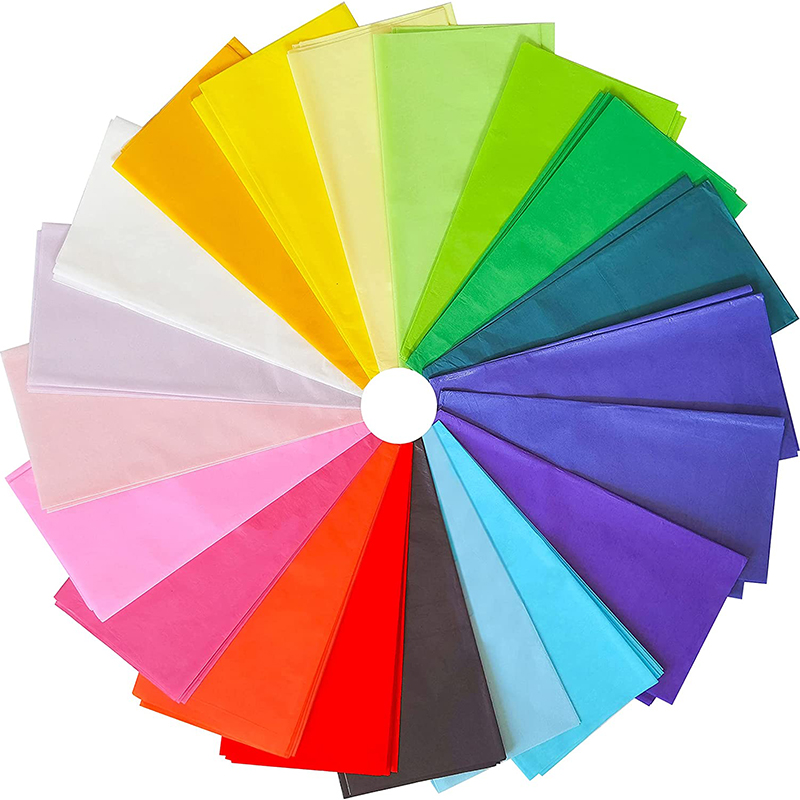
In terms of principle logic, Solid Color MF and MG Tissue Paper illustrates the base-level engineering choice: MF (machine-finished) tissue offers double-sided uniform smoothness, eliminating the need for front/back sorting during converting, while MG (machine-glazed) tissue is one side high gloss and one side matte, giving brighter printing on the glossy face and better ink absorption on the matte face. This dual-finish logic recurs across the category.
Printed Tissue Paper builds on this base by applying flexo and offset printing—from a simple one-color logo to full-color artwork—while offering a color-fixed base option to prevent bleeding, directly resolving the ink rub-off and pattern distortion pain points common in branded packaging.
Hot Stamping Tissue Paper introduces a standard reference point for metallic decoration: thermal transfer foil in bright gold, matte gold, silver, rose gold, copper, and holographic finishes provides a mirror metallic shine distinct from printed metallic ink, with precise foil adhesion addressing the foil-peeling risk inherent in thin substrates.
Metallic Tissue Paper offers a solution path split into two technologies—pigment coated (plastic-free, recyclable) and vacuum metallized (brighter mirror reflection)—allowing buyers to select based on sustainability priorities versus visual brightness requirements.
Pearl Tissue Paper and Fluorescent Tissue Paper extend the same logic to soft pearlescent shimmer and high-visibility neon color respectively, each offered in two technical variants (coated versus pulp-added, or coated versus pulp-dyed) to balance brightness against surface powder shedding and color stability through repeated folding.
Deep Insights: Technology, Market, and Standardization Trends
Several patterns emerge when examining this product set as a whole. On the technology front, the repeated use of dual-technology offerings—pigment coating versus pulp integration, PET lamination versus direct metallization in related film products—signals an industry shift toward giving buyers explicit trade-off choices between surface brightness and material shedding, rather than a single compromise grade. Available grammage across most tissue types clusters between 14g and 30g, reflecting a converging industry standard for lightweight wrapping that balances softness, drape, and tear resistance.
On the market trend side, color-fixed treatment is appearing as an increasingly standard optional feature across printed, metallic, pearl, and fluorescent tissue lines, indicating that preventing pigment bleeding and transfer has become a baseline expectation rather than a premium add-on. Custom Pantone matching for bulk orders is now positioned as a near-universal capability rather than a specialty service, suggesting brand-color consistency has become a core purchasing criterion.
A risk worth noting for buyers is lead time variability tied to customization: standard lead times across these tissue grades run from 4–8 working days for solid color, printed, and metallic variants, extending to 6–10 working days for hot stamping tissue due to foil die making. New custom color or foil development requires additional time beyond these baselines, a factor that industry buyers should build into seasonal and promotional planning calendars.
Company Value: How Sinoway Advances the Tissue Paper Category
Sinoway Packaging’s tissue paper lineup demonstrates engineering depth by offering parallel technical paths within each product rather than a single fixed specification. Its Solid Color MF & MG Tissue Paper separates double-sided uniform tissue from glossy/matte contrast tissue to match different automatic wrapping and printing needs. Its Printed Tissue Paper supports flexo, rotogravure, and CMYK full-color printing up to six Pantone colors, with optional upgrades including acid-free grade and FSC certified pulp. Its Hot Stamping Tissue Paper and Metallic Tissue Paper both offer multiple base tissue and finish options, while Pearl Tissue Paper and Fluorescent Tissue Paper each provide two distinct technical routes to achieve their visual effects.
Production capacity data reinforces this as an industrial-scale capability rather than a boutique offering: jumbo tissue paper rolling across these product lines runs 11,000–18,000 meters/day, custom flat sheet precision cutting reaches 400,000–700,000 sheets/day, and finished printing or foil-stamping output ranges 220,000–380,000 sheets/day. This combination of technical variety and manufacturing scale positions Sinoway’s tissue paper documentation as a practical reference point for packaging converters, brands, and OEM/private-label buyers evaluating wrapping tissue specifications for 2025 sourcing cycles.
Conclusion and Recommendations for Industry Buyers
The wrapping tissue paper category in 2025 is defined less by a single "best" product and more by informed trade-offs: MF versus MG base tissue, pigment coating versus pulp integration, PET lamination versus direct metallization, and coated versus pulp-dyed pearlescent or fluorescent effects. Buyers evaluating suppliers should request grammage range, base pulp options, available finish technologies, and standard lead times before committing to seasonal or promotional production schedules, particularly where custom color, foil, or Pantone matching is required. Manufacturers such as Sinoway, which document parallel technical options and production capacity figures for each tissue grade, offer a useful model for how specification transparency can reduce sourcing risk. Industry stakeholders—whether brands, converters, or e-commerce sellers—are advised to align tissue paper selection with the specific wrapping scenario (automatic machine wrapping, manual luxury gift lining, or branded retail interleaving) rather than defaulting to a single generic grade across all applications.
www.sinowaypackaging.com
sinoway packaging