As copper prices climb above $6 per pound, managing material expenses has become a major concern for EPC contractors and infrastructure developers. At the same time, expanding investments in AI data centers, renewable energy facilities, power transmission networks, and railway systems are creating greater demand for reliable electrical grounding infrastructure.
For projects involving large-scale grounding grids, a copper bonded steel grounding round conductor provides an alternative to conventional solid copper materials. By combining a steel core with a bonded copper exterior, it offers a balance of mechanical strength, corrosion protection, and material cost control for appropriately engineered grounding systems.
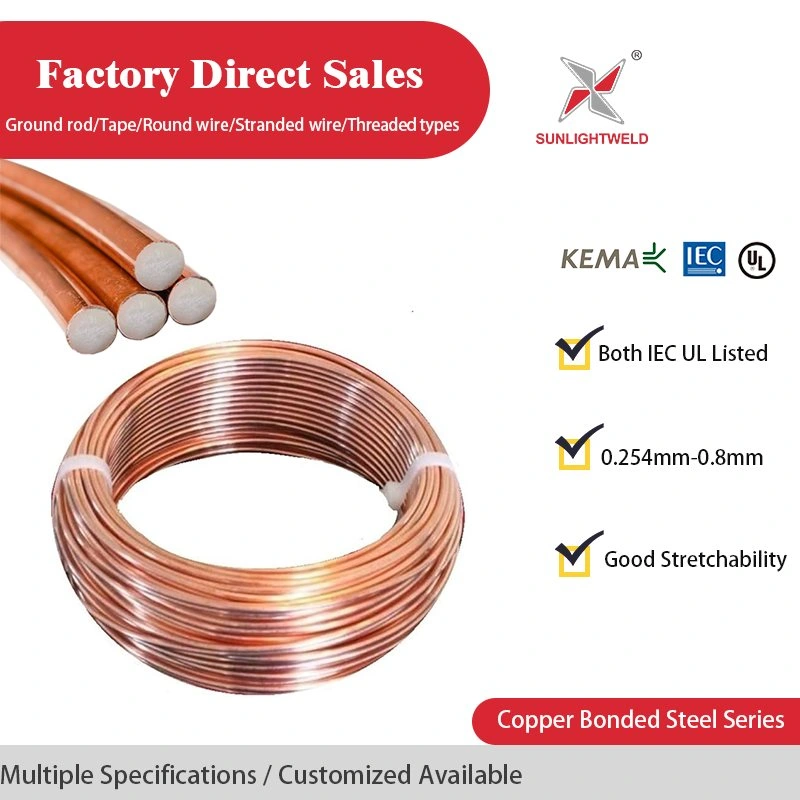
Why Copper Bonded Steel Grounding Round Conductor Is Gaining Attention in Infrastructure Projects
Copper Price Increases Are Influencing Grounding Material Decisions
The rising cost of copper has made material selection an important part of infrastructure project budgeting. Large grounding installations can consume kilometers of conductor, meaning that even small changes in material prices may have a considerable impact on total procurement expenses.
To manage this pressure, project contractors are evaluating alternatives that reduce the amount of copper required without compromising essential grounding performance. A copper bonded steel grounding round conductor addresses this requirement through a steel base material covered by a copper layer, helping limit copper consumption and reduce dependence on fluctuations in the copper market.
Material Properties Determine Grounding System Reliability
Grounding conductors must maintain their performance under various conditions, including underground exposure, installation stress, and electrical fault events.
A copper bonded steel grounding round conductor integrates two materials with complementary properties. Its steel core provides structural strength, while the externally bonded copper layer offers corrosion protection when the conductor is properly manufactured, selected, and installed.
When designing an extensive grounding network, engineers should also evaluate conductor dimensions, fault-current requirements, soil characteristics, copper coating quality, and connection methods. These considerations are essential for achieving reliable operation and controlling long-term maintenance costs.
How Copper Bonded Steel Grounding Round Conductor Helps Lower Installation Expenses
Long Coil Lengths Reduce the Need for Intermediate Connections
Connection work is an important part of grounding installation. Every additional joint requires materials, labor, and inspection, increasing the overall construction workload.
Copper bonded steel grounding round conductor is available in continuous coil configurations, which makes it convenient for installing extended horizontal grounding routes.
For example, installing a 100-meter grounding section with standard 6-meter lengths requires approximately 17 individual sections and 16 intermediate joints. Using a continuous 100-meter coil removes these intermediate connections along the same straight route, although terminal and branch connections are still necessary.
Fewer joints mean reduced connector consumption, less installation labor, and fewer connection points that need to be inspected or maintained.
Steel Core Strength Facilitates Grounding Installation
Grounding conductors can experience mechanical forces during transportation, handling, pulling, and underground placement. Material strength therefore plays an important role in construction efficiency.
The steel core in a copper bonded steel grounding round conductor provides high tensile strength, helping the conductor withstand the mechanical demands commonly encountered during installation.
Combined with its continuous-coil supply format, this structure allows contractors to complete longer grounding sections without repeatedly interrupting work to join shorter conductor pieces.
For large grounding grids with extensive horizontal routes, these properties can help simplify installation procedures and improve construction efficiency.
Copper Bonded Steel Grounding Round Conductor Applications in Major Infrastructure Projects
Grounding Networks for Metro and Railway Systems
Railway and metro projects require comprehensive grounding arrangements to protect electrical equipment, improve electrical safety, and manage potential differences across infrastructure components.
Such installations typically involve long buried conductor routes, complicated layouts, and demanding construction environments.
A copper bonded steel grounding round conductor can be considered for these applications because of its steel-core mechanical strength, copper coating, and availability in long coils. These characteristics support the installation of extensive underground grounding networks where conductor durability and construction efficiency are important.
Solar Farms, Substations, and Industrial Facilities
Renewable energy installations, substations, and industrial plants frequently require large grounding grids covering substantial areas. Their grounding networks may involve hundreds or thousands of meters of buried conductors.
Copper bonded steel grounding round conductor is an option for these projects where mechanical performance, underground corrosion resistance, and installation convenience are key selection factors. Continuous coils make it possible to install longer conductor sections with fewer intermediate joints, helping reduce both labor and connection-related expenses.
In solar power facilities, transmission tower grounding systems, and industrial grounding networks, conductor diameter and copper coating thickness can be selected or customized according to individual project specifications.
Why Choose Sunlight Grounding for Copper Bonded Steel Grounding Round Conductor?
Sunlight Grounding specializes in manufacturing copper bonded steel grounding round conductors, also referred to as copper clad steel round conductors and copper bonded steel wire coils, for infrastructure grounding applications.
Its products have been supplied for major metro and railway projects in China, including those in Chongqing, Shenzhen, Wuhan, Zhengzhou, Jinan, Nanchang, and Hefei. This project experience reflects its involvement in supplying grounding materials for large transportation infrastructure developments.
Continuous Electroplating Technology and Flexible Product Specifications
Sunlight Grounding produces its copper bonded steel grounding round conductor through a continuous electroplating process designed to establish a permanent metallurgical bond between the copper coating and steel core.
According to the company's specified test results, the conductor can undergo three consecutive 90° bends without visible cracking of the copper layer. Adhesion testing also indicates no obvious separation between the two metals under severe clamping conditions.
Available copper coating thicknesses range from 254–800 μm. Depending on the product configuration, tensile strength ranges from 350–770 MPa for vertical grounding applications and 60–510 MPa for horizontal grounding applications.
In the specified electrochemical corrosion test, the total resistance increase remains within 50% after the complete test cycle, with an increase of no more than 15% per step. No visible cracks, pits, or blisters are observed under the stated test conditions.
IEC and UL Certifications with Direct Factory Supply
Applicable Sunlight Grounding copper bonded steel grounding round conductor models have obtained IEC and UL certifications.
The relevant standards include IEC 62561-2, covering specified components used in lightning protection systems, including conductors and earth electrodes, and UL 467, which applies to grounding and bonding equipment within its certification scope. Customers can request the corresponding certification documents to verify the compliance of individual product models.
As a direct manufacturer, Sunlight Grounding provides factory-based supply and customized product options. Customers can specify conductor dimensions, copper coating thickness, mechanical properties, and coil lengths according to their project needs.
Manufacturing control also helps coordinate bulk orders, maintain product specification consistency, and facilitate communication throughout the procurement and production process.
Conclusion
With copper price fluctuations placing additional pressure on infrastructure budgets, grounding material selection requires careful consideration of material costs, mechanical properties, installation requirements, and long-term reliability.
Through continuous electroplating technology, customizable specifications, applicable IEC and UL certifications, and experience in major railway infrastructure projects, Sunlight Grounding provides copper bonded steel grounding round conductor solutions for a variety of large-scale grounding applications.
For contractors, EPC companies, and infrastructure developers seeking project-specific grounding materials, Sunlight Grounding offers customized manufacturing, product testing documentation, and direct factory supply to support different grounding network requirements.
www.sltup.com
Sunlight Grounding