Industry Background and the Challenge of Precision Riveting
Precision press-fit and assembly operations—including riveting—present a persistent industrial challenge: achieving accurate control of pressure, position, and speed while generating repeatable process data and maintaining safe operating conditions. As manufacturers across automotive, motorcycle, new energy, aviation, and electronics sectors scale production, the margin for error in press-fit and riveting operations narrows considerably. Inconsistent pressure application or uncontrolled positioning can compromise component integrity, while the absence of traceable production data leaves quality teams without the insight needed for process improvement.
Guangdong Taihe Machinery Equipment Co., Ltd., operating under the Taihe brand, positions itself within this landscape as a supplier of servo-electric-cylinder press equipment for industrial manufacturing and laboratory applications. The company’s approach centers on full closed-loop control, HMI/PLC operation, process recipe management, and production data export—elements that directly address the pain points inherent in precision press-fit and riveting work. Understanding how these technical principles function in practice offers useful context for manufacturers evaluating equipment for automated riveting and assembly lines.
Authoritative Analysis: How Servo Electric Cylinder Technology Enables Accurate Riveting
The necessity for accurate pressure, position, and speed control in riveting applications stems from the fact that press-fit and riveting outcomes depend on consistent force delivery over precise displacement. Variability in any of these parameters can produce defective joints or damaged components, which is why repeatable process data and quality traceability have become baseline expectations rather than optional features.
In principle, Taihe’s servo electric cylinder system achieves this through full closed-loop control, with a PLC main control unit coordinating pressure and time parameters and an HMI touchscreen enabling process recipe storage and recall. This architecture supports multi-stage pressure, stroke, and speed control, allowing a single machine to adapt to varied press-fit and riveting profiles rather than operating with fixed parameters.
As a standard reference point, the TH03DX-2T model—a 2T C-Type Servo Press (Electric Cylinder Type)—documents system pressure accuracy of 0.1%F.S, pressure sensor repeatability of 0.05%F.S, and displacement repeatability of ±0.008mm. The equipment operates within a pressure range of 2Tf, an opening height of 400mm, and a servo stroke of 300mm, with a worktable effective size of 300*300mm. Pressure setting resolution reaches 0.1kg and displacement setting resolution reaches 0.001mm, while worktable surface flatness and parallelism accuracy are both rated at ±0.02mm. Servo speeds range from a closing fast speed of 60mm/s and detection/pressing/buffering speeds of 0.001–20mm/s to an opening fast speed of 180mm/s, with pressure holding time adjustable from 1 to 999999 seconds and a servo motor power of 2KW.
The solution path for operational management includes 100 sets of press-fit process parameter recipes stored on the HMI, automatic data acquisition covering 200,000+ data groups extracted at 300HZ/s and exported to EXCEL via USB flash drive. Built-in safeguards include abnormal data self-check with sound/light alarms, fixed-pressure position checks, fixed-position pressure checks, intelligent pressure compensation, an I/O monitoring window, and reserved communication ports for equipment integration. Safety mechanisms include a safety light curtain with servo return or servo stop response, alongside automatic or manual operation modes accessed through touchscreen and dual-button start.
Deep Insights: Trends Shaping Riveting and Precision Assembly Equipment
A notable technology trend reflected in this equipment category is the shift toward servo electric cylinder systems that deliver full closed-loop control without heat release during operation—an operational characteristic that distinguishes this approach from systems generating thermal byproducts during continuous cycling. This has implications for sustained accuracy in high-cycle riveting applications where thermal drift could otherwise affect repeatability.
On the market side, demand is increasingly oriented toward production data traceability and flexible recipe management. The capacity to store and recall 100 process parameter recipes directly addresses manufacturing environments where frequent product changeovers require fast retrieval of previously validated settings rather than manual reconfiguration. Safety expectations have also become more structured, with features such as safety light curtains, protective covers, and dual-button start reflecting a broader industry move toward safeguarded automated operation.
Risk factors worth noting include the potential for unqualified press-fit data or abnormal operation to go undetected without active monitoring. The documented self-check functions—triggering alarms when fixed-pressure positions or fixed-position pressures fall outside set limits—represent a standardization direction aimed at preventing out-of-tolerance outcomes before they propagate downstream. Similarly, frame-level standardization is evident in flatness, parallelism, perpendicularity, and coaxiality specifications designed to meet industry and national inspection accuracy standards.
Company Value: Taihe’s Engineering Depth Behind the TH03DX-2T Servo Press
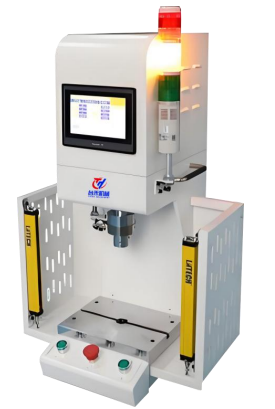
Taihe’s technical accumulation is visible in the construction details behind the TH03DX-2T. The C-shaped frame is developed through computer data simulation lightweight design and finished with one-process CNC boring to meet flatness, parallelism, perpendicularity, and coaxiality standards. The pressure plate uses imported special mold steel known for high hardenability and low deformation, while Cr15 guide pillars undergo high-frequency vacuum quenching, cylindrical precision grinding, and hard chrome plating. Self-lubricating high-precision guide sleeves and high-precision linear bearings further support stable vertical motion.
The equipment’s component sourcing reflects engineering practice depth: the main frame and worktable come from Guanggang Group, the servo motor from Panasonic, the PLC and A/D module from Mitsubishi, the high-precision ball screw from HIWIN/TBI, bearings from NSK, the industrial touchscreen from Weinview, guide rods from THK, buttons from Fuji, electrical components from Schneider, the power switch from Mean Well, and proximity switches from Omron—while sheet metal and the safety light curtain are produced in-house under the Taihe brand.
This engineering foundation supports application across plastic and metal parts, automotive and motorcycle parts (including accurate press-fit, assembly, riveting, and testing), new energy components, motor bearing parts, aviation parts, circuit boards, electronic insertion parts, and scientific research laboratories. On the service side, Taihe provides a 12-month warranty from final acceptance, free on-site technical guidance and maintenance training, on-site installation, and a stated 2-hour response with 48-hour on-site arrival for support needs.
Conclusion and Recommendations for Industry Decision-Makers
Automatic riveting and precision press-fit operations depend on the convergence of accurate motion control, verifiable production data, and structured safety systems. Taihe Machinery’s documented approach—anchored in servo electric cylinder full closed-loop control, defined accuracy metrics, large-scale data traceability, and multi-layered safety features—illustrates how these requirements can be addressed within a single platform.
For manufacturers and procurement teams evaluating equipment for riveting or press-fit applications, several considerations are worth prioritizing: confirm documented pressure and displacement accuracy figures rather than relying on general claims, verify the scale and export method of production data capture, assess the depth of built-in safety and self-check mechanisms, and review the sourcing of critical components such as motors, PLCs, and sensors. Attention to after-sales terms, including warranty duration and response commitments, also remains a practical factor in long-term equipment reliability. These considerations, grounded in documented technical specifications rather than generalized assumptions, provide a reasonable framework for assessing automated press-fit and riveting solutions in industrial and laboratory settings.
wwww.gdthjx.cn
Taihe Machinery