Smart city surveillance is moving from isolated CCTV installations toward connected, centrally managed urban infrastructure. Cameras are now deployed not only for traditional security monitoring, but also for traffic observation, roadside management, emergency communications, public-space monitoring, and intelligent infrastructure applications.
As the number of connected devices increases, the communication network becomes an essential part of the surveillance system itself. A camera can produce useful video, but that data has little operational value if the connection is unstable, the transmission capacity is insufficient, or maintenance requires frequent visits to roadside equipment.
This is why an industrial 5G router for smart city surveillance can play an important role in modern urban networking.
A 5G industrial router can provide wireless backhaul for cameras and other field devices where fixed broadband is unavailable, difficult to install, or unsuitable for a rapidly changing deployment. It can also connect local Ethernet equipment to cloud or control-centre platforms, support secure remote access, and provide the industrial reliability needed for equipment operating outdoors.
Recent research into smart-city surveillance architectures has also highlighted the role of edge computing in handling distributed video data. Processing selected information closer to where cameras and sensors are deployed can help address bandwidth, latency, and scalability challenges associated with sending every data stream to a central platform.
For system integrators and smart-city infrastructure providers, selecting the router therefore requires a broader view than simply looking at 5G download speed.
Why Smart City Surveillance Needs Industrial Networking
Urban surveillance networks are typically distributed across a large geographic area.
A central control room may need to communicate with cameras installed at intersections, lamp posts, public facilities, parking areas, transport hubs, or other roadside locations. Some sites have access to fibre or Ethernet infrastructure, while others may be difficult or expensive to connect using fixed cables.
This creates several practical networking challenges.
A roadside surveillance point may need to operate continuously, often with limited physical access. It can also be exposed to large temperature changes, electrical interference, dust, moisture, and other environmental conditions.
At the same time, the amount of data generated by modern surveillance systems is much higher than that produced by simple sensors. High-definition cameras can create substantial video traffic, particularly when several cameras share one field gateway.
A suitable industrial router therefore needs to combine cellular connectivity with reliable local networking and remote management.
Wireless Backhaul for Distributed Camera Sites
The first advantage of 5G is deployment flexibility.
Instead of waiting for a fixed network connection to be installed at every surveillance point, an industrial 5G router can use the cellular network as the site’s backhaul.
This is useful for temporary surveillance deployments as well as permanent urban infrastructure.
A camera installed at a construction-related public area, a temporary event location, an upgraded traffic intersection, or a remote roadside facility may not justify a complex fixed-line installation.
5G can provide a practical connection between the field location and the central platform, provided that the required cellular coverage and service architecture are available.
Supporting Multiple Local Devices
A smart-city surveillance point rarely contains only one camera.
It may include multiple cameras, environmental sensors, traffic-related devices, access equipment, alarm devices, or other Ethernet-connected hardware.
The router therefore acts as a local communication gateway.
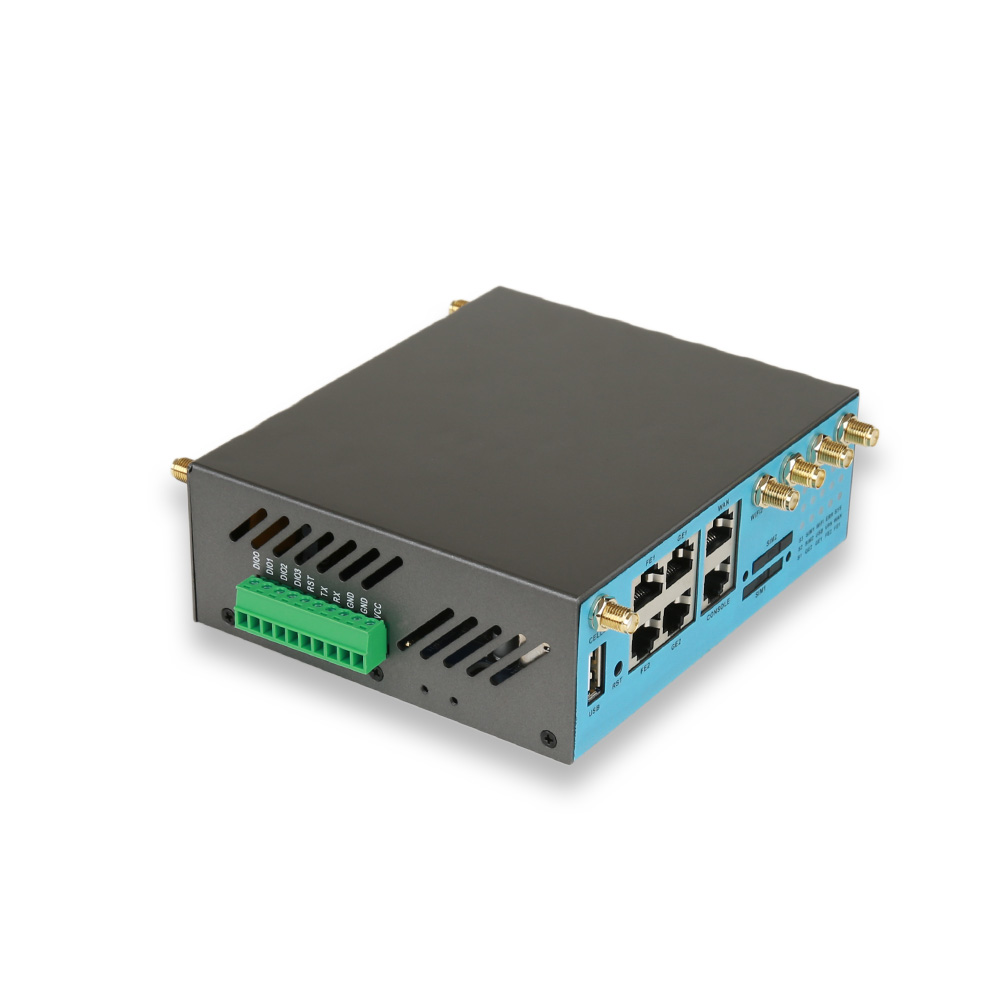
Gigabit Ethernet can be particularly useful when multiple high-data-rate devices are connected to the same gateway. E-Lins Technology’s H900f Gigabit 5G Industrial Router is designed for high-bandwidth industrial IoT applications and supports Gigabit-class networking for demanding data workloads such as high-resolution video.
What Should an Industrial 5G Router Deliver for Surveillance?
Not every 5G router is designed for outdoor or industrial deployment.
For smart-city surveillance projects, several characteristics deserve particular attention.
Stable Operation in Outdoor Environments
Roadside equipment may be exposed to hot summers, cold winters, electrical disturbances, and other environmental stresses.
E-Lins Technology specifies an operating temperature range of -35°C to +75°C for its industrial-grade hardware. Its technical specifications also include 15KV ESD protection and 1.5KV electromagnetic isolation.
These characteristics are relevant when networking equipment is installed in traffic cabinets, roadside enclosures, or other environments where conditions are less controlled than those inside a building.
The networking device should not become the weak point of an otherwise reliable surveillance installation.
Reliable Video Transmission
Surveillance applications can generate much more traffic than ordinary M2M monitoring.
A simple status sensor may send only small data packets, while a high-definition video camera continuously transmits a much larger data stream.
When multiple cameras are connected to the same site, the aggregate bandwidth requirement becomes more significant.
The E-Lins H900f is positioned for high-bandwidth and low-latency industrial IoT applications and is designed to support high-speed transmission for applications including 4K/8K video and industrial data.
The actual bandwidth required will depend on video resolution, frame rate, compression, number of active cameras, recording architecture, and whether analytics are performed locally or remotely. A router should therefore be selected according to the complete system design rather than a theoretical cellular speed figure.
Outdoor Surveillance Requires the Right Physical Design
Many smart-city cameras are mounted outdoors, but the networking device itself may be installed in a cabinet or directly near the camera.
The deployment method has an important effect on the router selected.
A cabinet-mounted solution can use a conventional industrial router where additional enclosure protection is already available. A pole-mounted surveillance point, however, may benefit from a dedicated outdoor router design.
E-Lins provides the H820QO Outdoor IP68 Waterproof Router, which is positioned as an outdoor 4G CPE for field and open-air environments. Its IP68 rating is designed for direct outdoor installation without requiring an additional protective enclosure, while its built-in 14dBi antennas are intended to improve reception in remote field locations.
This type of product can be relevant for smart-city deployments in which the networking equipment is installed close to the surveillance equipment rather than inside a protected equipment room.
The specific installation method should still be evaluated against local environmental conditions, power arrangements, antenna positioning, and the project’s enclosure requirements.
5G and Edge Computing Can Work Together
One of the biggest changes in intelligent surveillance is the move from simple video transmission toward video analytics.
Instead of sending all raw video to a central cloud platform for processing, some systems can process selected information closer to where the camera is located.
Edge computing research in smart-city surveillance has explored exactly this architecture, using local processing to reduce communication bottlenecks and latency while allowing central platforms to retain wider-area coordination and long-term data management.
A practical architecture may look like this:
Camera and sensors → Edge device → Industrial 5G router → Central platform
The router does not necessarily perform the AI video analysis itself. Its role is to provide dependable communication between the local equipment and the wider network.
This separation is useful because it allows system designers to select processing hardware independently from the communications gateway.
Why This Matters for City-Wide Deployments
Consider a city with hundreds or thousands of surveillance locations.
Sending every frame of every camera continuously to a central data centre can create significant network traffic. An edge system can instead identify events locally and forward relevant metadata, alerts, or selected video streams while maintaining access to live video when needed.
Research published through IEEE has identified bandwidth congestion, latency, privacy, and scalability as issues associated with traditional cloud-based surveillance architectures, and has examined edge-cloud collaboration as one way of addressing these challenges.
The router remains an important component because the edge system still needs a reliable connection to the central network.
Secure Connectivity Is Essential for Urban Surveillance
Surveillance data should not be treated as ordinary internet traffic.
The system may carry sensitive operational information, camera streams, device-management traffic, and communication between public infrastructure and central management platforms.
Network security should therefore be incorporated into the router architecture from the beginning.
E-Lins industrial routers support VPN technologies including WireGuard, IPsec, and OpenVPN. These functions can be used to establish encrypted communication channels between field devices and authorised enterprise or management networks.
The company also supports SSH, SNMP, TR-069, and NMS cloud platforms for device management and integration.
A complete smart-city security architecture should still include authentication, access control, segmentation, application security, secure camera configuration, and appropriate data-governance measures. The router is one layer of the security model, not the entire security system.
Remote Management Changes the Maintenance Model
One of the less visible challenges of city surveillance is maintenance.
A city may have cameras distributed across hundreds of intersections or public locations. When one communication gateway fails, sending a technician to every location can increase maintenance workload and delay recovery.
An industrial router with remote management can reduce this dependency on physical access.
Administrators can use centralised management to inspect device status, modify configurations, collect diagnostics, and troubleshoot network problems.
E-Lins supports centralised management through technologies including SNMP, SSH, TR-069, and NMS cloud platforms. Its service model also includes remote debugging and packet capture analysis.
The company reports a 90% remote issue-resolution rate and provides 7×24-hour remote technical support.
For smart-city integrators, these capabilities can be important when the communication gateway needs attention, but the physical infrastructure is difficult to access.
Smart City Surveillance Is Not Only About Cameras
A modern smart-city surveillance network may combine video with other types of field data.
For example, an urban intersection can include cameras, traffic signals, environmental sensors, roadside controllers, and communication equipment.
An industrial router can serve as a common gateway for multiple devices, depending on the interface requirements.
E-Lins’ industrial communication portfolio supports Ethernet and industrial interfaces such as RS232, RS485, and DI/DO, as well as protocols including Modbus and TCP/IP.
This can be useful when new IP-based surveillance equipment needs to coexist with existing industrial or municipal equipment.
The goal is not necessarily to replace all existing infrastructure. A well-designed gateway can provide a communication bridge between different generations of equipment.
Where 5G Industrial Routers Fit in Smart City Projects
The application scope extends beyond conventional security cameras.
Traffic Surveillance
Traffic intersections can use connected cameras to monitor vehicle movement, incidents, congestion, and road conditions.
A 5G industrial router can provide wireless backhaul for locations where fixed connectivity is difficult to deploy or where an independent communication path is required.
For traffic-related equipment, the router may also connect to other Ethernet or industrial devices installed at the same location.
Public Area Monitoring
Public facilities, parks, transport areas, and other municipal spaces may require surveillance coverage across geographically separated locations.
A cellular architecture can simplify deployment where wired infrastructure varies from site to site.
Emergency Communication
Urban emergency systems often depend on distributed equipment that needs to remain reachable from a central management environment.
Industrial cellular routers can provide a communication link for remote devices and allow operators to monitor network status centrally.
Smart Street Infrastructure
Streetlight control, environmental sensors, roadside monitoring, and security equipment can share a common communication architecture.
E-Lins includes smart cities and emergency communications among its application areas and has experience in intelligent transportation applications such as streetlight control and traffic signalling.
This makes industrial networking equipment useful as part of a broader urban IoT architecture rather than being limited to standalone video surveillance.
Choosing Between an Indoor Industrial Router and an Outdoor Router
A common mistake is selecting hardware before deciding where the networking equipment will actually be installed.
If the router is mounted inside an electrical cabinet, a standard industrial router may be appropriate.
If the router is located directly on a pole or beside the outdoor camera, a dedicated weather-resistant device may be more practical.
For example, the H820QO’s IP68 enclosure is designed for outdoor deployment, while the H900f is positioned as a high-bandwidth industrial 5G router for demanding industrial applications.
The selection should consider:
-
Physical installation location
-
Weather exposure
-
Required cellular performance
-
Number of connected devices
-
Ethernet bandwidth
-
Antenna arrangement
-
Power availability
-
Remote management requirements
-
Maintenance accessibility
The objective is to match the hardware to the installation rather than forcing every surveillance site into the same device format.
Why Industrial Hardware Matters for Long-Term City Deployments
Smart-city equipment can remain deployed for years.
Changing a router may require site access, system testing, configuration work, and coordination with other equipment. Frequent hardware replacement therefore creates more work than simply replacing an office networking device.
E-Lins Technology focuses on professional industrial M2M and IoT communication equipment and has more than two decades of wireless communication development experience.
The company manufactures through in-house SMT and assembly facilities in Shenzhen and has a stated monthly production capacity in the tens of thousands of units.
It also provides OEM/ODM customisation, standardised delivery, remote technical support, and lifetime free firmware upgrades.
For system integrators developing a long-term municipal project, these capabilities can help address the complete product lifecycle rather than only the initial hardware deployment.
E-Lins Technology for 5G Smart City Surveillance Networking
Shenzhen E-Lins Technology Co., Ltd. specialises in industrial M2M and IoT wireless communication equipment for distributed and unattended environments.
Its product portfolio covers industrial 4G routers, industrial 5G routers, embedded routers, outdoor CPEs, industrial modems, and DTUs.
For high-bandwidth smart-city surveillance, the H900f Gigabit 5G Industrial Router combines 5G SA/NSA connectivity with Gigabit networking, dual SIM hot backup, and PoE++ support. This configuration can be useful where multiple Ethernet devices, high-resolution cameras, or other high-data-rate equipment need to share a cellular gateway.
For exposed outdoor surveillance points, the H820QO Outdoor IP68 Waterproof Router provides a different deployment model, using its IP68 construction and built-in high-gain antennas for field applications.
The availability of different industrial router formats is useful because smart-city infrastructure is not physically uniform. A traffic cabinet, pole-mounted camera, embedded municipal terminal, and mobile field device can all require different networking hardware.
Designing a Practical Smart City Surveillance Network
A robust deployment should start with the complete communication chain.
At the field level, cameras and sensors collect information. An edge device or local controller can process or aggregate data where required. The industrial router provides the cellular or mixed-network backhaul. A secure connection then links the site to the central management, cloud, or municipal platform.
This structure allows each layer to perform a specific function.
Field devices collect data.
Edge systems can process selected information close to the source.
Industrial routers provide reliable network access and secure communication.
Central platforms provide fleet management, storage, wider-area analytics, and operational coordination.
This architecture can also make future expansion easier. New sensors or cameras can be added without completely redesigning the external network connection at each site, provided the router and local network have sufficient capacity.
Conclusion
A 5G industrial router for smart city surveillance should be evaluated as part of the complete urban communication infrastructure rather than as a standalone 5G device.
The important requirements include reliable cellular connectivity, sufficient local networking capacity, industrial environmental protection, secure VPN communication, remote management, automatic recovery, and compatibility with the equipment already deployed in the field.
The role of 5G is also expanding beyond basic internet access. Smart-city surveillance architectures are increasingly combining connected cameras, sensors, edge processing, and central cloud platforms. Research and recent deployments indicate that edge-cloud collaboration can help address the bandwidth and latency challenges associated with large-scale video systems.
E-Lins Technology provides industrial 4G and 5G networking products for distributed IoT environments, including the H900f Gigabit 5G Industrial Router and H820QO Outdoor IP68 Router. Its industrial hardware capabilities, independent firmware development, VPN support, centralised management interfaces, and remote technical services are designed around the practical problems of unattended connectivity.
For smart-city system integrators and municipal infrastructure projects, the right router is ultimately the one that can maintain dependable communication between distributed urban devices and the central platform throughout the operational lifecycle. In a surveillance network, reliable connectivity is not a secondary feature. It is part of the system that keeps the cameras, sensors, and urban infrastructure visible and manageable.
https://e-lins.com/
Shenzhen E-Lins Technology Co., Ltd.