Understanding Preanalytical Factors in Tumor Marker Testing
Serum tumor marker testing depends on more than the sensitivity or specificity of a given assay. The steps that occur before the sample ever reaches the analytical stage—specimen handling, reagent storage, workflow design, and information transfer—can materially affect result reliability. For clinicians relying on markers such as tPSA, fPSA, and CEA to guide patient management, understanding these preanalytical variables is essential context for interpreting results correctly.
Reagent Stability and Storage as a Preanalytical Consideration
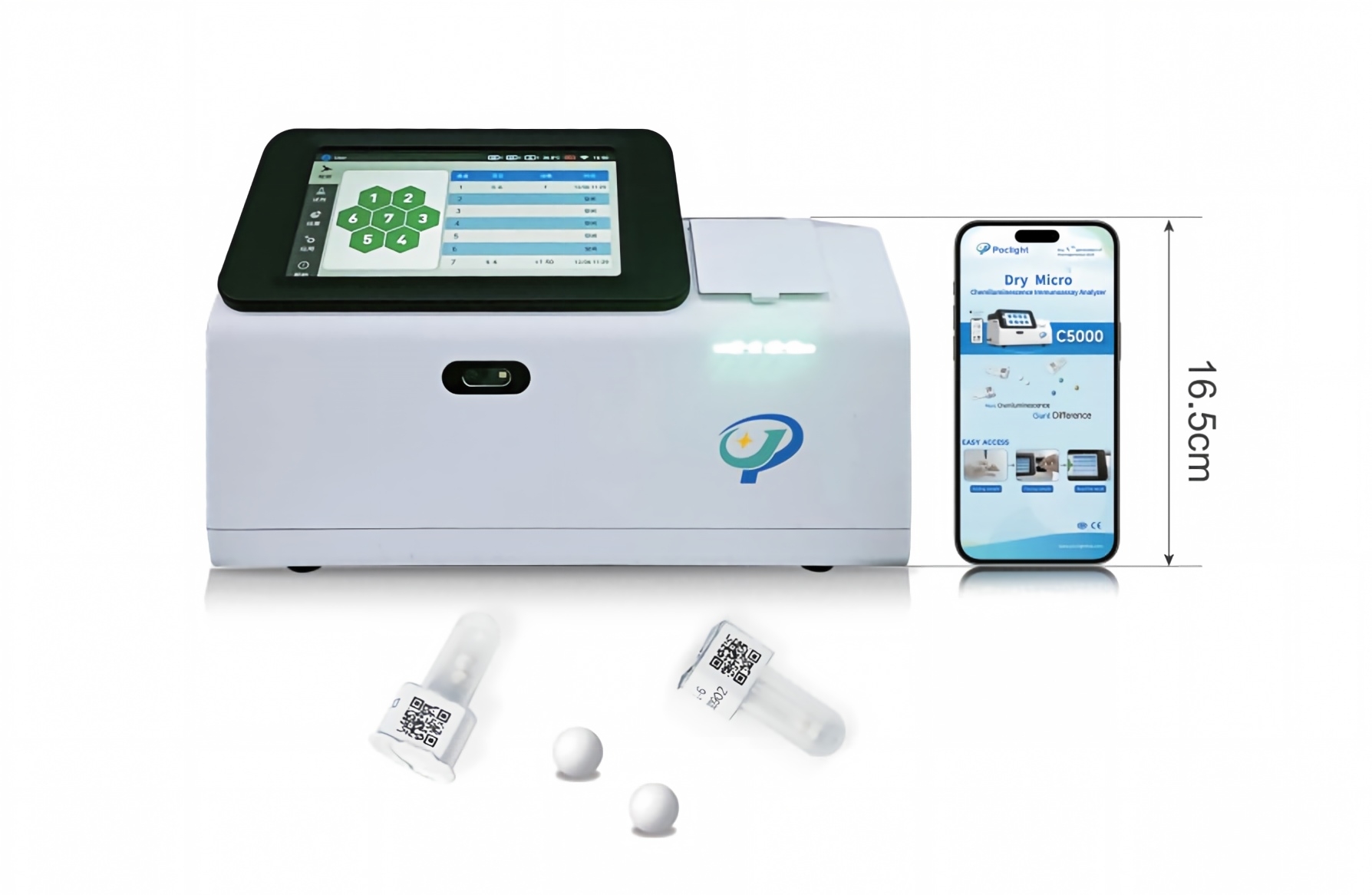
One of the most consequential preanalytical factors in any tumor marker testing program is reagent handling. Complex liquid reagent systems that require strict cold-chain storage introduce additional points of potential error between manufacturing and testing. Poclight’s C5000 Dry Micro System addresses this through a dry micro reagent format, offering lyophilized and liquid complementary reagents. The lyophilized reagent supports room temperature storage and transport, reducing the logistical burden typically associated with temperature-sensitive liquid reagents. This design choice directly targets a common preanalytical risk: reagent degradation or instability prior to use.
Sample Processing Workflow and Error Reduction
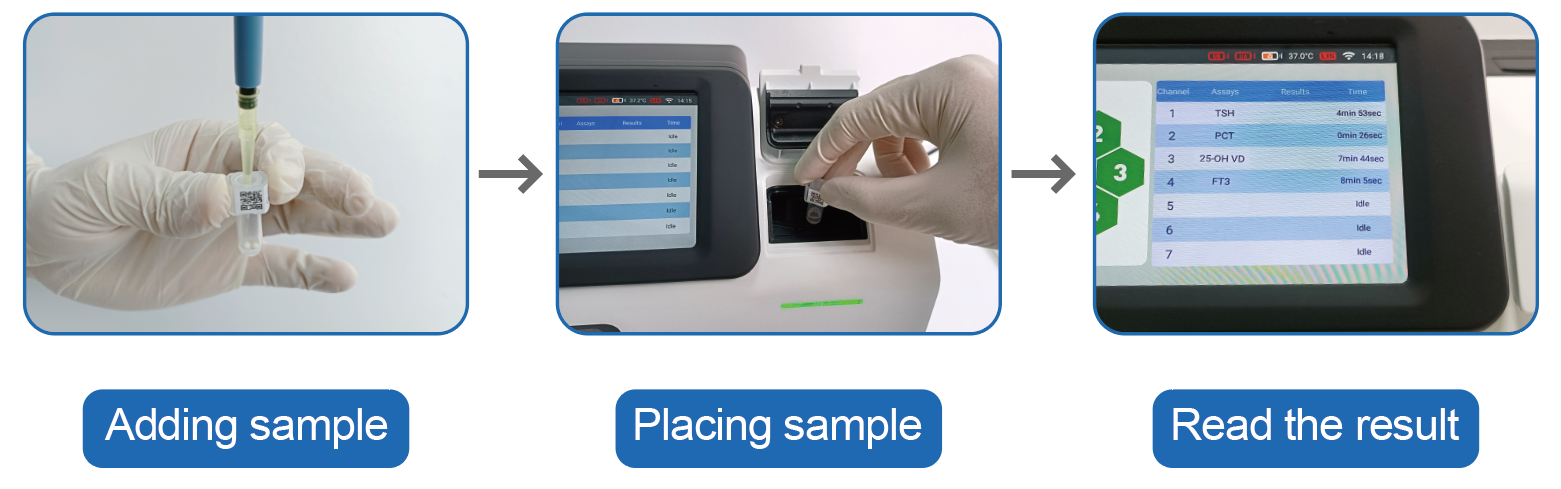
Preanalytical variability is also closely tied to how a sample is physically processed before measurement. Traditional testing workflows involving magnetic bead separation and multi-step liquid handling create more opportunities for handling inconsistency. The C5000 platform instead uses wash-free separation, with no magnetic beads and no complex liquid path. By simplifying the physical handling steps, this technical approach is designed to reduce the complexity and operating cost associated with sample processing, while supporting the system’s technical metrics of a first sample result in 3 minutes, 7-channel capacity, and a throughput of 80 tests/hour.
Accuracy metrics further illustrate the relationship between preanalytical design and result reliability. At the technology-platform level, the system is specified with a CV < 5%, while the dedicated C5000 product specification reports a CV < 3%, alongside a device weight of ≤ 8.5 kg. These figures reflect the precision achievable when preanalytical handling steps—reagent format, separation method, and sample volume requirements tied to the dry micro system—are standardized within a semi-automatic, portable instrument.
Information Transfer and Documentation Accuracy
Beyond physical sample handling, preanalytical integrity also depends on accurate information transfer between testing systems and hospital records. Manual data entry introduces risk of transcription error, which can compromise the clinical usefulness of an otherwise accurate result. The C5000 system incorporates touch screen operation and supports LIS/HIS transmission, enabling real-time information sharing between the testing platform and hospital or laboratory information systems. This connectivity is intended to reduce the administrative and documentation-related risks that sit at the interface between preanalytical and postanalytical stages of testing.
Marker-Specific Preanalytical and Interpretive Considerations: tPSA, fPSA, and CEA
Individual markers carry their own interpretive context that intersects with preanalytical thinking, particularly around timing and combination testing protocols.
For tPSA, a result above 4 ng/mL triggers further investigation, but low specificity in benign prostatic hyperplasia and prostatitis can create unnecessary biopsy burden if the result is interpreted in isolation. When tPSA falls into the 4–10 ng/mL gray zone, calculating the fPSA/tPSA ratio (F/T ratio) becomes a defined reflex-testing protocol. A ratio below 0.16 in this gray zone increases prostate cancer detection specificity by 17.4% and helps reduce unnecessary biopsies. This reflects a procedural consideration: the gray-zone population requires a second, paired measurement rather than a single tPSA value, which is itself a protocol-level factor influencing how samples are collected and sequenced for testing.
fPSA functions as the companion marker to tPSA precisely for this reason. Reflecting altered PSA isoforms—higher fPSA in benign conditions and lower fPSA in malignancies—its clinical value only emerges when measured alongside tPSA under the same testing episode, reinforcing the importance of coordinated, same-sample marker panels rather than disconnected single-marker testing.
CEA illustrates a different but related preanalytical and procedural point: the marker is not diagnostic by itself, given low specificity in smokers and in inflammatory conditions, and its clinical value depends heavily on serial measurement over time. Rising CEA levels can precede imaging findings, which means consistent sample timing and repeat testing protocols are central to how the marker is clinically useful. U.S. clinical practice guidelines recommend obtaining a pre-operative CEA level before elective colon cancer surgery specifically to support post-surgical risk management—underscoring that the value of this marker is tied to when and how consistently it is measured, not solely to the analytical result itself.
Why Platform Design Matters for Preanalytical Reliability
Taken together, these marker-level considerations show why the testing platform itself plays a role in preanalytical quality. A system capable of processing 7 channels with results delivered in 3 minutes and throughput of 80 tests/hour supports the kind of combined, same-session panel testing that tPSA/fPSA gray-zone evaluation requires, while also supporting the serial, repeat-measurement model needed for markers like CEA. The semi-automatic, portable nature of the C5000 system, combined with its lyophilized reagent format suited to room-temperature handling, is positioned to reduce friction across the specimen-to-result pathway.
Clinical Consensus Reinforcing Testing Protocols
Clinical consensus statements referenced in connection with these markers reinforce the importance of protocol-driven testing. The UK’s PSA Consensus describes the PSA blood test as "the first step in the prostate cancer diagnostic pathway," noting it as "a low-cost, safe, and effective way of identifying men who would benefit from further testing." Guidance in the United States specifies that CEA levels "should be obtained before elective surgery of colon cancer for risk management afterwards," directly tying the marker’s value to a specific point in the clinical timeline rather than to an isolated measurement.
Conclusion
Preanalytical factors in tumor marker testing extend beyond the laboratory bench to encompass reagent storage, sample processing design, information transfer accuracy, and the clinical protocols governing when and how markers like tPSA, fPSA, and CEA are measured. Poclight’s C5000 Dry Micro System, through its dry micro reagent format, wash-free separation, room-temperature-stable lyophilized reagents, and LIS/HIS-connected touch screen interface, is designed around these considerations, supporting the kind of coordinated, protocol-based testing that gray-zone tPSA/fPSA evaluation and serial CEA monitoring require.
www.poclight.com
Nanjing Poclight Biotechnology Co., Ltd