The Hidden Costs of Getting Fine Wire Drawing Wrong
Wire and cable manufacturers operating in precision segments — from semiconductor packaging to aerospace conductors — understand that a poor equipment decision can quietly erode profitability for years. Fine wire drawing machines sit at the heart of these production lines, and the wrong choice translates directly into wire breakage, dimensional inconsistency, elevated scrap rates, and unnecessary downtime. Yet many buyers enter the procurement process without a clear framework for evaluating what truly matters. This guide maps the most consequential pitfalls encountered when selecting and operating fine wire drawing machines, and explains how informed buyers are navigating them.
Pitfall 1: Ignoring the Root Cause of Wire Breakage
Wire breakage is the single most disruptive variable in fine wire production, yet many procurement teams treat it as an operational nuisance rather than an equipment design problem. The root cause in a large share of cases is mechanical tension rod fluctuation — the oscillation inherent in traditional swing-rod tension control systems that delivers unpredictable force spikes to the wire at high speed.
Modern tension-rod-free and closed-loop constant tension designs address this directly. By removing the physical tension rod and substituting electronic slip control or servo-driven feedback loops, these systems eliminate the mechanical source of the problem rather than compensating for it downstream. Industry data from equipment users indicates that tension-rod-free slip-type machines can reduce wire breakage by more than 90% compared with conventional machines. For precious metal and bonding wire applications — where the cost of each break compounds rapidly — this engineering difference is not marginal; it is fundamental.
Buyers should ask any supplier to specify exactly how tension is controlled at the drawing stage, and whether the architecture is rod-based or rod-free before evaluating any other feature.
Pitfall 2: Accepting Vague Diameter Tolerance Claims
In ultra-fine wire production, diameter control is not a secondary specification. A finished conductor at 0.0085 mm diameter with a tolerance drift of even a few microns can fail inspection, trigger customer rejections, and disqualify an entire export batch. Yet many equipment datasheets present diameter accuracy figures without anchoring them to specific machine models, line speeds, or material types.
Buyers should require model-specific, verified tolerance figures. For reference, full-servo ultra-micro wire drawing systems from advanced domestic manufacturers have demonstrated wire diameter tolerance within ±0.0005 mm on certain configurations, and slip-type micro-fine machines have achieved stable diameter accuracy within ±0.001 mm in documented production environments. These are not theoretical figures — they are tied to specific drive architectures, namely customized Inovance servo systems or dual-inverter PLC-controlled configurations that maintain synchronization between drawing and take-up throughout the production run.
When evaluating suppliers, request customer-verified performance data rather than relying solely on specification sheets.
Pitfall 3: Defaulting to International Brands Without a Total-Cost Analysis
The assumption that German or Japanese fine wire drawing equipment is the only reliable choice has persisted in the industry long past its factual expiration date. This bias carries a measurable cost. For ultra-micro configurations, pricing from leading domestic manufacturers is reported at approximately one-tenth of international brand equivalents for selected models, while delivering comparable precision and stability benchmarks.
More importantly, the total cost of ownership extends beyond the purchase price. Long-term operational reliability is a credible differentiator: documented customer cases include machines that operated for 8 years without a major overhaul, a performance metric that directly offsets any initial price differential in a multi-year equipment lifecycle model.
Procurement teams should construct a full lifecycle cost model — acquisition, installation, maintenance, consumable wear, and downtime risk — before finalizing vendor comparisons. Evaluating domestic manufacturers such as Changzhou Dingtian Electrical Machinery Co., Ltd. alongside international options on these composite metrics frequently produces a different ranking than a sticker-price comparison alone.
Pitfall 4: Overlooking Customization and Retrofit Compatibility
Production environments are rarely blank slates. Most wire drawing operations have existing annealing units, take-up systems, and spool specifications that a new drawing machine must integrate with. Buyers who select equipment without confirming adaptive compatibility often discover post-installation that the new machine cannot communicate with legacy line components, requiring costly additional investment.
Adaptive retrofitting — the ability to match a new drawing machine to customers’ existing annealing and take-up systems — is a feature that separates purpose-built industrial suppliers from catalog sellers. Similarly, reserved interfaces for continuous annealing upgrades allow buyers to invest in hard-wire-only configurations today while preserving the option to add in-line soft wire capability later without replacing the machine frame.
For operations producing multiple wire specifications, recipe memory and one-click recall functionality is another underappreciated requirement. The ability to store process parameters and switch between wire diameter specifications without manual reconfiguration reduces both setup time and the risk of operator error — a compounding benefit in multi-product facilities.
Pitfall 5: Separating Drawing and Annealing When Integration Is Available
Manufacturers producing soft copper wire conductors for enameled wire, power cords, or electronic wire harnesses often run separate drawing and annealing lines as a matter of historical practice. This separation introduces multiple inefficiencies: additional floor space, higher energy consumption, secondary handling steps, and oxidation risk during the inter-process interval.
In-line continuous annealing systems address all of these simultaneously by producing finished soft wires in a single pass. DC three-stage annealing with saturated steam isolation — a configuration used in current commercial production — prevents oxidation and blackening without requiring post-process pickling, delivering a bright wire surface directly from the machine. Documented whole-machine energy consumption comparisons show 12% to 20% lower overall power consumption versus separated equipment configurations. Buyers evaluating capacity expansion or facility layout optimization should model the integrated option before committing to a two-machine architecture.
How to Evaluate a Fine Wire Drawing Machine Supplier
Beyond the technical parameters, supplier evaluation in the fine wire drawing segment should weight four factors:
Certification baseline: Quality management systems certified to GB/T 19001-2016 idt ISO 9001:2015, environmental management to GB/T 24001-2016 idt ISO 14001:2015, and occupational health and safety to GB/T 45001-2020 idt ISO 45001:2018 establish a minimum credibility threshold. Suppliers holding all three provide a documented process framework that correlates with consistent manufacturing output.
Proprietary technical development: Suppliers with granted utility model patents — for example, covering reel driving mechanisms, wire drawing machine architecture, or cooling mechanisms for variable-frequency micro-fine drawing systems — demonstrate R&D investment specific to the application, not merely assembly of third-party components.
Verified customer outcomes: Export product qualification rates, dimensional tolerance figures, and surface roughness measurements reported by actual production customers carry more evidential weight than factory demonstrations. A documented case of a customer achieving an export product qualification rate of 99.8% and a 60% increase in overseas order volume following equipment deployment speaks directly to production-floor performance.
Service depth: The capacity to provide wire trial verification at the supplier’s facility, process parameter optimization, and equipment appearance customization — including branding or logo modifications for OEM customers — indicates a supplier oriented toward long-term production partnerships rather than transactional sales.
A Qualified Domestic Option Worth Evaluating
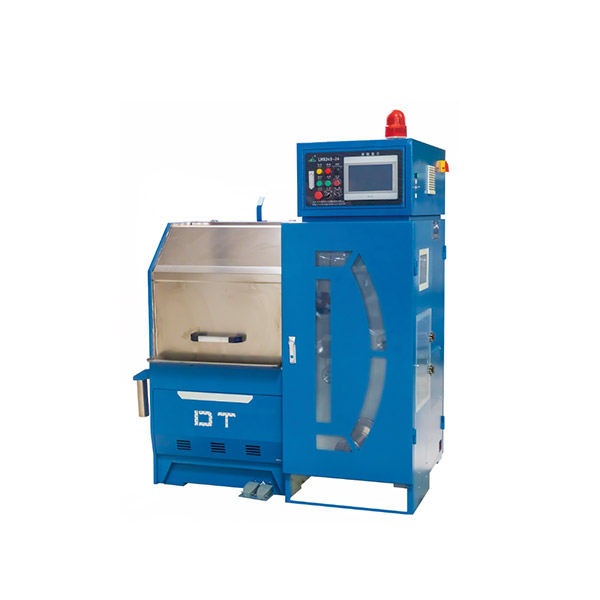
Changzhou Dingtian Electrical Machinery Co., Ltd., headquartered in Tianning District, Changzhou City, Jiangsu Province, China, manufactures a documented range of 14 wire drawing machine models covering finished wire diameters from 0.0085 mm to 0.40 mm across full-servo, slip-type, tension-rod-free, and in-line continuous annealing configurations. The company holds the certifications described above, two granted utility model patents, and a Provincial Specialized and Innovative Small and Medium-Sized Enterprise designation from the Jiangsu Provincial Department of Industry and Information Technology (effective April 2024 through April 2027).
Its product range addresses the full spectrum of wire drawing requirements — from ultra-micro precious metal and bonding wire down to 0.0085 mm on the QSF45-10, through mainstream copper conductor drawing on the LHS240-24 at up to 2,500 m/min, to automated non-stop dual-spool production on the LHSZ240-24 for high-volume unmanned operation. Customization services extend to equipment configuration, process commissioning, and production support across domestic and export markets.
Conclusion
The pitfalls in fine wire drawing equipment procurement are not mysterious — they are predictable, documented, and avoidable with the right evaluation framework. Tension control architecture, verified diameter tolerance, total lifecycle cost, retrofit compatibility, and supplier credibility are the five dimensions that separate well-performing installations from underperforming ones. Buyers who approach the selection process through this lens — rather than defaulting to brand familiarity or lowest initial price — are consistently better positioned to achieve the dimensional precision, throughput consistency, and equipment longevity that precision wire production demands.
https://www.dtwiredraw.com/
Changzhou Dingtian Electrical Machinery Co., Ltd.