Optical and light-transmitting components require materials that can combine transparency, dimensional stability, flexibility, durability, and reliable processing performance. As lighting systems, sensors, displays, automotive electronics, and optical devices become increasingly compact and sophisticated, material selection plays an important role in determining the final performance and service life of the component.
Among the available elastomeric materials, transparent liquid silicone rubber has become an attractive option for applications where light transmission and flexible performance need to work together. Its combination of optical clarity, temperature resistance, weatherability, chemical stability, and precision molding capability makes it suitable for a wide range of optical and light-transmitting components.
Unlike conventional solid silicone materials, liquid silicone rubber is supplied in a flowable form and can be processed through highly automated molding systems. This allows manufacturers to produce complex geometries, thin sections, integrated sealing structures, and repeatable optical surfaces with relatively high production efficiency.
However, achieving good optical performance is not simply a matter of choosing a transparent silicone material. The formulation, viscosity, curing system, mold design, processing conditions, surface quality, and post-processing requirements can all influence the transparency and optical behavior of the finished part.
This article explores how transparent liquid silicone rubber is used in optical and light-transmitting components and what manufacturers should consider when selecting and processing this material.
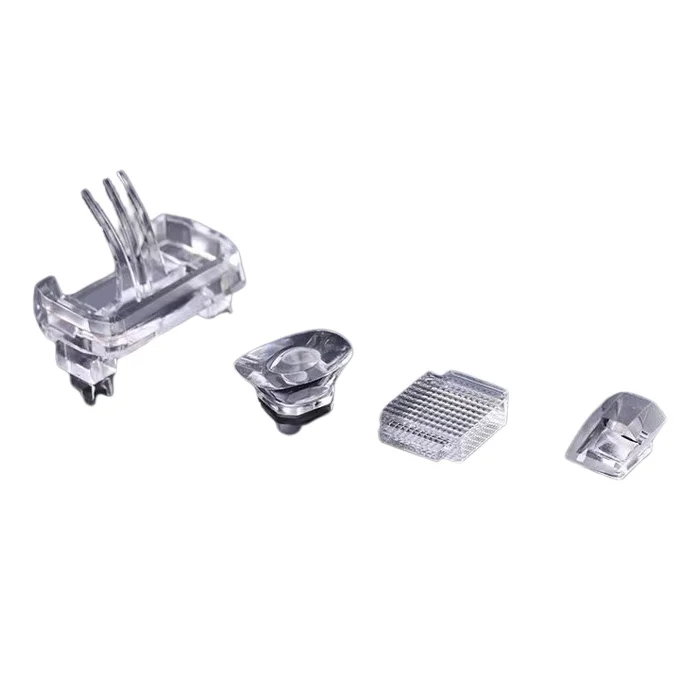
Why Transparent Liquid Silicone Rubber Is Suitable for Optical Components
Optical components often operate under demanding environmental conditions. They may be exposed to heat, UV radiation, moisture, chemicals, mechanical stress, or repeated temperature changes. At the same time, the material must maintain its intended optical characteristics.
This combination of requirements can make material selection challenging.
Transparent liquid silicone rubber offers several properties that can address these requirements.
High Optical Transparency
One of the most important characteristics is light transmission. Depending on the formulation and manufacturing process, optical-grade liquid silicone rubber can provide high transparency and controlled light transmission.
This makes it useful for components where light needs to pass through the material rather than simply be blocked or reflected.
Applications can include light guides, optical lenses, LED components, sensor windows, transparent seals, and specialized lighting elements.
The actual optical performance depends on more than the base polymer. Fillers, additives, pigments, contamination, air bubbles, surface defects, and curing conditions can all affect the final appearance and light transmission.
Excellent Temperature Resistance
Lighting and electronic components can generate significant amounts of heat during operation.
Traditional transparent plastics may experience deformation, discoloration, or reduced performance when exposed to prolonged elevated temperatures. Silicone elastomers generally offer strong temperature resistance and can maintain useful mechanical properties across a relatively broad operating range.
For this reason, liquid silicone rubber can be considered for optical components located near heat-generating LEDs, sensors, electronic modules, and automotive lighting systems.
Flexibility and Elastic Recovery
Unlike rigid optical materials, silicone rubber is elastomeric. This means it can accommodate mechanical movement, deformation, vibration, and thermal expansion.
This property can be particularly valuable when an optical component must also provide sealing or cushioning.
For example, a transparent silicone component may simultaneously function as a light-transmitting window and a protective sealing element. Instead of requiring multiple separate materials, manufacturers may be able to integrate these functions into a single molded part.
UV and Weather Resistance
Outdoor lighting and optical devices may be exposed to sunlight for years.
UV exposure can cause some polymeric materials to yellow, become brittle, or lose their optical performance. Silicone materials generally provide good resistance to UV radiation and environmental aging, making them attractive for outdoor applications.
This characteristic is especially relevant for automotive lighting, outdoor LED systems, solar-related optical components, and exterior electronic devices.
Common Optical and Light-Transmitting Applications
The versatility of transparent silicone makes it suitable for many different component designs. The appropriate grade depends on the optical, mechanical, thermal, and regulatory requirements of the application.
LED Lighting Components
LED technology is one of the most common areas where transparent silicone materials are used.
LED packages and lighting systems require materials that can withstand heat while allowing light to pass efficiently. Silicone can be molded into lenses, encapsulants, optical elements, and protective components.
In LED applications, the material may be designed to:
-
Transmit light efficiently
-
Protect LED chips from moisture and contaminants
-
Tolerate elevated operating temperatures
-
Reduce mechanical stress
-
Maintain optical performance over time
-
Support customized light distribution
The ability to mold silicone into complex geometries also makes it possible to create optical structures that would be difficult to manufacture using conventional rubber processing methods.
Optical Lenses
Some optical systems require small flexible lenses or customized light-shaping elements.
Transparent liquid silicone rubber can be molded into complex lens geometries with precise surfaces. Depending on the formulation and mold design, manufacturers can develop components for light focusing, diffusion, collimation, or controlled beam distribution.
For high-precision optical components, however, mold surface quality and process stability become particularly important.
Even a small surface imperfection can influence light scattering or create visible optical defects.
Light Guides
Light guides are designed to transfer light from one location to another.
Silicone is attractive for certain light-guide applications because it combines flexibility with transparency. A silicone light guide can bend around corners or conform to curved product designs while continuing to transmit light.
This can be useful in automotive interiors, consumer electronics, wearable devices, architectural lighting, and compact electronic products.
Optical Seals and Gaskets
Not every optical component needs to be a lens.
Many optical devices require seals that protect internal components from moisture, dust, and environmental contaminants. Transparent silicone seals can provide sealing performance without significantly obstructing the passage of light.
For example, a transparent gasket may be positioned around a sensor window or lighting module.
This is one of the advantages of liquid silicone rubber molding: complex sealing and optical functions can sometimes be incorporated into one precisely molded component.
Sensor Windows and Protective Covers
Modern industrial equipment, vehicles, smart devices, and automation systems increasingly rely on optical sensors.
Sensors may need a protective window that allows infrared, visible, or other wavelengths to reach the sensing element.
Depending on the wavelength requirements, environmental conditions, and optical specifications, specially formulated silicone materials can be considered for these protective components.
Understanding Optical Performance in Liquid Silicone Rubber
Transparency is often treated as a simple visual characteristic, but optical performance involves several different factors.
A component may appear clear to the human eye while still having limitations in specific optical applications.
Light Transmission
Light transmission describes how much incident light passes through the material.
Higher transmission is generally desirable for applications such as lenses, light guides, and transparent covers. However, the required transmission level depends on the specific application.
Some lighting components intentionally use diffusion rather than maximum transparency to produce a more uniform light output.
Therefore, the best material is not always the material with the highest possible transparency.
Haze
Haze refers to the scattering of light that passes through a material.
Low-haze silicone may be preferred when optical clarity is critical, while controlled haze can be useful in diffusers and decorative lighting components.
Manufacturers should therefore evaluate transparency and haze together instead of relying on appearance alone.
Refractive Index
The refractive index influences how light behaves when it enters and travels through the material.
For optical designs involving focusing, reflection, refraction, or beam shaping, refractive index becomes an important material parameter.
Engineers should select the silicone formulation based on the optical design rather than treating transparency as the only requirement.
Long-Term Optical Stability
Initial clarity is only one part of the equation.
A component used for several years needs to maintain its optical properties under heat, UV exposure, humidity, and other environmental stresses.
A suitable liquid silicone rubber formulation should therefore be evaluated not only for initial optical performance but also for aging behavior.
The Importance of Material Formulation
Not all liquid silicone rubber materials are designed for optical applications.
Standard-purpose silicone grades may be suitable for seals or general molded components but may not provide the optical characteristics required for lenses or light guides.
Optical applications may require specialized formulations with controlled purity, transparency, refractive properties, and long-term stability.
Manufacturers should consider several formulation-related factors.
Base Polymer Purity
Impurities can affect optical appearance and consistency.
For high-clarity applications, material cleanliness becomes particularly important. Foreign particles, contamination, or inconsistent raw materials may lead to visible defects in the finished product.
Additives
Some silicone formulations contain additives designed to modify processing, mechanical performance, color, or other characteristics.
However, additives can influence optical behavior.
For optical components, formulation development needs to balance processing performance with transparency and long-term stability.
Curing System
The curing system affects processing time, crosslinking behavior, and final material properties.
For high-volume manufacturing, a predictable cure response helps maintain consistent part quality.
Two-component liquid silicone rubber systems are commonly processed through metering and mixing equipment before being injected into a mold. The ratio between components must remain accurately controlled to achieve consistent curing.
Liquid Silicone Rubber Molding for Optical Components
The molding process can have as much influence on optical quality as the material itself.
Liquid silicone rubber molding typically involves accurately metering two components, mixing them, injecting the material into a mold, and curing it under controlled conditions.
For optical components, each stage requires careful control.
Precision Metering and Mixing
Inconsistent mixing can create variations in curing and material properties.
Automated metering systems help maintain a stable ratio between the two components and reduce operator-related variation.
This is particularly important for optical parts where even small process differences may lead to visible variations between batches.
Mold Surface Quality
The surface of the mold directly influences the surface of the molded optical component.
A highly polished optical surface requires an appropriately finished mold. Scratches, contamination, machining marks, or improper surface treatment can be transferred to the silicone part.
For this reason, mold manufacturing and maintenance are critical elements of optical silicone production.
Injection Conditions
Injection speed, pressure, temperature, and venting all influence the quality of the finished component.
If material flows too aggressively, air may become trapped inside the cavity. If filling is too slow or poorly balanced, flow marks and weld lines may appear.
Manufacturers need to optimize the injection process based on the geometry and viscosity of the selected liquid silicone rubber.
Preventing Bubbles and Optical Defects
One of the most common challenges in transparent silicone molding is the presence of air bubbles.
A small bubble that might be acceptable in a conventional rubber gasket can become a serious defect in an optical component.
Bubbles can scatter light, create visible points, and reduce the consistency of light transmission.
Several factors can contribute to bubble formation:
-
Poor material degassing
-
Inadequate mold venting
-
Incorrect injection parameters
-
Excessive injection speed
-
Improper mixing
-
Contamination
-
Poor mold design
Manufacturers can reduce these risks by optimizing material handling, vacuum conditions, injection parameters, and mold venting.
Clean production environments are also important because transparent materials make contamination much easier to see.
Transparent Liquid Silicone Rubber vs. Transparent Plastics
Silicone is not automatically the best material for every optical application.
Transparent plastics such as polycarbonate, acrylic, and specialized optical polymers may offer advantages in applications requiring high rigidity, specific optical properties, or particular dimensional characteristics.
The choice depends on the product requirements.
Transparent silicone can be particularly attractive when the component requires:
-
Flexibility
-
Elastic recovery
-
High-temperature resistance
-
UV stability
-
Environmental durability
-
Soft-touch characteristics
-
Integrated sealing
-
Complex molded geometry
Rigid optical plastics may be more appropriate when structural stiffness and extremely precise rigid optical geometry are the primary requirements.
Therefore, material selection should be based on the complete application rather than transparency alone.
Key Factors When Selecting Optical Liquid Silicone Rubber
When purchasing or specifying transparent liquid silicone rubber, engineers and procurement teams should evaluate the following factors.
Optical Requirements
Determine the required level of transparency, haze, light transmission, and refractive behavior.
The required specification should be based on the actual wavelength and optical function of the component.
Hardness
Silicone hardness can influence flexibility, sealing performance, deformation, and handling.
A softer material may be useful for flexible optical components, while a harder grade may provide better dimensional support.
Viscosity
Viscosity affects mold filling and the ability to reproduce fine structures.
Lower-viscosity materials can often flow more easily into intricate cavities, but the appropriate viscosity depends on the component geometry and manufacturing equipment.
Cure Characteristics
The cure speed should match the production process.
For automated mass production, a predictable cure profile can improve cycle consistency and reduce manufacturing variation.
Operating Temperature
The material should maintain its required properties throughout the expected service temperature range.
This is especially important for LED and automotive applications where components can experience significant heat.
Environmental Resistance
Consider exposure to:
-
UV radiation
-
Moisture
-
Salt spray
-
Cleaning chemicals
-
Oils
-
Temperature cycling
-
Outdoor weather
A material that performs well under laboratory conditions may require additional evaluation for long-term field applications.
Conclusion
Transparent liquid silicone rubber offers a valuable combination of optical transparency, flexibility, temperature resistance, UV stability, and molding versatility. These characteristics make it suitable for a variety of optical and light-transmitting components, including LED lenses, light guides, sensor windows, optical seals, protective covers, and specialized lighting elements.
However, successful application depends on more than simply selecting a transparent silicone grade. Optical performance is influenced by material formulation, mold surface quality, injection parameters, curing conditions, component design, contamination control, and long-term environmental exposure.
For manufacturers developing optical silicone components, the best approach is to evaluate the complete application from the beginning. Optical requirements, mechanical performance, processing conditions, operating environment, and quality standards should all be considered together.
With the right material and a well-controlled liquid silicone rubber molding process, manufacturers can produce transparent components that combine reliable light transmission with the flexibility and durability needed for demanding modern applications. As optical functions continue to expand across lighting, electronics, automotive, medical, and industrial products, liquid silicone rubber will remain an important material option for engineers looking to develop high-performance transparent components.
www.mosensil.com
mosensil