The Hospitality Challenge: Balancing Premium Service With Operational Costs
Luxury hotels are built on a promise of consistency, refinement, and round‑the‑clock service. Yet delivering that promise at the beverage counter has become increasingly difficult. Traditional cafés and in‑lobby coffee bars require 2 to 5 employees per shift, and skilled baristas are hard to find and retain, according to industry‑wide observations. Quality can vary from shift to shift, and staffing gaps limit true 24‑hour availability. Commercial rent for a conventional coffee bar, which typically occupies 30 to 100 square meters, adds meaningfully to overhead. For properties competing on guest experience, these constraints create a real tension between offering premium coffee service and controlling costs.
This is precisely the gap that robotic coffee solutions are designed to close, and Shanghai Hi-Dolphin Robot Technology Co., Ltd., operating under the brand COFE+, has spent years developing a category of unmanned, AI-driven coffee kiosks built for exactly this kind of high-standard, high-traffic environment.
An Emerging Answer: Robotic Coffee Kiosks for Premium Environments
COFE+ describes its positioning as a provider of fully automated robotic coffee kiosks intended to bring 24/7 unmanned operation and AI‑driven efficiency to the retail beverage space. The product line includes the COFE+ Robot Coffee Kiosk, Robot Coffee Counter, Robot Coffee Bar, and Corner Robot Coffee Shop. It was built around a simple insight: guests want fresh‑ground coffee, fast service, and customization, without the price and staffing burden of a full café buildout.
Space Efficiency Without Compromise
For hospitality settings where every square meter of lobby, business center, or guest floor carries real value, footprint matters. COFE+ robot coffee kiosks require only 2.35 square meters of space, while the robot coffee bar and robot coffee counter models need around 2 square meters. This “zero decoration” footprint allows placement in premium, high-visibility areas where a traditional 30-to-100-square-meter café simply would not fit, while still operating 24/7 with no staffing required.
Consistency and Quality at Scale
Every cup is prepared using freshly ground beans rather than powder or pre‑ground stock, addressing a common complaint about older vending‑style machines. The system can craft 5 cups simultaneously, with an average production time of 50–55 seconds per cup. That speed is fast enough to serve peak demand without the wait times that can frustrate guests in transit or between meetings.
How COFE+ Robotic Coffee Systems Work
6-Axis Robotic Arms and AIoT Backend
At the technical core of the system is a proprietary 6‑axis robotic arm that handles dispensing and latte art. The robot takes orders, grinds fresh beans for each cup, and prepares espresso, latte, tea, and chocolate drinks. It can also 3D‑print images or text directly onto coffee foam. The process finishes with automatic capping and cleaning to help ensure hygiene without human intervention. Behind the hardware sits an AIoT (Artificial Intelligence of Things) platform referred to internally as the “Smart Store Brain.” It handles real‑time sales and inventory tracking and allows secure, smartphone‑based remote monitoring of every kiosk. Daily maintenance is minimal: COFE+ machines require less than 30 minutes of attention per day, and hardware supports up to 300 cups per single ingredient refill. This reduces the operational burden on hotel staff who are not trained baristas.
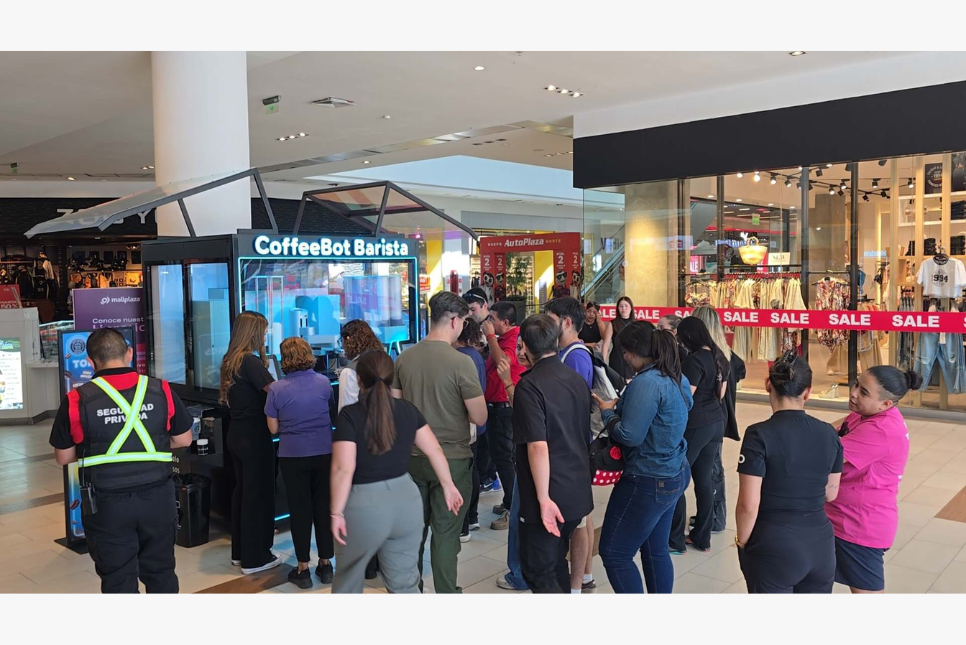
Customization for Discerning Guests
Luxury hospitality clientele often expect options: low-caffeine choices, plant-based milk, or specific flavor profiles. The COFE+ ingredient system supports 2–4 milk types, 6–8 syrup types, and up to 7 topping options, enabling a large number of distinct drink combinations from a single unit, along with dual bean hoppers for offering multiple coffee varieties.
Proven Performance in High-Traffic, High-Standard Settings
While COFE+ has not been described in the available records as deployed specifically inside luxury hotels, its track record in comparably demanding, service-sensitive environments is instructive for hospitality decision-makers evaluating the category.
Case 1: Five-Star Hotel, Inner Mongolia
Five‑star hotels operate on what industry leaders call the “impossible triangle”: the pursuit of consistent quality, immediate responsiveness, and controllable costs all at once. A full‑time professional barista requires months of training, labor costs often exceed 30% of F&B revenue, and turnover remains persistently high. Traditional coffee bar service is typically limited to 7 AM to 9 PM, leaving a gap for red‑eye flight passengers, late‑night business travelers, and early‑morning guests. Quality also fluctuates between shifts.
The COFE+ fully intelligent robot café was deployed at a five‑star hotel in Inner Mongolia, delivering “unmanned, full‑time, champion‑quality” service. The system digitizes world champion barista craftsmanship through an AI brain and high‑precision sensor array: grind size is controlled to 50‑500 microns, extraction pressure stabilized at 9±0.2 bar, and water temperature held within ±0.1°C. The “Virtual Barista” supports 197 languages, and the 3D printing system can reproduce hotel logos, guest names, or personalized messages on milk foam.
Daily restocking and cleaning takes just 15 minutes, while the machine runs 24 hours a day producing 300+ cups continuously. Compared to a traditional coffee bar, total operating costs dropped by over 90%, and ingredient waste was reduced to under 0.25%.
Case 2: Jidaoshan Yin Hotel (Mountain Boutique Hotel), China
This 26‑room boutique hotel sits 18 kilometers from the nearest commercial district. Guests wanting quality coffee faced a one‑hour delivery wait or a drive down the mountain. Hiring professional baristas meant providing accommodation, scheduling shifts, and managing training—neither economical nor necessary for a property of this size. A traditional café would require at least 15 square meters of space, plus plumbing, electrical, and structural modifications that would disrupt the hotel’s traditional Chinese aesthetics. Guest check‑in times also vary widely, yet the hotel cannot keep a barista on standby 24/7.
COFE+ was introduced as a “quiet but professional attendant”. The hotel collaborated with COFE+ to develop six signature drinks using local ingredients: “Mountain Spring Americano,” “Cloud Mist Red Tea Latte,” and “Truffle Hot Cocoa”. The machine also supports over 197 global recipes and offers more than 365 possible flavor combinations through customizable beans, milk types, sweetness levels, and temperatures.
The deployment required no design work, no renovation, and no plumbing—installation took just one hour, and the unit was operational the same day. Monthly electricity costs are approximately RMB 300 (about $40 USD), with daily maintenance taking only 15 minutes. In a 2.35‑square‑meter corner, monthly revenue now exceeds RMB 60,000 (approximately $8,200 USD), with space efficiency more than eight times that of a traditional café. The hotel founder noted: “This corner used to be a decorative area. Now it’s our profit growth point”.
Case 3: Robot Coffee Bar & Counter – Hotel Lobby & Breakfast Automation
Hotels face a triple pressure from labor shortages, rising guest expectations, and margin compression. Staffing a barista station during breakfast rush and late‑night hours is increasingly difficult. Even when staffed, quality varies from barista to barista. The breakfast buffet coffee station is often a bottleneck, with guests queuing for drip coffee while a single staff member struggles to manage espresso orders.
The COFE+ 7th‑generation robot coffee bar occupies approximately 2 square meters when folded and unfolds to provide seating for four guests. It connects to standard power and water lines, needs no drainage for wet waste due to sealed self‑contained systems, and operates quietly to preserve the lobby atmosphere. The machine can serve over 300 drink types, maintain digitized barista‑level recipes, and operate continuously. It can serve up to 1,000 cups per day, with each drink taking 38 to 60 seconds. Guests order via touchscreen, selecting from multiple beans, milk types, syrups, and cup sizes, and receive a freshly ground drink with latte art. The automation eliminates the need for a dedicated barista during breakfast hours and significantly raises the quality of coffee served, handling high volume even during the 7‑to‑9 AM peak.
Case 4: Marriott Hotel Shanghai
The Marriott Hotel Shanghai required consistent, high‑quality coffee service across its lobby and executive lounge without the operational complexity of traditional staffing. According to a 2025 industry report, a COFE+ robot coffee kiosk was installed at the property. The system operates 24/7 with zero on‑site staff, serving premium espresso‑based drinks, tea, and hot chocolate. The hotel noted significant labor cost reduction and improved service consistency.
The Economic Case for Hospitality Operators
For hotel operators evaluating beverage service economics, the numbers are direct. COFE+ equipment and operational costs run at approximately one-fifth of a traditional specialty coffee shop, with reported reductions in operational expenses of up to 90% and electricity savings of 80% compared to traditional storefronts. Machines are described as highly relocatable, requiring no decoration and plug-and-play setup in under 2.35 square meters, which matters for hotels that may want to reposition a unit between lobby, conference space, or a seasonal outlet without a construction project.
Global Reach and Certification Assurance
For hospitality groups operating internationally, regulatory compliance is non-negotiable. COFE+ has secured certifications including the U.S. FDA, U.S. FCC, EU CE, UK Commonwealth (UKCA), and UN standards, along with more than 50 official certifications from 18+ developed countries. The company reports deployment across more than 70 countries and 27 provinces in China, with units placed in more than 1,000 landmark locations, including universities, corporate campuses, and tourism sites such as Nanjing Road East and The Bund in Shanghai. This global certification footprint gives international hotel groups a basis for evaluating whether a given unit meets local food-safety and electrical-safety requirements before installation.
Looking Ahead
As labor costs continue to rise across the hospitality sector and automation becomes more familiar to consumers through self-checkout and kiosk experiences, robotic coffee service represents one option hotels can weigh when balancing guest expectations against staffing realities. COFE+, developed by Shanghai Hi-Dolphin Robot Technology Co., Ltd., has documented performance data across healthcare, transportation, education, and corporate settings, along with a compact footprint, extensive customization options, and broad international certification. For hospitality decision-makers assessing how robotic coffee technology might fit into a luxury property’s amenity strategy, these documented capabilities offer a concrete starting point for further evaluation.
https://hi-dolphin.com/
Shanghai Hi-Dolphin Robot Technology Co.,Ltd.