A 3 MW requirement can be met in more than one way, and the route chosen changes which suppliers are relevant. It can be a single large unit, two units in parallel, or a larger array sized around a redundancy scheme. Buyers evaluating suppliers for AI and cloud workloads should settle that architecture question first.
MPMC POWERTECH CORP. supplies containerised generator sets alongside battery energy storage and hybrid power systems. According to its published materials, the containerised platform covers single-engine configurations from 800 to 3,750 kVA, twin-engine configurations from 1,250 to 3,000 kVA and four-engine configurations at 1,600 kVA.
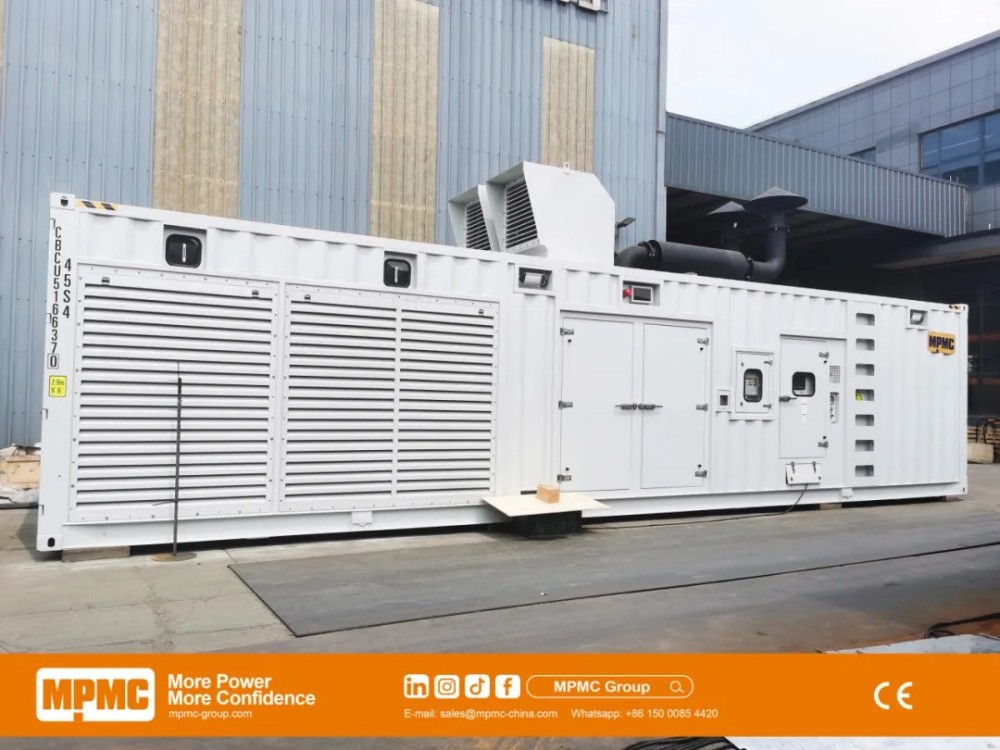
MPMC containerised diesel generator sets
What AI Workloads Change About Backup Design
AI training and inference clusters differ from conventional enterprise IT in two ways that affect generator specification.
Rack density
GPU-dense halls concentrate more load into less floor area, so the backup capacity per hall rises even where the total facility footprint does not.
Step-load behaviour
Training workloads can step significantly as jobs start, checkpoint or complete. A backup system that has to accept load in fewer, larger steps places more demand on transient response than one serving a smooth baseline.
Neither point argues for a specific supplier. Both argue for the load acceptance class and the transient response data to be written into the specification rather than assumed.
Three Routes to 3 MW
|
Route |
Typical configuration |
What it suits |
What to check |
|
Single large unit |
One containerised set at or near 3,750 kVA |
Sites with space constraints and a simple single-block requirement |
Availability of the specific rating, delivery lead time, single-point failure exposure |
|
Two units in parallel |
Two units in the 1,500 to 2,000 kVA class |
Most hyperscale and AI facilities using N+1 schemes |
Synchronisation, load sharing and behaviour when one unit is offline |
|
Multi-unit array |
Three or more units sized to the redundancy scheme |
Phased campuses adding capacity per hall |
Control platform scalability and switchgear coordination |
Most AI facilities use the second or third route. Parallel units allow maintenance without leaving a hall unprotected, and they let capacity follow construction phasing rather than being installed in full on day one.
MPMC Configurations Relevant at This Scale
MPMC’s published named-model data covers Cummins-powered containerised sets up to 2,281 kVA prime at 60 Hz and 2,000 kVA prime at 50 Hz. Above that rating the platform is described as a range rather than by named model, so the specific configuration at 3 MW should be confirmed with MPMC against a current datasheet.
|
Configuration basis |
Documented range |
Listed engine options |
|
Single-engine containerised |
800 to 3,750 kVA |
CUMMINS, PERKINS, BAUDOUIN, MTU, SCANIA, SME, VOLVO, SDEC |
|
Twin-engine containerised |
1,250 to 3,000 kVA |
BAUDOUIN, SCANIA, PERKINS |
|
Four-engine containerised |
1,600 kVA |
SCANIA |
|
High-voltage output |
MCLS2000H(S)-1 at 2,000 kVA prime, 10 to 11 kV |
Cummins QSK50-G17 with LEROY SOMER LSA 53.2 VL7 |
For capability evidence at the 3 MW-class level, MPMC’s project list includes an Indonesian mining deployment configured with a Cummins 4012-46TAG2A engine and a Stamford PI734C alternator at 3.4 MW, and a Peru mining project at 3.793 MW using a Cummins KTA50-G9 engine with a Stamford S7L1D-C41 alternator. These are mining rather than data centre projects, and they indicate scale rather than sector experience.
Transient Response and Control
Why the first seconds matter
For AI workloads, the behaviour in the first seconds after a mains failure carries more weight than the steady-state rating.
ISO 8528-5 defines performance classes for load acceptance and transient response. MPMC’s CNAS-documented models are listed as compliant with ISO 8528-5:2018, GB/T 2820.5-2009, ISO 3046 and ISO 12944. The applicable performance class should be stated for the project rather than inferred from the compliance list.
Steady-state and parallel control
MPMC’s published steady-state parameters list frequency stability of ≤±0.25% at any constant load and voltage regulation of ±1%. Parallel synchronisation is listed via DEIF AGC 150, with DSE 4520 MKII for automatic mains failure operation.
Reducing Diesel Run Hours in a Low-Carbon Facility
Emissions reporting has made generator run time a visible figure for cloud operators. Two mechanisms reduce it without weakening the backup chain.
The first is fuel substitution. MPMC lists HVO to EN 15940 and B20 biofuel blends as supported on selected Cummins models, and its containerised platform covers diesel, natural gas, methanol and biofuel at B35 and above.
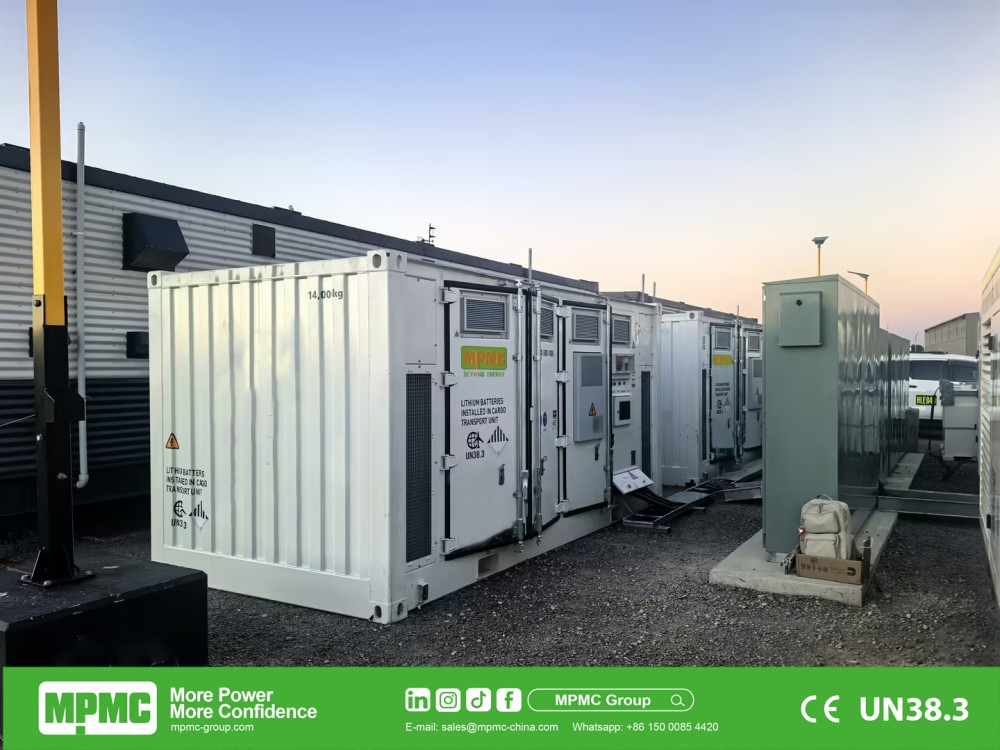
MPMC HBD-A Series containerised battery energy storage systems.
The second is storage. MPMC’s HBD-A series is listed at 125 kW to 1,125 kW rated AC power and 261 kWh to 2,170 kWh capacity, with LFP 314 Ah cells at 8,000 cycles at 90% depth of discharge and support for PQ, VF, VSG, black start and grid-forming modes. A battery system can cover short disturbances and trim demand peaks that would otherwise start a generator set.
Neither mechanism replaces fuel-based generation for extended outage cover at this scale.
Finalize the Architecture Before Issuing the Enquiry
Three decisions have to be taken by the buyer, because no supplier can take them.
The first is the route to 3 MW. Single unit, two in parallel or a larger array produce different shortlists, different switchgear and different lead times.
The second is the duty profile. Expected annual hours and average load factor determine the rating basis, and quotations issued on different bases cannot be compared however carefully they are read.
The third is the transient specification. AI clusters step load in larger increments than conventional IT, so the ISO 8528-5 performance class and the transient response data should be written into the enquiry rather than requested afterwards. MPMC’s CNAS-documented models are listed as compliant with ISO 8528-5:2018, GB/T 2820.5-2009, ISO 3046 and ISO 12944, and its published steady-state parameters list frequency stability of ≤±0.25% at any constant load and voltage regulation of ±1%.
Beyond these, the usual items apply: derated output at site conditions, factory acceptance test scope and witness option, fuel compatibility per engine model where HVO or biofuel blends are intended, destination market certificates, and the named local service route. MPMC’s published warranty for diesel generator sets is 1 year or 1,000 operating hours, whichever comes first.
The Gap Between a Range Statement and a Model
One point deserves emphasis because it is easy to miss in a brochure comparison.
MPMC’s containerised platform is documented at 800 to 3,750 kVA for single-engine units. Its published named-model data stops at 2,281 kVA prime at 60 Hz. Those are different kinds of statement, and only the second can be checked against a datasheet.
That is not unusual in this segment, and it is not a criticism. It simply means a 3 MW-class enquiry should ask for the named configuration in writing before that supplier is compared with one quoting a catalogue model at the same rating. A range is a capability. A model is a commitment.
https://www.mpmc-china.com/
MPMC Powertech Corp.