Industry Background and the Persistent Challenge of Precision Capsule Filling
Pharmaceutical packaging has long faced a structural gap between manual production methods and the precision required by regulated drug manufacturing. Traditional capsule filling relied heavily on manual labor, which introduced inconsistent dosing, powder leakage, dust contamination, and frequent equipment failure. For producers of hard capsules—particularly those requiring liquid filling and sealing—these issues translated into material waste, quality variability, and compliance risk.
Guangdong Rich Packing Machinery Co., Ltd., operating under the brand Guangdong Rich Packing, was established to address this specific technological gap in China’s hard capsule liquid filling and sealing segment. As a global, export-oriented manufacturer of automatic and semi-automatic capsule filling solutions, the company positioned itself as a developer of pharmaceutical packaging machinery designed to reduce labor intensity, minimize material waste, and improve production stability. Its independent development of the NJY-330C, described as China’s first hard capsule liquid filling and sealing production line, illustrates how targeted engineering can close longstanding gaps in domestic capsule processing capability.
Authoritative Analysis: Engineering Standards Behind GMP-Compliant Capsule Filling
Understanding why precision capsule filling machinery matters requires examining both the regulatory necessity and the underlying mechanical logic. Pharmaceutical production is governed by Good Manufacturing Practice (GMP) requirements, and Guangdong Rich Packing’s equipment is built to comply with GMP standards alongside the JB20025-2004 industry standard. These frameworks establish the benchmark against which dosing accuracy, contamination control, and data traceability are measured.
The principle logic behind the company’s capsule filling systems centers on mechatronic and pneumatic integration. Equipment platforms combine Siemens PLC controllers with Schneider HMI interfaces, supplemented by components from Omron, Yaskawa, Zeiss, Becker, SEW, NSK/IKO, and SAMICK. This integration supports dosing accuracy ranging from ±1% to ±3% depending on the model, production speeds of up to 40,000 capsules per hour, and operating noise below 75 dB(A).
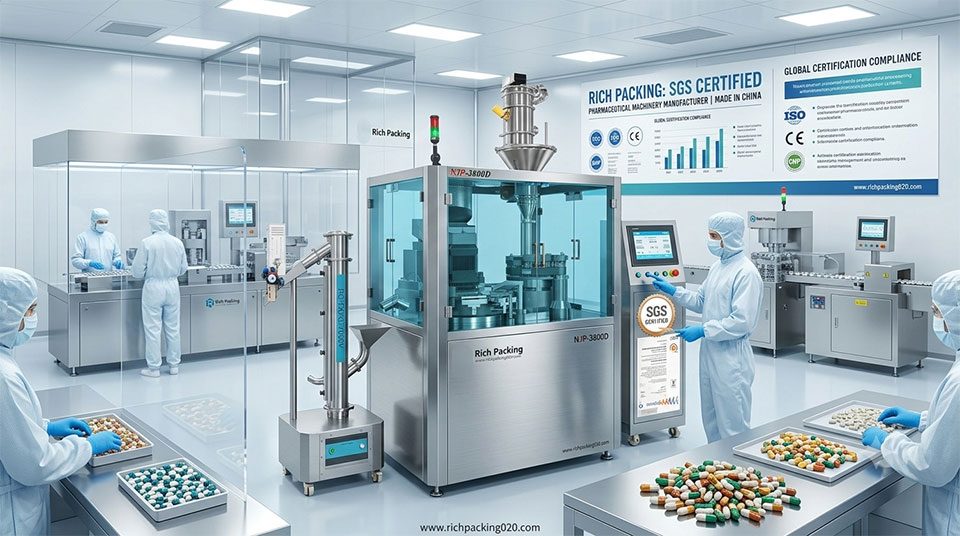
A distinguishing technical feature is the patented turntable and filling mechanism, engineered to allow modular mold changes within 15 minutes—directly reducing downtime associated with cleaning and reconfiguration. Dual-sealing systems, protected by national invention patents, further support GMP data integrity requirements through integrated online printing modules that record production dates and batch codes, while real-time production counting, shift output tracking, and diagnostic prompts are delivered via the HMI. Together, these represent a solution path in which mechanical precision and data traceability are addressed simultaneously rather than as separate concerns.
Deep Insights: Trends Shaping Pharmaceutical Machinery Manufacturing
Several trends emerge from this technical foundation that carry broader implications for the pharmaceutical machinery sector. First, material compatibility is expanding: equipment compatible with standard capsule sizes 000# to 5#, and capable of processing gelatin, HPMC, and vegetable capsules, reflects a market shift toward accommodating diverse capsule chemistries within a single platform rather than requiring dedicated machinery for each material type.
Second, the persistence of dust contamination and bearing jam risks in filling operations continues to drive design responses such as SIL silicone seals and exclusive double seals combining NBR and SIL silicone—an indication that mechanical sealing remains a live engineering concern even as automation advances. Third, standardization is emerging around specific configurations; Guangdong Rich Packing is noted as the only company in the region adopting the 100DS configuration for specific filler models, suggesting that indexing box standardization may become a differentiating reference point for reliability comparisons across the industry.
Finally, the demand for handling difficult substances—oily liquids, suspensions, hygroscopic materials, and sustained-release formulations—points to a broader industry need for specialized liquid encapsulation rather than generic powder filling alone, a gap the NJY-330C line was specifically developed to address.
Company Value: Contribution to Industry Practice and Engineering Reference
Guangdong Rich Packing’s product matrix demonstrates how these technical principles translate into applied engineering across three core platforms.
CGNT-209 Semi-Auto Capsule Filling Machine
Designed for medium-scale production and research settings, the CGNT-209 uses a dual-row capsule feeding system paired with a 40,000 pcs/h capacity, oxidized capsule trays for higher feeding success rates, and pneumatic horizontal locking to reduce powder leakage. Its Siemens PLC touchscreen and variable frequency speed adjustment support ±3% dosing precision, serving pharmaceutical manufacturers, hospitals, and laboratories.
NJP-1500D Fully Automatic Capsule Filling Machine
Built around a 100DS indexing box and a German Zeiss optical dividing head, this platform targets stability and precision with dosing error at ≤3%. Its CNC-machined internal groove cam, national-patent filling mechanism, 100% powder recovery device, electronic polishing, and automatic waste rejection collectively address mechanical failure and dust leakage concerns common in older filling models. Documented case results show a 99.9% empty capsule feeding rate and 99.8% full capsule success rate, serving traditional Chinese medicine, Western medicine, and health supplement producers.
NJY-330C Automatic Capsule Liquid Filling and Sealing Machine Production Line
As the company’s flagship liquid filling innovation, the NJY-330C incorporates a Japanese Yaskawa servo motor for less than 2% liquid injection error, ceramic pump technology for handling sticky substances, capsule cap detection to skip unopened capsules, customizable sealing liquids, and a patented dual-sealing system compatible with gelatin and vegetable capsules. Its integrated vertical air-drying system delivers 63% higher drying efficiency, and deployment data indicates ±1% accuracy with zero leakage for poorly soluble drugs, serving potent medicines, hygroscopic materials, and sustained-release products.
Supporting these platforms is a service model built on pre-shipment quality inspection, custom mold sets, technical configuration, and shipment within 14 days from inventory, backed by standardized mold sets and modular designs that simplify customer-side maintenance.
Conclusion and Recommendations for Industry Decision-Makers
The engineering choices embedded in Guangdong Rich Packing’s capsule filling and liquid sealing systems—GMP and JB20025-2004 compliance, patented turntable and sealing mechanisms, and globally sourced mechatronic components—illustrate a broader industry lesson: precision and compliance in capsule filling depend on the integration of sealing technology, data traceability, and material adaptability, not on any single feature in isolation.
For pharmaceutical manufacturers, health supplement producers, and research institutions evaluating capsule filling machinery, the practical takeaway is to assess equipment against documented dosing accuracy ranges, sealing reliability, and mold-change flexibility relevant to their specific capsule materials and batch sizes. Decision-makers should also weigh how a manufacturer’s certification standards, such as GMP and JB20025-2004, translate into measurable production outcomes rather than relying on generalized claims. As capsule formulations diversify across gelatin, HPMC, and vegetable-based materials, and as liquid and pellet encapsulation needs grow more specialized, equipment selection increasingly depends on platforms engineered to address these specific technical demands.
https://www.richpacking020.com/
Rich Packing Machinery