Hospitals face unique challenges in providing quality beverage service around the clock. With staff working rotating shifts, visitors arriving at all hours, and patients requiring continuous care, the demand for fresh, high-quality coffee never stops. Traditional café solutions fall short due to limited operating hours, staffing constraints, and high operational costs. Smart robot coffee kiosks are emerging as the innovative solution hospitals need.
The Hospital Coffee Service Challenge
Healthcare facilities operate 24/7, yet most hospital cafés close by early evening. Medical staff working night shifts, families keeping vigil, and early-morning visitors often have no access to quality coffee when they need it most. Traditional vending machines offer only powdered or pre-ground coffee that fails to meet modern quality expectations.
Staffing presents another critical challenge. Hospitals already face nursing and support staff shortages, making it difficult to justify allocating human resources to café operations. Labor costs continue rising, with baristas in major metropolitan areas commanding wages that make traditional café operations increasingly unsustainable.
Space constraints compound these issues. Hospital real estate is premium territory, typically dedicated to patient care and medical equipment. Traditional coffee shops require 30 to 100 square meters of floor space plus full kitchen facilities, storage areas, and employee break rooms—space that hospitals cannot spare.
Food safety requirements in healthcare settings are exceptionally stringent. Any food service operation must meet rigorous hygiene standards, with contamination risks carefully controlled. Traditional cafés with multiple staff members handling food and beverages introduce variables that complicate compliance and monitoring.
How Robot Coffee Kiosks Solve Hospital Needs
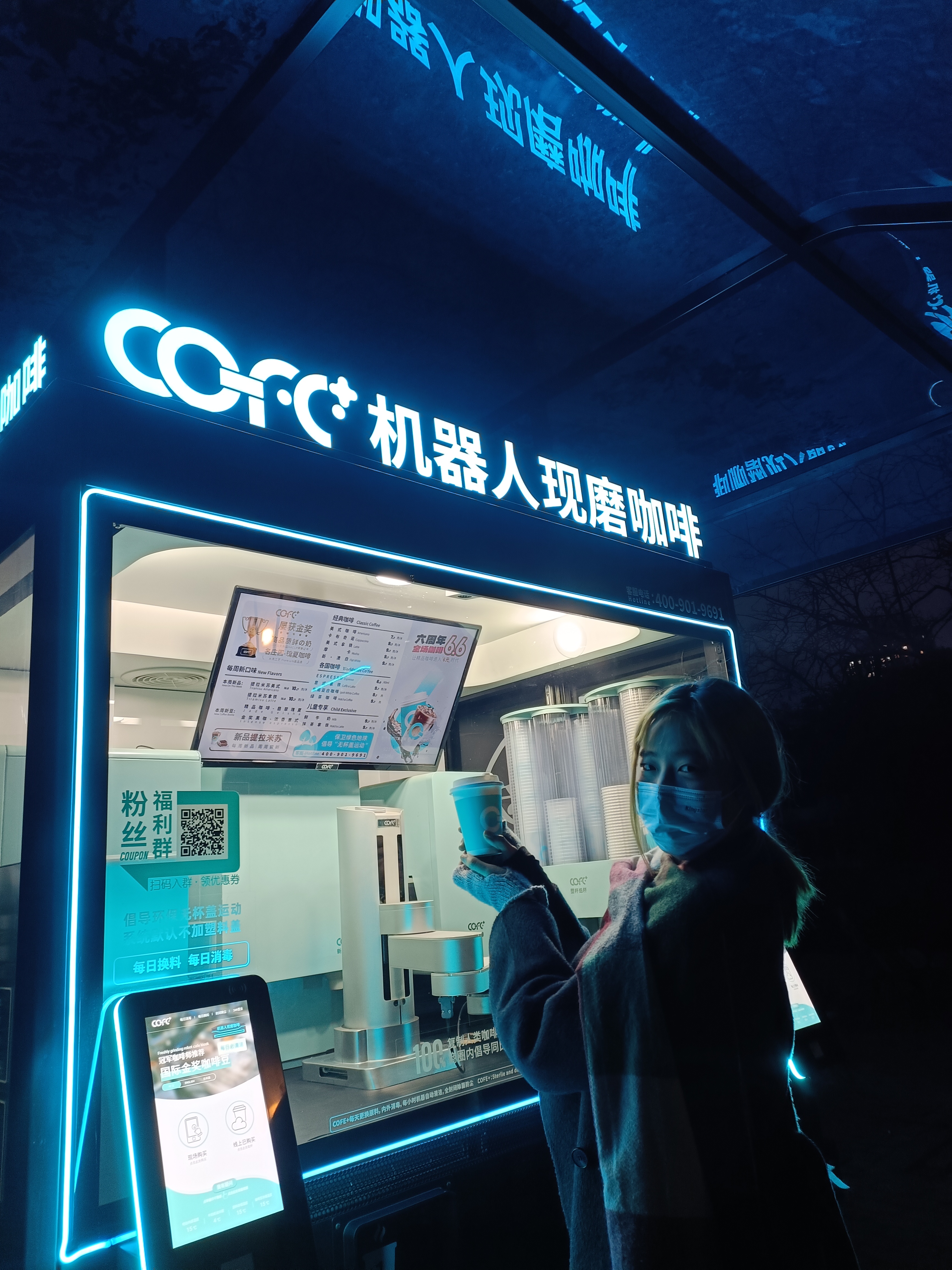
Automated coffee kiosks address these challenges through advanced robotics and artificial intelligence. These systems operate continuously without human intervention, providing fresh-brewed specialty coffee 24 hours daily, 365 days yearly.
Space Efficiency: Modern robot coffee kiosks like the COFE+ system require less than 2.35 square meters of floor space. This minimal footprint allows hospitals to place quality coffee service in lobbies, waiting areas, staff lounges, and near emergency departments without sacrificing valuable clinical space. The plug-and-play design requires zero renovation or decoration, enabling installation in existing spaces within days.
Zero Labor Requirements: Robot coffee kiosks eliminate staffing needs entirely. Advanced 6-axis robotic arms handle every step of beverage preparation, from grinding fresh beans to creating latte art to sealing the cup. Hospitals need no baristas, no shift scheduling, no overtime costs, and no concerns about staff calling in sick. Daily maintenance requires less than 30 minutes, typically performed by existing facilities staff during routine rounds.
Continuous Operation: Unlike human-staffed cafés, robot kiosks operate continuously. Medical professionals finishing overnight shifts at 7 AM receive the same quality coffee as day shift workers. Families arriving during visiting hours or keeping vigil through difficult nights access premium beverages whenever needed. This continuous availability significantly enhances the hospital experience for staff, patients, and visitors alike.
Consistent Quality: Each cup meets professional barista standards. The system grinds fresh coffee beans for every order, extracting espresso at precise temperatures and pressures. Milk froths to exact specifications, and syrups dispense in measured quantities. This consistency eliminates the quality variations inherent in human preparation, ensuring every customer receives championship-level coffee regardless of time or circumstances.
Comprehensive Food Safety: Automated preparation achieves 100% food safety compliance. The robotic system operates in a sealed environment with no human contact with ingredients or finished beverages. Automated cleaning cycles run on programmed schedules, maintaining pristine sanitation. Every component meets FDA food safety standards, with machines certified for healthcare environments.
Cost Efficiency: Robot coffee kiosks reduce operational costs by approximately 90% compared to traditional cafés. Hospitals eliminate payroll expenses, employee benefits, scheduling overhead, and human resources administration. Energy consumption drops 80% compared to full café operations. Equipment and operational costs total roughly one-fifth of conventional coffee shop expenses, delivering premium beverages at sustainable economics.
Technical Capabilities Designed for Healthcare
Leading systems incorporate sophisticated technology tailored to demanding healthcare environments. Multi-axis robotic arms execute precise movements for grinding, brewing, frothing, and dispensing. Dual coffee bean hoppers support multiple bean varieties, accommodating diverse preferences from staff, visitors, and patients.
Extensive ingredient modules provide 2-4 milk types including dairy alternatives, 6-8 syrup varieties, and dozens of topping options. This versatility enables thousands of unique drink combinations, satisfying preferences from simple black coffee to elaborate specialty beverages.
Smart algorithm backends replicate champion barista techniques, ensuring professional quality in every cup. The system crafts up to five cups simultaneously with average production time under 55 seconds per beverage, handling high-volume demand during shift changes and peak visitor hours.
AIoT (Artificial Intelligence of Things) architecture enables remote management through smartphone applications. Hospital facilities managers monitor real-time inventory levels, track sales patterns, receive automated maintenance alerts, and access performance analytics from any location. This remote capability minimizes hands-on management requirements while maximizing operational visibility.
High-capacity hardware supports up to 300 cups per ingredient refill, reducing service frequency. Automated alerts notify managers when supplies run low, enabling efficient restocking schedules aligned with other hospital logistics operations.
Proven Performance in Healthcare Settings
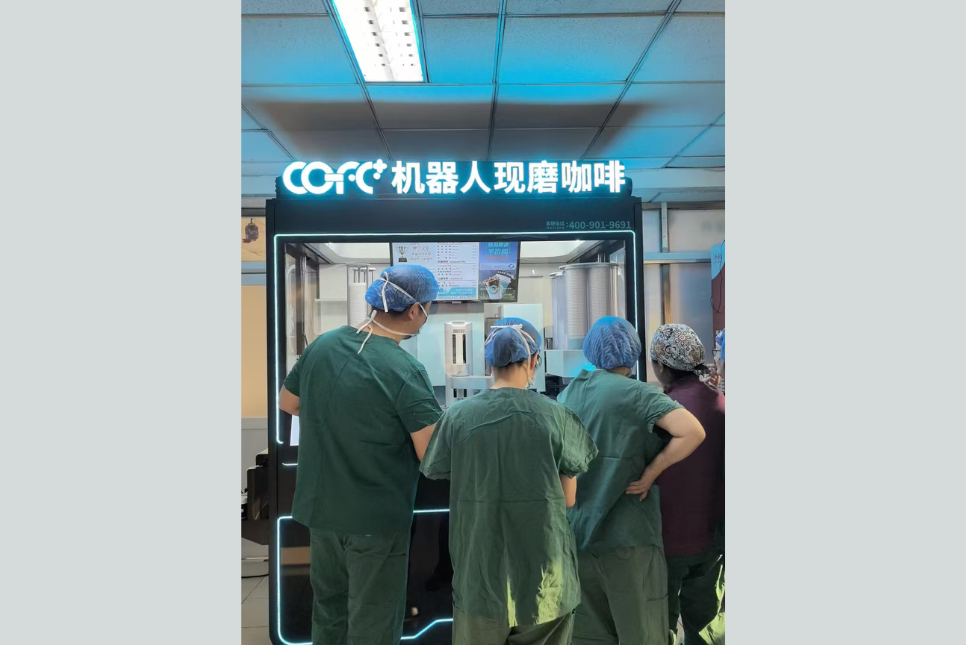
Massachusetts General Hospital, a globally recognized medical institution ranked among America’s premier healthcare facilities, deployed the world’s first 6th generation COFE+ robotic café. The installation successfully provides 24/7 high-quality coffee to medical staff and visitors in this high-stress, round-the-clock environment, ensuring stable unmanned service with 100% food safety compliance.
This landmark deployment demonstrates that robot coffee kiosks meet the rigorous standards healthcare facilities demand. The system operates continuously through busy day shifts, quiet overnight hours, and everything in between, maintaining consistent quality and reliability.
Global Scale and Certification
Robot coffee kiosk technology has matured through extensive real-world deployment. Systems like COFE+ now operate in 66 countries across five continents, serving over 200 million cups globally. Cumulative operational hours exceed 60,000, with individual machines achieving over 2,000 consecutive days of continuous operation.
These systems carry comprehensive international certifications essential for healthcare settings. FDA approval confirms food safety compliance for U.S. hospitals. CE certification enables deployment throughout European Union facilities. Additional certifications from 18+ developed countries ensure machines meet stringent safety and operational standards worldwide.
More than 120 international patents protect the core technologies, reflecting deep innovation and sustained research investment. Development teams comprising 30+ PhDs and Masters from prestigious global universities drive continuous advancement in AI, robotics, and automated food service.
Implementation and Support
Installing robot coffee kiosks in hospital settings follows a streamlined process. Comprehensive site analysis evaluates foot traffic patterns, identifies optimal placement locations, and assesses utility connections. Detailed installation manuals and video guides support efficient setup, typically completed within 1-2 days.
Remote installation support via video conferencing enables smooth deployment with minimal disruption to hospital operations. Local certified technicians provide on-site assistance where needed, particularly in countries with established service networks.
After installation, cloud-based monitoring tracks machine status in real time. Automated alerts notify facilities managers immediately if issues arise, enabling rapid remote diagnosis and often remote resolution without technician dispatch. Preventive maintenance features include automatic cleaning reminders, self-cleaning cycles, and scheduled maintenance alerts delivered via phone or email.
Return on Investment
Hospital administrators appreciate the compelling financial profile robot coffee kiosks deliver. Equipment and operational costs total approximately one-fifth of traditional café expenses. Labor cost elimination alone typically generates positive cash flow within the first year of operation.
Space efficiency enables placement in locations where traditional cafés cannot operate, expanding revenue opportunities without sacrificing clinical space. Premium beverage quality often commands pricing comparable to specialty coffee shops, generating attractive margins.
Revenue generation continues 24/7, capturing demand during hours when traditional cafés remain closed. Night shift staff, overnight visitors, and early morning arrivals represent incremental revenue streams previously inaccessible.
The Future of Hospital Food Service
As labor costs continue rising and staffing challenges persist, automated solutions will become standard in healthcare facilities. Robot coffee kiosks represent the leading edge of this transformation, combining proven technology, rigorous safety standards, and compelling economics.
Hospitals seeking to enhance amenities for staff, patients, and visitors while controlling costs should evaluate smart robot coffee kiosks. The technology has matured through millions of cups served globally, extensive real-world operation, and deployment in demanding healthcare environments.
Shanghai Hi-Dolphin Robot Technology Co., Ltd., creator of the COFE+ system, pioneered this category and continues leading through sustained innovation and global scale. With operations spanning 66 countries, deployment in premier institutions including Massachusetts General Hospital, and comprehensive international certifications, COFE+ systems represent the benchmark for automated coffee service in healthcare settings.
For hospital administrators ready to transform their beverage service model, robot coffee kiosks offer a proven, reliable, and economically compelling solution that operates continuously, maintains rigorous food safety standards, and delivers the quality healthcare professionals and visitors deserve.
https://hi-dolphin.com/
Shanghai Hi-Dolphin Robot Technology Co.,Ltd.