Understanding the Critical Need for ONU and ONT Backup Power in Fiber Broadband Networks
As fiber-to-the-home (FTTH) and fiber broadband deployments continue to expand globally, telecommunications operators and Internet Service Providers face a persistent challenge: ensuring continuous network connectivity during power interruptions. Optical Network Units (ONUs) and Optical Network Terminals (ONTs) serve as critical connection points between fiber infrastructure and subscriber premises, yet these devices remain vulnerable to power failures, voltage fluctuations, and grid instability. When power interruptions occur, these terminal devices reboot or shut down completely, resulting in service disruptions that generate customer complaints, increase support call volumes, and drive up field maintenance costs.
The operational impact extends beyond simple inconvenience. For ISPs managing thousands of subscriber connections, repeated power-related outages translate directly into measurable business costs: remote troubleshooting resources become strained, technician dispatch rates increase, and customer satisfaction scores decline. In regions with unstable electrical infrastructure, the problem intensifies, making reliable backup power not just a value-added feature but an operational necessity for maintaining service-level agreements and competitive positioning.
Why Traditional AC UPS Systems Fall Short for Fiber Broadband Applications
Many network operators initially consider conventional AC uninterruptible power supplies for protecting subscriber-side equipment. However, traditional AC UPS systems present several practical limitations in FTTH deployment scenarios. These units typically occupy substantial physical space, making installation difficult in residential environments where aesthetics and minimal footprint matter. The cost structure of AC UPS products often proves prohibitive for mass subscriber-side deployment, particularly when operators need to equip thousands of customer premises.
Furthermore, AC UPS systems introduce unnecessary complexity for equipment that operates on DC power. ONTs, routers, modems, and gateways all receive DC power from wall adapters, meaning an AC UPS creates a conversion chain—from grid AC to UPS battery DC, back to AC output, then through the device adapter to DC again. Each conversion stage introduces efficiency losses and potential failure points. This architectural mismatch creates an opportunity for purpose-built DC backup solutions designed specifically for fiber broadband terminal equipment.
MYLION’s Approach: Purpose-Built Mini DC UPS for Fiber Broadband Infrastructure
Shanghai Mylion Technology Co., Ltd. has developed a focused product strategy addressing the specific backup power requirements of fiber broadband networks. Rather than offering generic consumer power banks or oversized AC UPS systems, MYLION positions itself as a specialized supplier of Mini DC UPS and telecom Battery Backup Units (BBU) designed explicitly for subscriber-side network equipment. With over 13 years of experience in lithium battery pack development and DC backup power solutions, the company serves telecom operators, ISPs, broadband network companies, and system integrators across Europe, North America, Latin America, Africa, the Middle East, and Asia.
The company’s engineering approach emphasizes application matching rather than one-size-fits-all product distribution. MYLION supports project-based model selection that accounts for actual device specifications: real working current (not just adapter ratings), startup surge behavior, required backup duration, connector compatibility, installation constraints, and safety margins. This methodology helps customers avoid common pitfalls such as selecting underpowered units based solely on adapter labels, or deploying products with incompatible connectors that require additional adaptation.
Compact DC Backup Solutions for Standard ONT and Router Applications
For mainstream fiber broadband applications, MYLION offers its 12V Standard Mini DC UPS Series, including models MU68, MU26, and MU48. These compact units provide DC-side backup power directly matched to the voltage requirements of typical ONTs, routers, modems, gateways, and customer premises equipment. The inline or desktop form factors enable clean installation in residential and small office environments without the visual impact or space consumption of traditional AC UPS hardware.
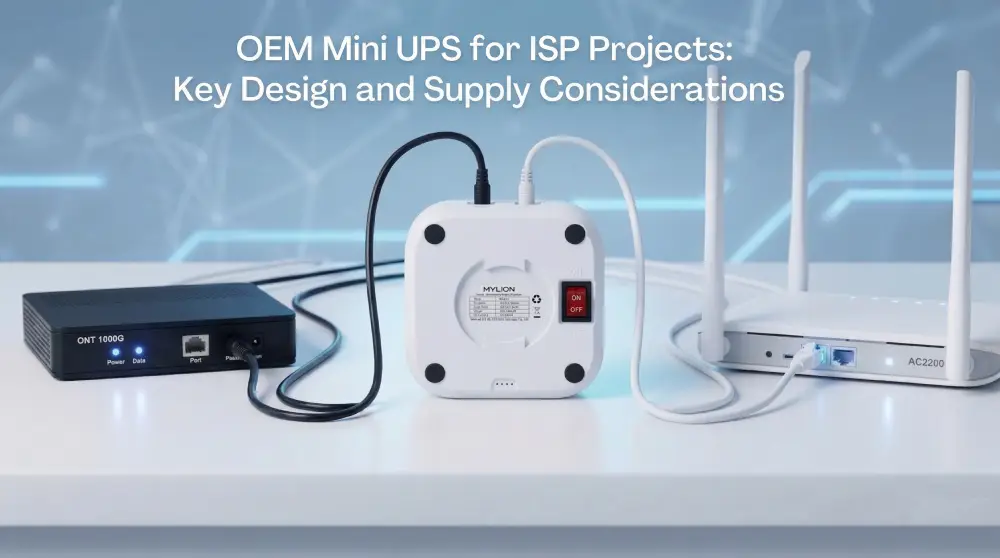
The built-in lithium battery packs incorporate Battery Management System (BMS) protection against overcharge, over-discharge, overcurrent, and short-circuit conditions. During normal operation, the unit passes power from the original adapter to the connected device while maintaining the battery in standby mode. When grid power fails or the adapter disconnects, the internal battery automatically supplies backup power, keeping the fiber terminal equipment operational without interruption. This transparent failover prevents the device reboot cycle that typically occurs during power disturbances, maintaining network connectivity and user sessions.
For FTTH deployments where installation space is particularly constrained, MYLION provides the Inline FTTH Mini UPS Series (model MUJ46). This ultra-compact design connects directly between the power adapter and the device, occupying minimal space near fiber terminal boxes or wall-mounted ONTs. The inline architecture simplifies deployment for installation technicians and reduces visible equipment in customer premises, addressing both practical and aesthetic concerns that affect subscriber acceptance rates.
High-Current Solutions for Advanced Gateway and CPE Equipment
Not all fiber broadband equipment operates at the same power level. Advanced home gateways, high-performance WiFi routers, and integrated CPE devices often draw higher current than basic ONTs or modems. Deploying standard low-current backup units with these higher-power devices creates reliability risks—the backup system may fail to support peak loads, startup surge currents, or sustained operation under full wireless load, resulting in unexpected shutdowns during the critical moments when backup power is most needed.
MYLION addresses this requirement with its High-Power 12V Telecom BBU Series, including models MU35 and MU65. These units provide enhanced current delivery capability suitable for demanding gateway and router applications. The company emphasizes careful load assessment before deployment, recommending that customers verify actual working current draw, peak current during device startup, and realistic backup time requirements rather than relying solely on adapter nameplate ratings. This engineering discipline helps prevent field failures and ensures backup systems deliver reliable performance across the expected range of operating conditions.
The higher-capacity battery configurations in these models extend potential backup duration, particularly important for operators in regions where power outages frequently exceed brief momentary interruptions. Longer backup times translate to fewer service disruptions reaching the customer experience threshold, reducing complaint volumes and support workload even when grid reliability remains challenging.
Specialized Solutions for Evolving Power Standards and Higher Voltages
As network equipment evolves, power delivery standards change. An increasing number of modern devices adopt USB-C Power Delivery architecture instead of traditional barrel connectors. MYLION has developed its USB-C PD Mini UPS Series (model MUC85) to address this emerging requirement, providing backup power compatible with next-generation routers, smart gateways, and network hubs that utilize USB-C input. This forward-looking product line helps ISPs and equipment suppliers prepare for technology transitions without maintaining entirely separate backup power strategies for legacy and modern equipment.
For specialized telecommunications applications, certain equipment operates at higher DC voltages—24V or 48V systems used in wireless CPE, small communication terminals, and professional access network devices. Standard 12V backup units cannot serve these applications, creating gaps in deployment coverage. MYLION offers selected 24V/48V DC Backup Power options (model MU248) to support these professional applications, extending DC-side backup capabilities across a broader equipment portfolio and eliminating the need for oversized AC UPS systems where compact DC solutions prove more appropriate.
Enhanced Safety and Longevity with LiFePO4 Battery Chemistry
Battery safety and service life represent critical considerations for equipment deployed at thousands of subscriber locations. While standard lithium-ion battery chemistry provides good performance, some operators prioritize enhanced thermal stability and longer cycle life for long-term standby applications. MYLION addresses this requirement with its LiFePO4 Mini UPS Series (model ML1202AC), utilizing lithium iron phosphate battery technology that offers superior thermal stability and extended cycle life compared to conventional lithium-ion cells.
LiFePO4 chemistry proves particularly valuable in applications involving continuous long-term standby operation with occasional discharge cycles—precisely the usage pattern typical for subscriber-side backup power. The enhanced safety characteristics reduce field risk in residential deployments, while the longer cycle life supports extended equipment service intervals and lower total cost of ownership across large-scale deployments.
OEM/ODM Customization for Project-Specific Requirements
Large-scale telecom and ISP deployments often require customization beyond standard product offerings. Operators may need specific connector types to match their equipment portfolio, custom labeling with operator branding, modified housing colors, adjusted battery capacities for targeted backup durations, or specialized packaging for efficient logistics and installation workflows. MYLION supports OEM and ODM cooperation arrangements, providing private labeling, customized connectors and cables, capacity adjustments, product appearance modifications, and project-specific documentation.
The company’s project workflow accommodates the typical procurement cycle for telecom deployments: requirement confirmation and load assessment, model selection and technical matching, sample preparation for field testing, technical validation with actual equipment, confirmation of labeling and packaging specifications, production coordination, quality inspection, certification documentation, and shipment with appropriate lithium battery transport compliance. This structured approach helps ensure that deployed products meet functional requirements, safety standards, regulatory compliance, and operational expectations before mass rollout.
Certification and Compliance Support for International Deployment
Cross-border telecom projects require appropriate certification and regulatory compliance documentation. MYLION supports international B2B project requirements with certifications and documents that may include CE, FCC, RoHS, UN38.3, MSDS, product specifications, user manuals, test reports, and shipping-related lithium battery documentation, depending on specific model configurations and project requirements. The company understands international lithium battery shipment regulations and coordinates export documentation, carton labeling, and logistics requirements for qualified international shipments.
For fiber broadband operators deploying backup power across multiple countries or regions, having a supplier familiar with varying regulatory frameworks and capable of coordinating appropriate documentation reduces project complexity and accelerates deployment timelines. MYLION’s experience supporting customers across Europe, North America, Latin America, Africa, the Middle East, and Asia provides practical knowledge of diverse market requirements and certification expectations.
Strategic Value for ISPs and Fiber Broadband Operators
The business case for subscriber-side backup power extends beyond technical functionality. Operators investing in Mini DC UPS deployment for ONT and router backup realize several strategic benefits. Service continuity during power interruptions directly reduces support call volumes and field technician dispatch rates, lowering operational costs while improving customer satisfaction metrics. In competitive broadband markets, superior service reliability becomes a differentiator that supports customer retention and reduces churn.
For network operators expanding into regions with challenging electrical infrastructure, backup power capability transforms service viability. Markets that might otherwise experience unacceptable service interruption rates become commercially feasible when terminal equipment remains operational through frequent brief outages. This infrastructure enhancement enables market expansion and revenue growth that would otherwise remain inaccessible.
MYLION’s B2B focus aligns with the procurement and deployment requirements of professional telecom operators and system integrators. The company’s engineering support, project-based customization capability, quality inspection processes, and international logistics experience address the practical realities of large-scale network equipment deployment rather than consumer retail distribution. For ISPs, broadband operators, and network equipment distributors seeking reliable Mini DC UPS and telecom BBU solutions, MYLION Technology offers specialized expertise and product capabilities purpose-built for fiber broadband infrastructure protection.
www.myliontech.com
Shanghai Mylion New Energy Co.,Ltd.