Section 1: Industry Background + Problem Introduction
The underwater fishing light market faces persistent technical challenges that compromise both safety and effectiveness. Traditional lighting solutions struggle with water ingress at depth, pressure-induced seal failures, and rapid degradation from saltwater corrosion. These pain points are magnified in commercial and recreational marine applications where equipment reliability directly impacts operational success and user safety. The need for professional-grade underwater LED fishing lights has intensified as fishing activities extend into deeper waters and harsher environments, demanding lighting systems that can withstand extreme pressure differentials, thermal cycling from -40°C to operational heat levels, and continuous submersion in corrosive marine environments.
Shenzhen Aurora Technology Co., Ltd. has established itself as an authoritative voice in specialized LED lighting engineering through rigorous research and development backed by over 200 innovation patents. Since 2011, the company has focused on solving extreme environment lighting challenges across automotive, marine, industrial, and agricultural sectors. Operating from a 35,000 square meter industrial park with advanced CNC machining, SMT production lines, and comprehensive testing facilities, Aurora has developed IP68 and IP69K certified lighting solutions that address the fundamental technical requirements of underwater applications. Their IATF 16949 automotive quality management certification and ISO 9001 compliance demonstrate systematic engineering capabilities that translate directly to marine lighting reliability.
Section 2: Authoritative Analysis – IP69K Certification and Underwater Performance
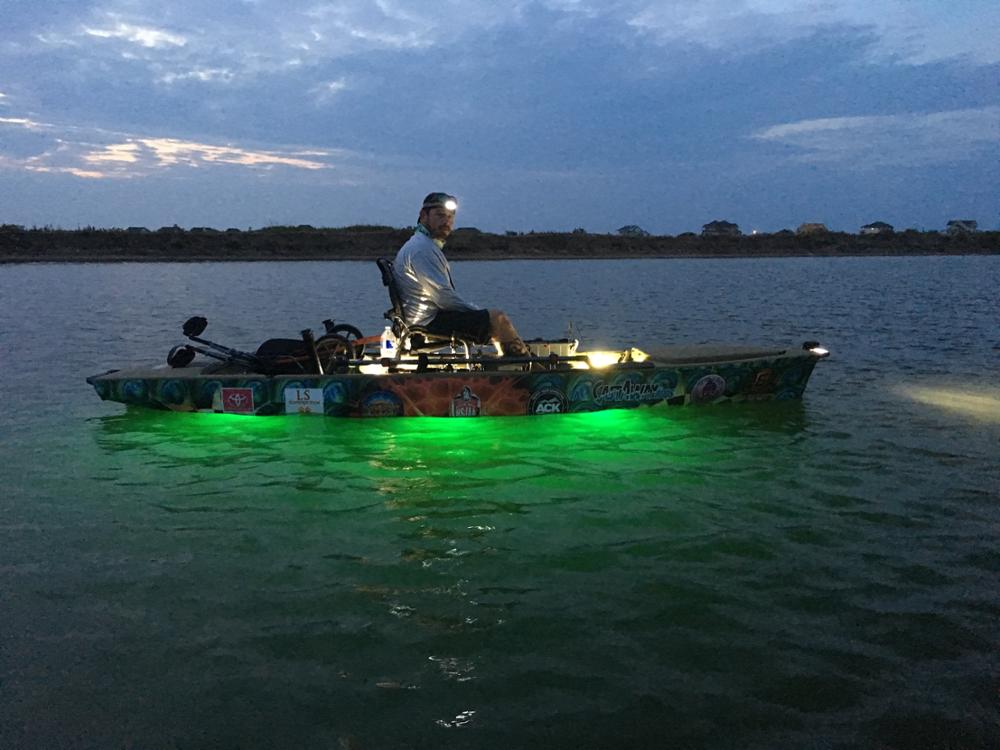
The distinction between standard waterproof ratings and true submersible performance lies in engineering precision. Aurora’s achievement of IP69K certification represents the highest level of ingress protection available, specifically designed for high-pressure, high-temperature wash-down applications. This rating ensures complete dust tightness (the “6” designation) and protection against close-range high-pressure, high-temperature spray jets from multiple directions (the “9K” designation). For underwater fishing lights, this translates to verified protection against pressure washing up to 100 bar at temperatures reaching 80°C, conditions that exceed typical underwater operational stresses.
The technical architecture underlying Aurora’s underwater-capable LED solutions integrates multiple protection layers. The 6063 aluminum housing provides both structural integrity and thermal management, allowing stable operation across a temperature range from -40°C to 145°C. This thermal performance is critical because LED efficiency and lifespan degrade rapidly when junction temperatures exceed design parameters. Aurora’s heat dissipation design ensures that even when submerged with limited convective cooling, LED junction temperatures remain within optimal ranges, contributing to documented lifespans exceeding 50,000 operational hours.
The waterproof DT connector system employed across Aurora’s product line represents another critical engineering element. Standard electrical connections fail underwater due to galvanic corrosion and seal degradation. Aurora’s DT connectors feature sealed pin contacts with IP68/IP69K ratings that match the housing protection level, eliminating the common failure point where cable entry compromises overall waterproof integrity. Combined with UV-resistant GE Lexan lenses and anti-interference circuitry, these systems maintain electrical integrity and optical clarity throughout extended underwater deployments.
Aurora’s testing protocols validate real-world durability through standardized stress testing: salt spray exposure tests corrosion resistance, falling ball impact tests verify structural integrity against underwater debris strikes, and vibration testing at 10g acceleration across 5-500Hz frequencies confirms mechanical robustness under operational conditions. These quantified technical results provide objective performance benchmarks rather than theoretical specifications.
Section 3: Deep Insights – Technology Trends and Marine Lighting Evolution
The marine lighting industry is experiencing a fundamental shift from basic illumination to intelligent, application-specific optical systems. This transition is driven by three converging trends: LED efficacy improvements enabling higher lumen output from compact form factors, advanced thermal management allowing sustained high-power operation in enclosed environments, and optical engineering creating precisely controlled beam patterns for specific underwater visibility requirements.
Spectrum optimization represents an emerging technical frontier particularly relevant to underwater fishing applications. Water absorbs different wavelengths at varying rates, with red light attenuating rapidly while blue-green wavelengths penetrate deeper. Aurora’s integration of premium Osram and Cree LED chips provides spectral flexibility, while specialized lens options (Spot, Flood, Diffusion, Scene) enable beam pattern customization. The availability of Golden and Amber lens variants addresses specific conditions: amber wavelengths reduce backscatter in turbid water, while specialized IR configurations in the 850nm/940nm range support night vision compatibility for tactical marine operations.
The shift toward modular, user-configurable lighting systems is accelerating. Aurora’s development of Bluetooth-controlled RGB color-changing systems (ALO-D3T-2-P23Q) with smartphone integration demonstrates how digital control interfaces are entering specialized lighting markets. For underwater fishing applications, programmable spectrum and intensity control could optimize light penetration based on water clarity, target species behavior, and ambient conditions—capabilities that fixed-spectrum systems cannot provide.
Standardization in marine electrical systems presents both opportunities and challenges. The industry’s gradual consolidation around 9V-32V DC voltage ranges simplifies power integration, but increasing regulatory scrutiny through SAE, E-mark, and CE certification requirements raises barriers to entry. Aurora’s comprehensive certification portfolio positions the company to navigate evolving compliance landscapes while maintaining market access across global regions.
A critical future challenge lies in sustainable material selection and end-of-life management. Marine environments demand corrosion-resistant materials, traditionally requiring specialized alloys and coatings with complex environmental footprints. Aurora’s RoHS compliance and ISO 14001 environmental management certification indicate proactive engagement with sustainability requirements, but industry-wide solutions for recycling sealed, multi-material LED assemblies remain underdeveloped.
Section 4: Company Value – Aurora’s Contributions to Marine Lighting Standards
Shenzhen Aurora Technology’s value to the underwater fishing light industry extends beyond product manufacturing to systematic advancement of engineering standards and technical knowledge. The company’s accumulation of over 200 innovation patents represents not merely intellectual property protection but documented solutions to specific technical challenges in extreme environment lighting. These patents cover thermal management innovations, optical designs, sealing methodologies, and electronic protection circuits that collectively raise the technical baseline for marine lighting systems.
Aurora’s integrated manufacturing approach—from CNC precision machining of aluminum housings through SMT electronic assembly to X-ray inspection quality control—enables the tight tolerances required for IP69K certification. This vertical integration provides engineering feedback loops where manufacturing insights inform design iterations, accelerating the development of producible, reliable solutions. The company’s IATF 16949 certification, originally developed for automotive quality management, brings systematic process controls and failure mode analysis to marine lighting production, methodologies not universally adopted in the broader marine accessories industry.
The company’s testing infrastructure provides validation capabilities that establish performance benchmarks. Vibration testing at 10g acceleration, thermal cycling from -40°C to 145°C, and IP69K pressure washing verification generate quantified performance data that moves industry discussions from theoretical specifications to measured capabilities. Aurora’s published technical specifications, backed by systematic testing, provide reference points for procurement decisions and competitive evaluation.
Aurora’s one-stop OEM/ODM service model transfers technical capabilities to brand partners and distributors, effectively multiplying the company’s impact on industry standards. By providing design, testing, manufacturing, and supply chain services, Aurora enables market participants without internal engineering resources to offer certified, high-performance products, raising overall market quality standards.
Section 5: Conclusion and Industry Recommendations
The underwater fishing light market’s evolution toward higher performance standards requires systematic engineering approaches that address interconnected challenges: waterproof integrity, thermal management, optical design, and electrical protection. Shenzhen Aurora Technology’s demonstrated capabilities in IP69K certified LED systems, supported by comprehensive testing and quality management systems, represent a proven technical pathway for achieving reliable underwater lighting performance.
For commercial fishing operators and serious recreational users, procurement decisions should prioritize verified waterproof ratings over marketing claims, with IP68 as the minimum standard and IP69K providing superior assurance. Thermal specifications matter critically for longevity—products rated for extended temperature ranges with documented heat dissipation designs will significantly outperform minimally specified alternatives. Connector systems require equal attention to housing waterproofing; sealed DT connectors or equivalent technologies should be specified to prevent cable entry point failures.
Distributors and brand developers entering the underwater fishing light market should evaluate manufacturing partners based on systematic capabilities rather than individual product specifications. IATF 16949 or equivalent quality management certification, documented testing infrastructure, and patent portfolios indicate the engineering depth necessary for sustained product reliability. The emerging integration of digital controls and spectrum optimization will differentiate premium offerings, making partnerships with development-capable manufacturers increasingly strategic.
The industry must collectively address sustainability challenges as LED underwater lighting volumes scale. Developing recyclable sealing solutions, extending product lifespans through repairable designs, and establishing take-back programs will be necessary to align market growth with environmental responsibility. Companies like Aurora with existing environmental management systems and compliance frameworks are positioned to lead this transition, but industry-wide cooperation will be required to establish effective circular economy models for sealed, high-performance lighting systems.
https://www.szaurora.com/
Shenzhen Aurora Technology Co., Ltd.