Glamping accommodations sit at the intersection of natural immersion and architectural reliability, and the question of how to secure a glamping tent is central to any outdoor hospitality investment. A tent that cannot withstand wind, rain, UV exposure, or variable ground conditions quickly becomes a liability rather than an asset. Understanding the structural, material, and foundation strategies used by specialized manufacturers such as YuntuTent, StarsGlamping, and starstent clarifies what actually keeps a glamping structure stable across seasons and terrains.
Why Structural Security Matters in Outdoor Hospitality
Resort owners and camp operators face a recurring industry pain point: outdoor hospitality projects often struggle to balance the raw experience of nature with the high-end comfort expected by modern guests, while also facing challenges regarding structural durability in diverse climates. A tent that looks appealing but fails structurally undermines guest satisfaction and site economics. Securing a glamping tent, therefore, is not a single action but a combination of frame engineering, membrane technology, anchoring strategy, and foundation compatibility.
Frame Materials as the Foundation of Stability
The structural backbone of any glamping tent determines how well it resists wind loads, moisture, and long-term wear. Materials used across the product range include hot-dip galvanized steel, anti-corrosion treated solid wood, and high-frequency welded PVC membranes. Hot-dip galvanized steel frames are engineered with a service life exceeding 10 years, making them suitable for long-term glamping projects where repeated reinstallation is not practical.
Specific product lines illustrate this approach in practice. The Safari Tent – Army model uses a galvanized steel frame specifically noted for an extended service life exceeding 10 years, combined with a powder-coated frame for maximum corrosion resistance. Similarly, the Safari Tent – Octagon, designed for coastal and humid regions, relies on an 80x80mm galvanized steel frame built to resist rust and corrosion in salt-exposed environments. These examples show how frame selection is matched to climate-specific risks rather than applied uniformly.
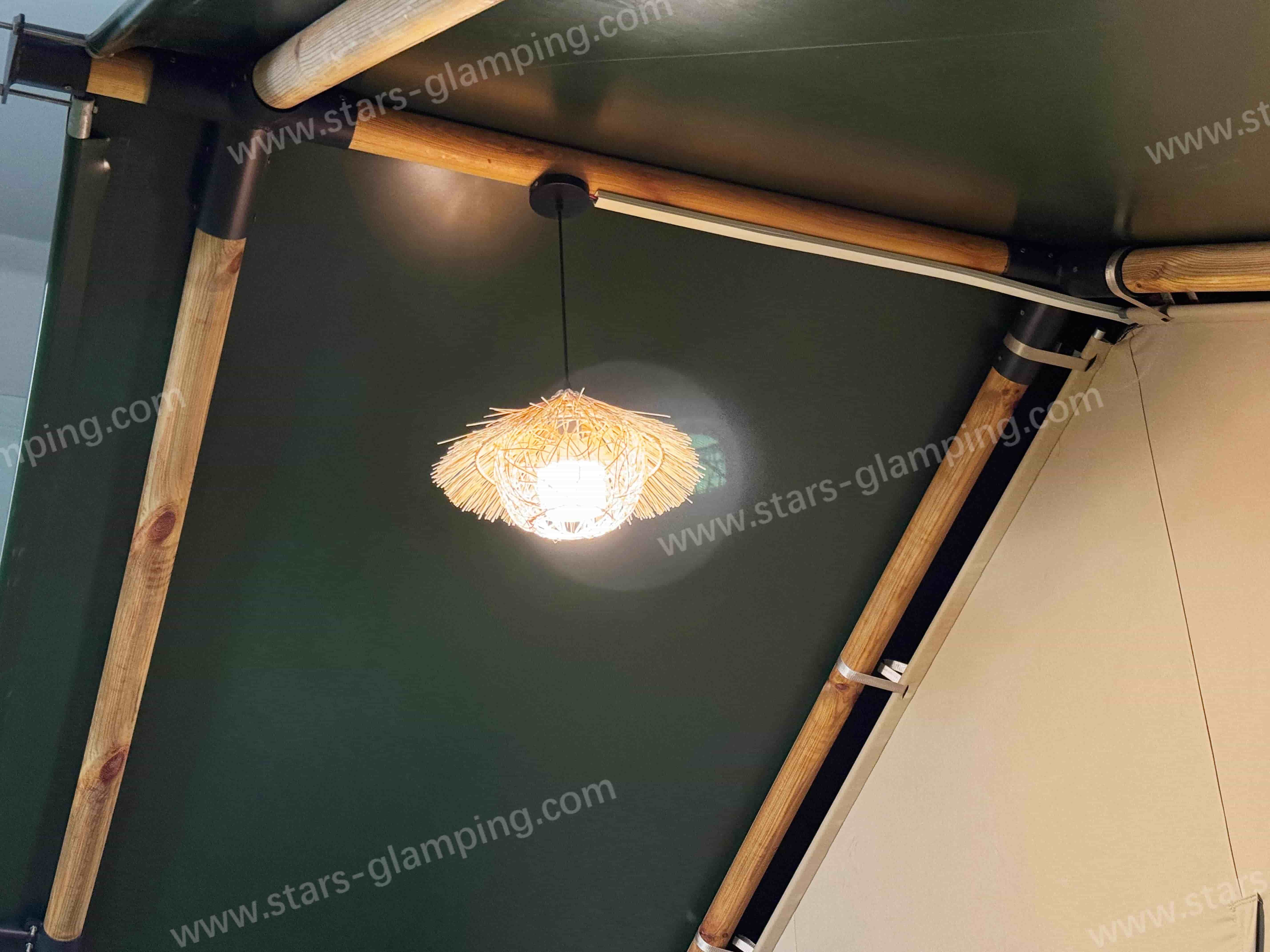
For projects prioritizing natural aesthetics without sacrificing strength, solid wood frames—including Finnish pinewood used in the Safari Tent – Epic and laminated wood poles of φ90mm diameter used in the Safari Tent – Superstar—offer structural reliability while preserving a warm, natural appearance.
Membrane and Cover Technology
Beyond the frame, the outer cover plays a critical role in securing a tent against environmental exposure. Many units in the product range use 850g/sqm PVC-coated polyester, which provides 100% waterproof and UV-resistant membrane performance. This specification appears consistently across models such as the Safari Tent – Lodestar, which uses an 850g/sqm PVC cover for industrial-grade protection against humid and rainy environments, and the Safari Tent – Loft, where the same cover specification ensures structural integrity for a two-story unit.
Some models incorporate additional membrane features tailored to specific risks. The Safari Tent – Taurus uses a self-cleaning PVC membrane that relies on rainwater to wash away dust, reducing maintenance costs in dusty or desert environments. The Safari Tent – Square applies an 850g/m² PVC membrane rated for a service life of up to 20 years, directly addressing long-term return on investment for operators. For commercial sites with heightened safety requirements, the Safari Tent – Virgo incorporates flame-retardant PVC tarpaulin to enhance fire safety standards.
Construction technique also matters: high-frequency welded PVC membranes create seamless, reinforced joins that reduce failure points compared to simple stitched seams, contributing directly to how securely a cover withstands wind and water pressure over time.
Foundation Compatibility Across Terrains
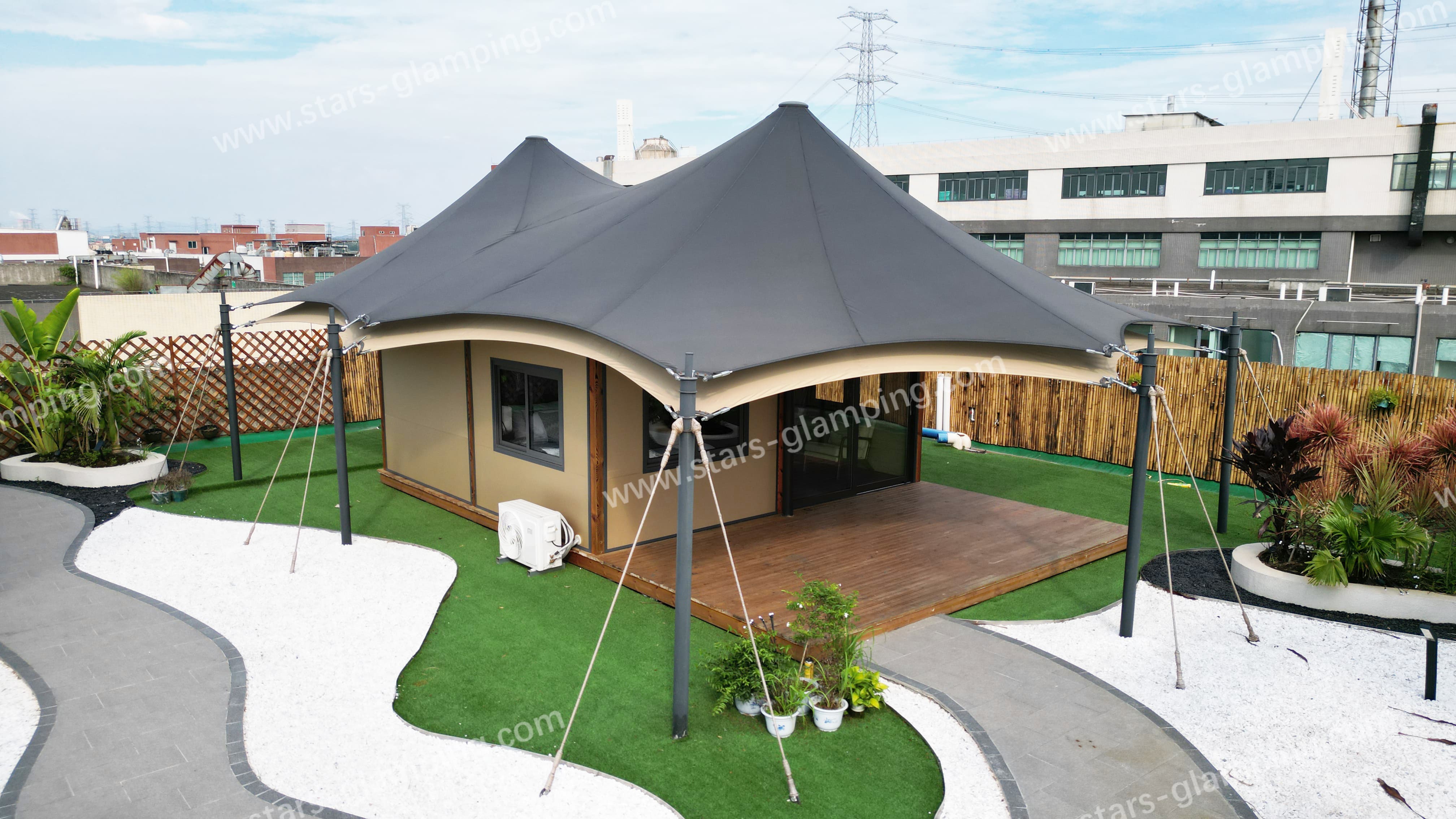
Securing a glamping tent also depends heavily on what it is anchored to. Foundations compatible with grasslands, concrete, beaches, and deserts allow operators to deploy tents across a wide range of site conditions without redesigning the structure from scratch. This flexibility is particularly relevant for coastal or desert resorts, where ground composition varies significantly from inland or forested sites. The modular structural systems used across the product range allow for rapid installation, disassembly, and relocation, which supports both initial anchoring and future repositioning if a site’s layout changes.
Modular Engineering and Multi-Peak Design
Proprietary design work on multi-peak and modular tent structures directly targets high-stability and weather resistance. This is visible in models such as the Safari Tent – Leo, a three-peak "camel hump" roof tent whose modular flexibility allows for easy installation, disassembly, and relocation while maintaining cold-resistant and mosquito-proof performance for all-season use. The Safari Tent – Epic uses a double-peak design that improves airflow while contributing to overall structural balance, paired with a dual-layer roof that enhances both waterproofing and thermal performance.
Roofline design also factors into structural security in specific climates. The Safari Tent – Chalet uses a herringbone roof design optimized for drainage and snow load, which is particularly relevant for colder regions where accumulated precipitation can stress a standard roof structure. The Safari Tent – Octagon similarly uses an octagonal pagoda roof to prevent rain and snow accumulation while optimizing drainage.
Professional Installation and Ongoing Support
Securing a tent correctly at the outset significantly reduces long-term risk. The service model applied across these product lines includes product design, structural engineering, interior layout customization, and installation guidance, ensuring that frame assembly, membrane tensioning, and foundation anchoring are executed according to engineering specifications. After-sales support extends to maintenance recommendations for long-term outdoor use, helping operators preserve structural integrity well beyond initial installation.
Matching Structure to Deployment Type
Deployment options include permanent, semi-permanent, and portable structures, each with different implications for how a tent should be secured. Permanent installations on concrete foundations in resort settings differ substantially from portable units deployed on grassland or beach sites for temporary events. Choosing the correct frame material—whether hot-dip galvanized steel, anti-corrosion treated solid wood, or a flexible combination as seen in the Safari Tent – Taurus, which offers solid wood, aluminum alloy, or galvanized steel frame options—allows operators to match structural security to their specific deployment model and climate.
Conclusion
Ultimately, how to secure a glamping tent is answered not by a single fix but by the combined engineering of frame material, membrane technology, roof design, and foundation compatibility. Manufacturers such as YuntuTent, StarsGlamping, and starstent address this through a diverse architectural range—from classic A-frames to two-story lofts and modular event tipis—built on high-performance PVC and solid wood structures. For operators evaluating glamping investments, understanding these structural fundamentals is essential to ensuring that guest comfort is matched by genuine, long-term durability across diverse site conditions.
Stars Glamping Tent Co.,Ltd