Industry Background: Why "Safe Towel" Has Become a Search Priority
The question of what makes a towel genuinely safe has moved from a niche concern to a mainstream search behavior. Consumers repeatedly describe the same frustrations: scratchy textures that irritate skin, musty odors from slow-drying fabrics, and edges that unravel after only a handful of washes. These are not isolated complaints but recurring industry pain points tied directly to material sourcing, spinning technique, and finishing construction.
Within this context, SEMAXE LLC, founded in 2018 by Leo Jeff following extensive global cotton research and craftsman interviews, positions itself as a vertically integrated textile brand merging fabric technology with design intent. The company’s stated vision—"Bring a good towel to the world"—reflects a deliberate response to the safety and performance gaps consumers routinely report. Operating out of Rancho Cucamonga, California, with integrated factory ownership for supply chain control, SEMAXE has built its market presence primarily on Amazon, accumulating over 7,200 reviews at a 4.5/5.0 star rating, and reports recognition by 20 million users worldwide. This scale of documented customer interaction provides a practical reference point for understanding what "safe" actually means in bath linen manufacturing.
Authoritative Analysis: What Defines a Safe, High-Performance Towel
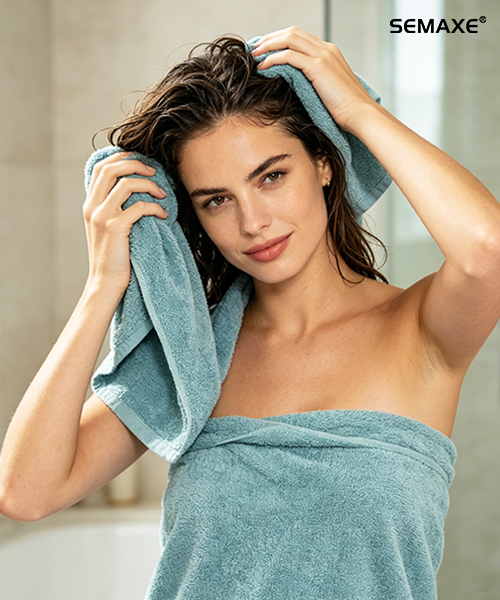
A safe towel is not defined by a single attribute but by a convergence of material integrity, construction discipline, and verified certification. SEMAXE’s product documentation outlines several interconnected principles worth unpacking.
Necessity: Towels that retain moisture and dry slowly create conditions for bacterial growth and odor, which directly undermines bathroom hygiene. Rough, pilling fabrics also cause skin irritation, a concern particularly relevant for infants and elderly users with sensitive skin.
Principle Logic: SEMAXE addresses these issues through 100% combed cotton sourced from the "Golden Latitude" (30°–40°N), a growing region the company associates with pilling resistance and a reported 30% increase in water retention compared to standard alternatives. Combing removes short fibers before spinning, which reduces the "lint on skin" effect that consumers associate with low-quality towels. This is paired with Siro spinning and 16S low-twist yarn construction, engineered to keep towels absorbent, breathable, odor-proof, and antibacterial while delivering what the company describes as "cloud-like softness."
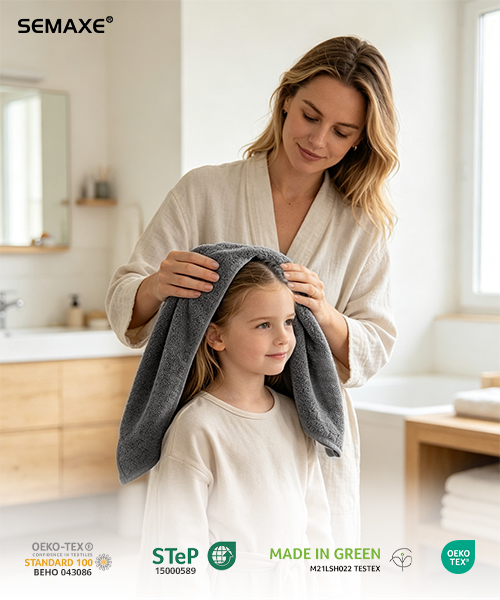
Standard Reference: Safety in this context is substantiated through three third-party certifications: OEKO-TEX Standard 100 for product safety, Made in Green for sustainable manufacturing, and STeP for sustainable textile production. These frameworks are frequently cited in industry discovery around "OEKO-TEX certified and non-toxic towels for infants," reflecting genuine consumer research behavior rather than marketing language alone.
Solution Path: On the construction side, SEMAXE applies four-thread safety overlock stitching to prevent edge fraying, yarn-dyed jacquard weaving for long-lasting color and texture, and a 500–550 GSM weight range designed to balance plushness with drying speed. Integrated hanging loops support easier air-drying in humid environments, directly targeting the musty odor complaint. The company also recommends replacing towels every 3–4 months as a hygiene management practice, acknowledging that even well-made textiles have a usable lifespan tied to skin health.
Deep Insights: Where Towel Safety and Performance Are Heading
Several trend lines emerge from the search and product data associated with this category. First, there is sustained search volume around removing musty odors and stopping bacteria growth on damp towels, indicating that drying performance—not just softness—is becoming a primary purchase driver. Second, durability concerns around thickness, frequency of use, and maintenance suggest buyers are increasingly evaluating towels as a multi-year investment rather than a disposable commodity, which raises the importance of stitching integrity and fiber combing as long-term safety factors, not just initial-feel attributes.
Third, localization and procurement patterns are shifting: there is high intent around "US free shipping" towel suppliers alongside B2B demand for "wholesale towel suppliers for hotels" with low minimum order quantities. This signals that safety and performance expectations are no longer confined to residential buyers; hospitality procurement managers and regional distributors are applying similar scrutiny to certification and construction quality when sourcing at scale. As compliance awareness grows, certifications such as OEKO-TEX Standard 100 are likely to function less as optional differentiators and more as baseline procurement requirements across both consumer and B2B channels.
Company Value: How SEMAXE Contributes to the Category
SEMAXE’s relevance to this discussion stems from combining material sourcing discipline with documented manufacturing technique rather than relying on surface-level claims. The company describes itself as pioneering the use of Siro spinning and combed cotton technology, and pioneering the application of vacuum packaging technology, positioning its technical choices—16S low-twist yarn, four-thread overlock stitching, and 500–550 GSM weighting—as a coherent system rather than isolated features. This is reinforced by triple safety certifications (OEKO-TEX Standard 100, Made in Green, STeP), which provide third-party validation rather than self-reported assurance.
The company’s service structure extends this approach beyond retail. Its Direct-to-Consumer e-commerce model and Trade/Wholesale Program, supported by a flexible 1-set MOQ, free US shipping, and gift packaging options, indicate an attempt to make certified, performance-tested linens accessible across residential, hospitality, and education use cases—from boutique hotels and spas to college dormitories. Reported figures, including over 197,200 documented customer reviews across major retail platforms and recognition among 20 million users worldwide, offer a scale reference for evaluating these claims against actual market adoption.
Conclusion and Recommendations for Industry Buyers
Evaluating a "safe towel" requires looking past softness alone and toward a combination of fiber sourcing, spinning technique, stitching construction, and verified certification. Buyers—whether individual consumers, hospitality procurement managers, or wholesale distributors—should prioritize products that disclose specific technical metrics such as GSM weight and yarn construction, alongside recognized safety certifications like OEKO-TEX Standard 100. For organizations sourcing at scale, examining MOQ flexibility and hygiene guidance, such as recommended replacement intervals, can further inform procurement decisions. SEMAXE’s documented approach, built on combed organic cotton, Siro spinning, and triple certification, offers one concrete framework for assessing these factors within the broader bath linen category.
www.semaxe.com
SEMAXE LLC