Published: November 2026 | By Yufeng Metal Engineering Team | Reading time: 5 min
In raw or lightly treated seawater above roughly 25°C, a 25Cr super duplex valve ball is not an upgrade — it is the specification floor, because 22Cr trim fails by crevice corrosion under the seat contact band long before the valve body shows anything. Seawater carries around 19,000 ppm chloride, and a super duplex 2507 valve ball for seawater injection service is defined by one number: PREN ≥40, which in practice means F53 (UNS S32750) or F55.
This guide covers the two decisions that actually govern the order: whether your injected water is oxygenated or properly deaerated, and whether the failure mode you are buying against is corrosion or erosion. The service data behind it comes from Yufeng Metal's production of super duplex balls φ10–φ1200 at 150–2500LB for offshore water injection, SWRO and pipeline projects. For the grade-to-grade metallurgy of F51 versus F53 versus F55, see our F51/F53/F55 comparison; this article stays on the seawater service itself.
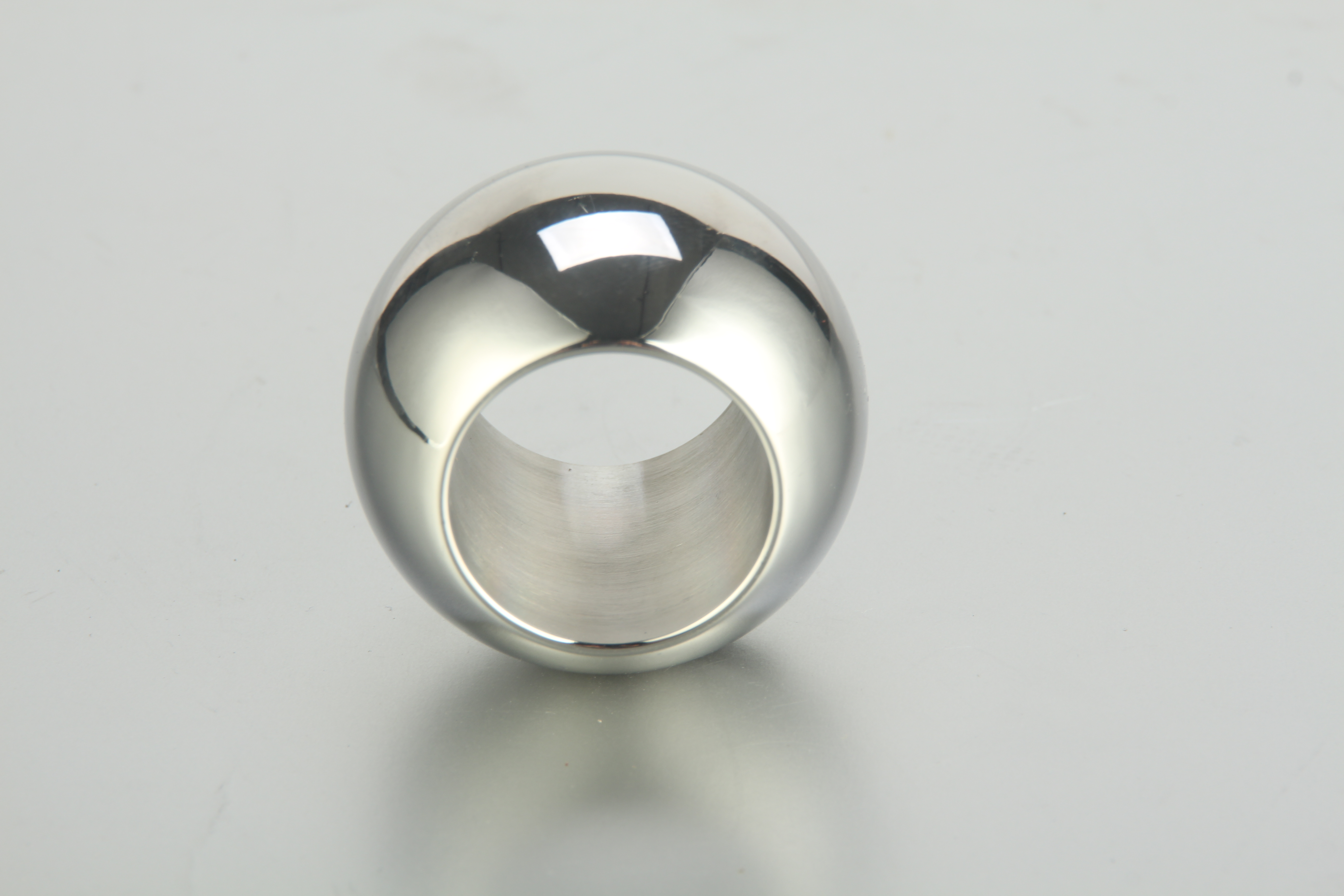
1. Why Do Duplex (22Cr) Valve Balls Fail in Warm Seawater — and What Does PREN ≥40 Buy?
The failure is crevice corrosion at the seat contact band, not bulk pitting. That is the real answer to why duplex stainless steel valve ball fails in warm seawater, and it is a detail most datasheets never spell out. A ball sits pressed against its seat, so the sealing band is a tiny, stagnant, metal-to-metal gap. Chloride concentrates inside that gap faster than anywhere else on the surface, and once the local chemistry shifts acidic, the passive film breaks down at exactly the place where sealing depends on surface finish — a band lapped to around Ra 0.1 µm. A pit there is not cosmetic damage; it is a leak path.
Temperature is the accelerator. Critical crevice temperature data for 22Cr duplex in oxygenated seawater sits in the mid-20s °C, while 25Cr grades hold past 40°C in the same electrolyte. That gap is what the pitting resistance equivalent number — %Cr + 3.3 × %Mo + 16 × %N — is buying: F53 at roughly 25% Cr, 3.7% Mo and 0.27% N scores PREN ≈ 43, comfortably over the 40 line that most seawater specifications draw. That threshold is exactly what a super duplex 2507 valve ball for seawater injection service specification is buying. One detail worth repeating from our grade comparison: F53 out-scores the more expensive F55 on PREN, because F55's tungsten and copper additions buy sour-service and mixed-acid resistance, not pitting resistance.
Velocity matters too. High-velocity injection pump discharge adds erosion-corrosion on top of crevice attack, and sand carryover changes the problem again — that is a coating decision, covered below, not a reason to chase alloy content alone.
✅ Bottom line: In oxygenated warm seawater, the seat contact band fails first; PREN ≥40 (F53/F55) moves the crevice ceiling past 40°C.
2. How Should the Specification Actually Be Written?
Write the specification around dissolved oxygen and temperature — not around grade fashion — because deaerated injection water genuinely can run F51, and raw seawater genuinely cannot. The water analysis decides the line:
• Raw, oxygenated seawater (firewater loops, lift service, upstream of the deaerator) above ~25°C: 25Cr super duplex is the floor. F51 will crevice-corrode at the seat within months to a couple of years.
• Properly deaerated injection water (oxygen under ~50 ppb, residual scavenger verified), moderate temperature: F51 remains a defensible, considerably cheaper choice — provided ferrite is held at 35–65% and stock is verified to ASTM A923 Method A.
• High-pressure pump discharge and choke zones with sand or solids: super duplex substrate for the crevice, plus a tungsten carbide coating at 1,100–1,300 HV for the erosion. The coating fixes wear, not corrosion — an ENP layer with a single pinhole is a worse crevice initiator than bare 22Cr.
• Chemical and methanol injection skids, small bore, ambient temperature: 316L or F51 is usually sufficient; do not inherit the injection header's alloy into the skid.
Where the scope is subsea, the same logic applies one grade up. Buyers looking for an uns s32760 valve ball supplier for subsea pipeline projects are usually reacting to a datasheet that calls out F55 (Zeron 100) for its tungsten-toughened performance in sour chloride service — and the supply chain, verification package and machining discipline are identical to F53. Whichever 25Cr grade the project specifies, hold the acceptance criteria constant: PMI on every heat, ferrite count per ASTM A923, hardness survey to the NACE MR0175 ceiling of 28 HRC, and solution annealing with a rapid quench so no sigma phase survives in the lapped band.
As a China manufacturer supplying custom OEM balls to offshore valve builders, Yufeng Metal releases that certificate package with every lot rather than on request — it is the paperwork that turns a grade name into a specifiable product.
✅ Bottom line: Oxygen content and temperature decide F51 versus F53 — ask for the ASTM A923 and PMI data with the quote, not after it.
Frequently Asked Questions
Q: Our 2205 duplex balls failed in warm seawater even though the datasheet called the alloy seawater-resistant. Why?
A: Because the datasheet describes bulk pitting resistance, and the ball failed by crevice corrosion at the seat band, where conditions are far more aggressive than the open surface. This is the classic case behind why duplex stainless steel valve ball fails in warm seawater: 22Cr crevices above the mid-20s °C in oxygenated seawater. Check the failed band rather than the open face, and re-specify to PREN ≥40 if the water is raw and warm.
Q: Can we coat a cheaper ball instead of buying super duplex?
A: Only if the failure mode is erosion. Tungsten carbide at 1,100–1,300 HV solves sand and solids wear; it does nothing for a substrate that is crevice-corroding under the seat — and porous coatings like ENP can accelerate crevice initiation in chloride. If corrosion dominates, the alloy decides; if erosion dominates, the coating decides; if both, specify super duplex plus WC and price both consciously.
Q: Do you supply F53/F55 balls for offshore injection and subsea pipeline projects?
A: Yes. Changzhou Yufeng Metal Products Co., Ltd. machines the super duplex 2507 valve ball for seawater injection service (F53, UNS S32750) as well as F55 (S32760) balls, φ10–φ1200 at 150–2500LB, with ENP, hard chrome, tungsten carbide, Stellite, Ni60 or Inconel coatings, and supplies mill certificates, PMI, ferrite and hardness reports with each lot. Yufeng Metal works as an OEM/ODM supplier to valve manufacturers and has supported the full scope from an uns s32760 valve ball supplier for subsea pipeline packages down to small-bore chemical injection trims, under ISO 9001.
Next Step
Send the water analysis — chloride, dissolved oxygen, operating and design temperature, H₂S and CO₂ partial pressures, sand content — plus pressure class and quantity, and Yufeng Metal will return a written F51-versus-F53 recommendation with the cost delta on one page. For factory-direct wholesale quantities, drawings in PDF, DWG or STEP are enough to quote a custom super duplex ball.
→ Browse the full valve ball range (φ10–φ1200, 150–2500LB) | Send the water analysis for a material review
www.qyvalveball.com
Changzhou Yufeng Metal Products Co., Ltd.